

The U.S. Military Has Finally Left Syria
After considering a permanent U.S. presence, the Trump administration instead evacuated American troops once and for all.
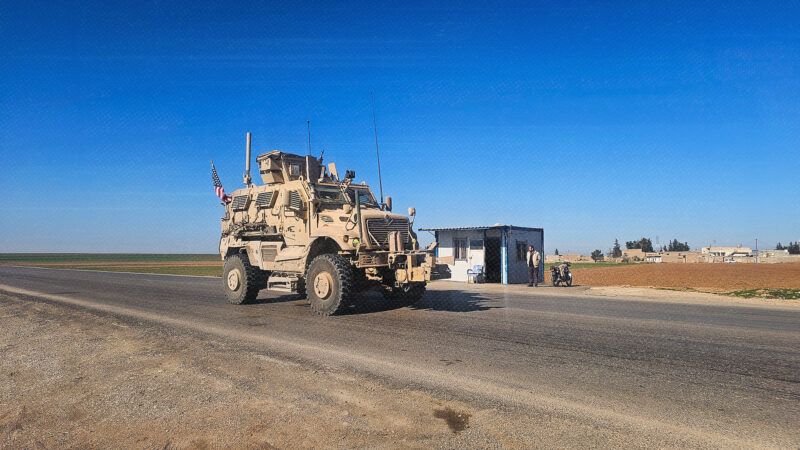
For the first time in a decade, there are no U.S. bases in Syria. The Syrian foreign ministry and U.S. Central Command both announced on Thursday afternoon that U.S. forces had handed over their last base in Syria to the Syrian army. The U.S. military may continue to advise and support the Syrian army without permanent outposts, reports The New York Times.
U.S. troops first entered Syria in 2015 to support Kurdish rebels against the Islamic State group, which lost its last Syrian territory in 2019. President Donald Trump flip-flopped several times in his first term about whether U.S. troops would stay. He declared a U.S. withdrawal in December 2018, backtracked on it, declared another withdrawal in October 2019, and backtracked again after neighboring Turkey invaded Kurdish-held areas of Syria.
U.S. officials pushed to keep a military presence in Syria, shifting its mission from fighting the Islamic State group to confronting Iran and Russia. Trump administration envoy James Jeffrey publicly admitted to playing "shell games" to hide the full size of the U.S. deployment and preempt political pressure to leave.
The Syrian civil war (and the major Russian-Iranian presence) ended with the December 2024 revolution, led by Ahmad al-Sharaa, a former commander in Al Qaeda who became a U.S.-friendly reformer. But the Trump administration considered keeping U.S. forces in Syria for good. Late last year, the U.S. military began joint patrols with the new Syrian army and visited the site of a potential U.S. base to monitor the Syrian-Israeli border.
Events in Syria seem to have made that option completely unpalatable. In December 2025, a Syrian police officer shot up a meeting between Syrian and U.S. troops in Palmyra, killing three Americans. It was a reminder that despite the new Syrian government's eagerness to please Washington, many of its rank-and-file supporters still resented the foreign army on their soil.
Then, in January 2026, negotiations between the Kurdish rebels and the new Syrian government broke down. The Syrian army launched a lightning offensive that forced Kurds to submit to central government rule. Fearing a prison break amid the chaos, the U.S. military evacuated thousands of Islamic State suspects from Syrian Kurdish custody to Iraq. The decade-old alliance that had brought the U.S. military to Syria in the first place was over.
Finally, the war with Iran showed just how vulnerable American troops in the Middle East were to missiles and drones. Unlike the well-defended U.S. fortresses in Israel and the Persian Gulf monarchies, U.S. outposts in Syria were ramshackle affairs that lacked air defenses. A drone attack by Iraqi guerrillas in January 2024 had already killed three U.S. troops on the Syrian-Jordanian border.
The U.S. withdrawal from Syria happened under the best possible circumstances, with a friendly Syrian government in power and a minimum of violence. But it still happened against the will of hawks who wanted the U.S. military in Syria forever—with a constantly shifting justification.




