

With Viktor Orbán Gone, Will Hungary Embrace Free Markets Under Péter Magyar?
Hungary’s voters turned against the poster boy of the national conservative movement.
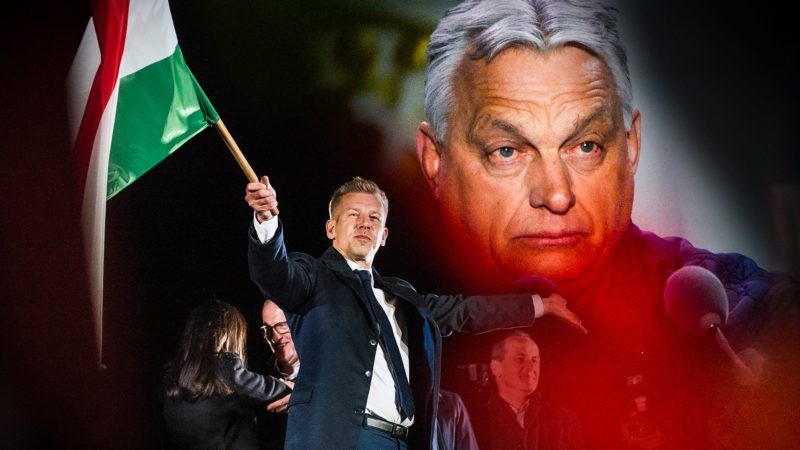
National conservatism was dealt a blow this week when Hungarians ousted Prime Minister Viktor Orbán in the country's parliamentary elections on Sunday. The country turned out in record numbers to elect Péter Magyar, a former Orbán loyalist and the leader of the center-right Tisza party, who declared that "together, we liberated Hungary." With record turnout, preliminary election results put Magyar's Tisza party on course for 138 seats in the 199-seat parliament, with Orbán's nationalist Fidesz party on course for 55, and the far-right Our Homeland on course for six.
While Orbán's defeat has undoubtedly been met with dismay by his MAGA allies, much of Hungary has celebrated the news. "We are so happy that Orbán is finally gone!" said one Hungarian celebrating on Sunday night, as the crowd in the capital chanted "Russians go home!"
Given Orbán spent 16 years in office, this response is understandable. After being elected in 2010, one of the first things his party did was amend the constitution to give itself more power, despite making no promise of constitutional reform during the election. The new constitution, which was rushed through with no referendum or consultation with opposition parties, allowed the government to expand Hungary's Constitutional Court, appoint Orbán loyalists, and consolidate the regime's domestic power.
With this new power, the Hungarian government rewrote electoral law in its favor, eliminating the two-round voting system, undermining opposition, and introducing a "winner compensation" mechanism that inflated Fidesz's seat share. Gerrymandering followed, with constituency boundaries redrawn to favor Fidesz, allowing the party to retain its supermajority despite its declining popularity.
Subsequently, the government attacked the media. New rules restricted political advertising to state-controlled media, hindering opposition visibility and causing the government's messaging to dominate the airwaves. The government took direct control of public service media, imposing uniform control over six television channels, six radio stations, and its press agency, the Cato Institute's Johan Norberg noted. Journalists were laid off and replaced by loyalists, and taxpayers subsidized hundreds of pro-Fidesz media outlets. According to Reporters Without Borders, in 2005, Hungary had the world's 12th-freest media. By 2025, it had dropped to 68th.
Having consolidated power over Hungary's democratic institutions and media, Orbán could exert control over the economy. His promise to split from the "liberal paradigm" through "unconventional economic policy" meant selective wealth redistribution to regime loyalists and the expansion of the public sector. Between 2010 and 2020, the value of assets owned by the Hungarian state increased by 52 percent.
Orbán also introduced pronatalist policies, including subsidies and tax credits to encourage childbearing, which were hailed by American conservatives. The fertility rate in Hungary rose from 1.25 per woman in 2010 to 1.61 in 2021, according to the Hungarian Central Statistical Office. However, that rise turned out to be a mere blip. Since then, the fertility rate has declined every single year. In 2024, the total fertility rate was 1.39. Hungary's fertility rate is now estimated to be 1.31, meaning that the fertility rate is back to what it was in 2007, before the government's expensive pronatalist subsidies were introduced.
Increased state intervention, cronyism, and strict immigration controls have led Hungary's economy to stagnate; it has not achieved meaningful economic growth since 2022, and has the highest unemployment rate in a decade. The Hungarian economy grew by just 0.4 percent in 2025, 0.2 percentage points lower than the year prior, and meager in comparison to Poland, which grew by 3.6 percent, and Bulgaria, which grew by 3.1 percent.
Hungary has gone "from one of the top performers" among post-communist countries to "the second-worst E.U. member—very much thanks to Orbán," Adam Bartha, director of the European Policy Information Center, a European network of free market think tanks, tells Reason.
With Orbán's model now rejected at the ballot box, all eyes now turn to Magyar and what he may deliver. "I'm cautiously optimistic," says Bartha. Speaking from Budapest, he says the result shows that "the national conservative idea of a welfare state, but just for us, is financially unsustainable."
Magyar's campaign was centered around fighting the corruption of the Orbán era. "We should not accept that stealing public money is normal," Magyar said on Monday during a press conference following his election victory. "We became the poorest and the most corrupt country in Europe."
He's also taken steps to stabilize relationships with Europe; Magyar's first trip as prime minister will be to Warsaw, Poland, which has seen enormous economic success as a result of its free market reforms. Perhaps it is a signal of what direction his government will attempt to follow.
"There is a strong, kind of historic link between Poland and Hungary, and I think [Magyar] will try and capitalize on it, not just from a political perspective, but also from a cultural perspective," says Bartha. "Poland is not a perfect free market paradise, but if you look at the track record over the last 10 years, it has done a much better job of implementing free market reforms than Hungary."
Notably, Magyar has also pledged to halt taxpayer-funded support for political activities, such as CPAC Budapest, which in 2024 was funded by the Orbán regime, possibly to the tune of more than 3 million euros (about $3.5 million), according to the Hungarian investigative outlet Atlatszo.
Despite these positive signs, there are reasons to be cautiously optimistic. Magyar is still likely to continue Hungary's hard line on immigration, and is unlikely to dramatically change course from his predecessors' track record of generous welfare spending. Indeed, Hungary's debt-to-GDP ratio was 74.6 percent in 2025, and is estimated to rise further in the short term.
Still, the end of the Orbán regime, and its national conservatism that has left Hungary worse off, is welcome news for the country and the world. Across the globe, especially in the United States, Orbán has encouraged right-wing politics to shift in an increasingly illiberal position. Perhaps Magyar's victory points to a different future for Hungary—one that reaffirms the enduring case for freer markets.




