

Why Is It So Damn Hard To Find Sympathetic Student Loan 'Victims'?
Less than half of the Class of 2024 took out college loans averaging $30,000—a manageable amount that buys over $1 million in extra lifetime earnings.
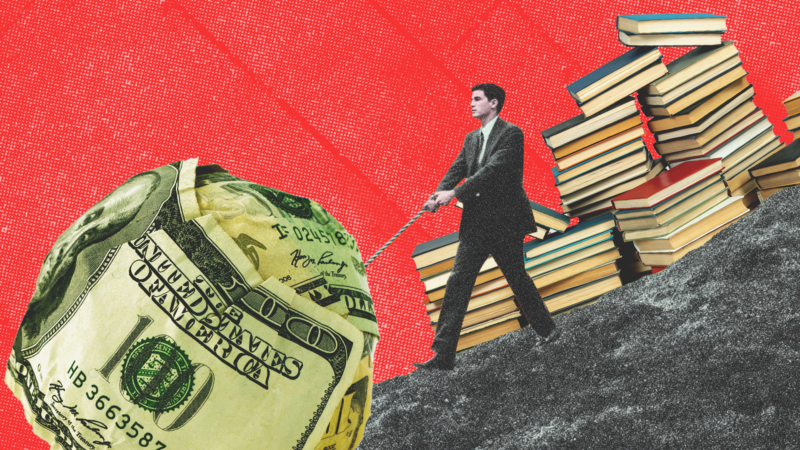
Is any subgenre of journalism more debased and alienating than the student-loan sob story? If paying for college with heavily subsidized, federally backed loans was in fact the cause of the new, universal serfdom we hear so much about, you'd think that places like The New York Times would be able to scare up highly sympathetic young adults who tug at readers' heartstrings like orphans in a Dickens novel.
Instead, in stories like last week's "Student Debt Burdened Them, So They Moved Abroad and Stopped Paying," you get characters like 37-year-old Amanda Lynn Tully, who "graduated in 2017 with a master's degree in historic preservation from the University of Oregon, $65,000 in federal student loans and no job offers in the conservation field." Tully, reports the Times, "felt misled" and so "made a drastic decision: She moved to Prague, where she had completed an internship, and defaulted on her loans. She hasn't made a payment in over seven years."
Right off the bat, something seems off. Tully, the Times tells us, grew up in Colorado and "spent her teenage years as a ward of the State of Colorado and believed a college degree was her ticket to a better life." That sounds like an incredibly rough way to start out, but how did we get to Oregon and graduate school so quickly? And then there's this:
Ms. Tully was on an income-based repayment plan, which allows many borrowers to have their remaining debt forgiven after 20 years of making qualifying payments. She was paying $60 per month when she defaulted. This amount, to many, may seem manageable. But for her, it remained psychologically burdensome.
It's at this moment that the Times, and Tully, loses virtually all readers—and taxpayers. As a first-generation college student who paid my own way through college and graduate school, partly by taking out loans, it's tough to hear someone grouse about a $60 monthly payment, especially for a graduate degree, something just 13.2 percent of Americans hold.
But whenever we talk about the roughly $1.8 trillion in student debt, it's worth remembering that people pursuing graduate degrees—including M.D.s, law degrees, and master's degrees—account for "40 percent of federal student loans issued each year," even though such programs enroll just "15 percent of all students in higher education." When it comes to borrowing for undergraduate degrees, less than half of all students (47 percent) graduating in 2024 had student debt and the average total indebtedness was $29,560, according to LendingTree.
That's not nothing, but it works out to about a monthly payment of around $325 per month for 10 years under current interest rates. If borrowers opt into an income-driven repayment system, they could have lower monthly payments stretched over more years. Given that recent college grads command starting salaries ranging between $78,000 for engineering majors to $60,000 for communications majors, student debt, for holders of B.A.s anyway, is eminently manageable.
Add to that, too, that having a bachelor's degree both decreases the likelihood of being unemployed and increases median annual income for workers between the ages of 25 and 34. While there are many variables to factor into any evaluation of the benefits of earning a B.A., virtually all analyses find substantial lifetime income gains for college graduates over their high school counterparts, typically totaling over $1 million dollars.
Only a few years ago, President Joe Biden unsuccessfully tried to wipe out $500 billion in student loans (the Supreme Court ruled he overstepped). Forgiving all or some amount of student debt polls well, though, and has been a widely touted policy item among high-profile Democrats such as Sen. Elizabeth Warren (D–Mass.) for years now.
But such plans are as fundamentally misguided as journalistic accounts are unpersuasive. Student-loan forgiveness shifts the cost of a benefit that accrues to individuals to taxpayers at large, even as the national debt continues to spiral upwards and out of control. We should find loan-forgiveness plans as off-putting and misguided as individuals who find $60 monthly payments "psychologically burdensome." It shouldn't be at all controversial or odd to insist that beneficiaries of a program pay for all or most of the benefit, especially when all data suggest that they can do so without anything approaching serious hardship.




