
Their Children Were Alone Outside. So Police Visited the Family—Twice.
Nick and Shaley Knickerbocker’s story shows how some people’s idea of “neglect” goes well beyond real risk.
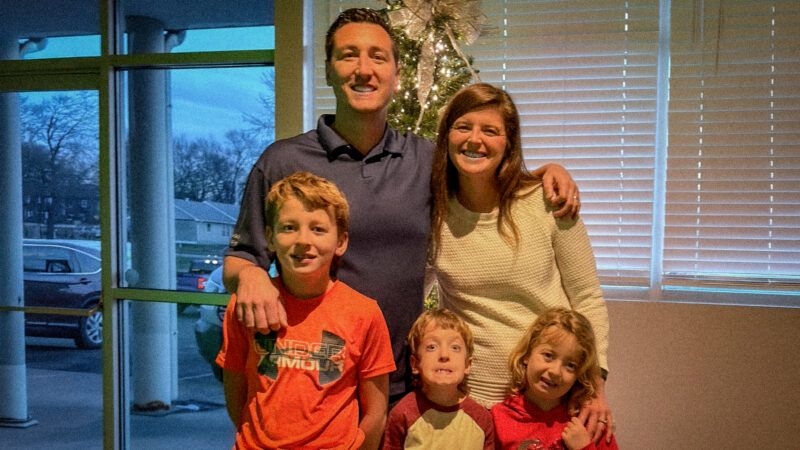
Eighteen months ago Shaley Knickerbocker was living in small-town Kansas—Baldwin City, population about 5,000—when she sent her kids out to play one morning. It was about 7:30. They were 8, 6, and 4 years old at the time. She could see them from her living room.
That evening, Knickerbocker said, "I'm putting the kids to bed and a police officer shows up at our house."
Knickerbocker's husband, Nick, answered. The cop said he'd gotten a report that their children had been playing outside unsupervised.
That was news to Shaley Knickerbocker, who assured her husband she had been home all day. She homeschools and sometimes the kids play outside. (The horror!) "The cop was understanding," says Knickerbocker. He told her husband, "I just have to do this [because] a report was made."
"Probably someone made a call to [the Kansas Department for Children and Families] or a hotline and it got filtered to law enforcement and they had to do a welfare check," says Knickerbocker, herself a forensic nurse.
Things went no further, but Knickerbocker couldn't shake the funny feeling knowing that a neighbor had reported her.
A few months later, Knickerbocker and her kids "were at the park just around the corner and one needed to go the bathroom," she recounts. "I said, 'Just walk home.'" Her husband was there.
As the boy, Hudson, age 6, did so—on a sidewalk path just out of Knickerbocker's sight—a police officer pulled up and asked him if he knew where he was going. "'He said, 'I live right there.'" Nonetheless, the cop said, "'Well, I'll walk you to your house,'" says Knickerbocker.
When they arrived home moments later, the officer asked Knickerbocker's husband, "Did you know your kid was outside? Do you know what's going on?" The way Knickerbocker sees it, "her question implied that he didn't know our child was out walking by himself"—as if allowing a child to go somewhere briefly on his own were unimaginable.
While the cop made no official report, Knickerbocker had had enough.
"We intend to raise our kids like that—to let them go outside," she said. While they'd only been in their home for two years, they started looking to move.
In the meantime, they had a college student living with them who would sometimes walk the dog. This caused such a stir that the local Facebook group was posting pictures of the young woman from their Ring cameras, asking, "Does anyone know who this is?"
After that, "We sold our house and moved out into the country," she says. "It is so much better."
Now Knickerbocker can let her kids play outside without fearing another legal run-in. And the neighbors have 13 grandkids they let play "free-range." Everyone is breathing easier.
And soon they can breathe easier still, I'm hoping, as the Kansas State Legislature just unanimously passed a Reasonable Childhood Independence law. The law clarifies that "neglect" is when you put your child in obvious, serious danger—not anytime you let them play outside, or walk home, or simply take your eyes off them. It awaits Gov. Laura Kelly's signature.
Let Grow has helped pass such bills in 12 states to date, often with the help of the Reason Foundation, the nonprofit that publishes this website. A childhood independence law "would make me feel safer," says Knickerbocker, "but also less guilty. I knew we were living in a safe place. I knew my kids. But in those situations where I was questioned, I did question myself. Having a law like that would have taken away the guilt from the get-go."
