

Reason.com - Free Minds and Free Markets
Reason logo Reason logo
  • Latest
  • Magazine
    • Current Issue
    • Archives
    • Subscribe
    • Crossword
  • Video
    • Reason TV
    • The Reason Roundtable
    • Free Media
    • The Reason Interview
  • Podcasts
    • All Shows
    • The Reason Roundtable
    • The Reason Interview With Nick Gillespie
    • Freed Up
    • The Soho Forum Debates
  • Volokh
  • Newsletters
  • Donate
    • Donate Online
    • Ways To Give To Reason Foundation
    • Torchbearer Society
    • Planned Giving
  • Subscribe
    • Reason Plus Subscription
    • Gift Subscriptions
    • Print Subscription
    • Subscriber Support

Log In

Create new account

Artificial Intelligence

Sam Altman's (Not So) New Deal for Superintelligent AI

The plan’s deregulatory planks merit praise. Its calls for central planning and redistribution do not.
Jack Nicastro | 4.8.2026 11:15 AM

Share on FacebookShare on XShare on RedditShare by emailPrint friendly versionCopy page URL Add Reason to Google
Media Contact & Reprint Requests
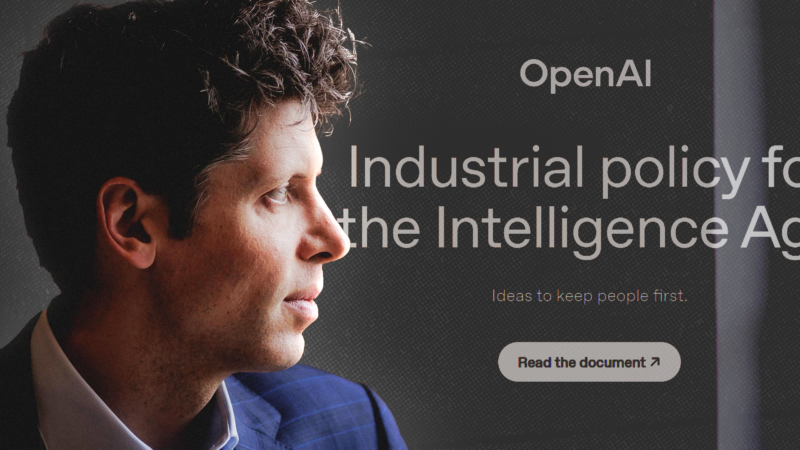
Illustration of OpenAI CEO Sam Altman | Florian Gaertner/IMAGO/Newscom
(Florian Gaertner/IMAGO/Newscom)

OpenAI's "New Deal" for the AI age is full of old—and failed—ideas. 

On Monday, OpenAI published Industrial Policy for the Intelligence Age: Ideas to Keep People First. The 13-page white paper presents the frontier developer's economic and regulatory prescriptions for a world with superintelligent AI. 

Starting with the positives, the paper rightly recognizes that bundling fringe benefits—health insurance and retirement plans—with employers harms workers by limiting labor market mobility. To ameliorate the problems of employer-sponsored benefits, OpenAI recommends creating "portable benefit platforms that pool contributions from multiple sources and route them into standardized accounts attached to the individual, not the job."

The company also recommends "using AI to handle the overhead that usually blocks entrepreneurship," including "accounting, marketing, and procurement." Given the sheer amount of paperwork it can take to start a business, "startup-in-a-box" supports, which OpenAI defines as model contracts and shared back-office infrastructure, can be critical for helping innovators quickly translate ideas from the back of a napkin to multibillion-dollar companies, says Kevin Frazier, senior fellow at the Abundance Institute. 

But as the company makes the case for easing business costs, it makes several recommendations that would stifle innovation. This includes the call to radically alter the tax code by imposing "higher taxes on capital gains at the top [and] corporate income." OpenAI also advocates for creating a public wealth fund—whose funding source is unspecified—to allow every citizen to "invest in diversified, long-term assets that capture growth in both AI companies and the broader set of firms adopting and deploying AI." 

Research published by the Cato Institute has associated higher corporate income tax rates with less research and development investment and fewer patents filed per year. Similarly, hiking taxes on capital gains discourages investment in startups. This means less innovation and, consequently, slower economic growth. Meanwhile, the $1.48 trillion in debt amassed by state and local pension plans, as well as the Social Security trust fund's impending insolvency, suggest that the government is an irresponsible fiduciary that should not be entrusted to oversee even more capital. 

Unfortunately, this is not the only instance of OpenAI advocating for more state power; the plan also calls for the expansion of the existing safety net, which includes food stamps, unemployment insurance, "Social Security, Medicaid, and Medicare that are not just in place but fully functional, accessible, and responsive to the realities people will face during the transition [to superintelligence]." 

Given the transformative economic potential of AI, it's reasonable to believe that safety nets will likely have to be updated in response to superintelligence. But sticking to the same "tried and failed" mechanisms is the wrong approach, says Frazier. "The goal should not be to…attach AI to existing systems and assume that their flaws will immediately be remedied," he says, but to fundamentally reevaluate these systems.

In some ways, OpenAI's suggestions for the future of AI are better than other policies proposed by lawmakers. For example, instead of calling for a nationwide moratorium on new data center construction to reduce strain on the electric grid, the company calls for "the expansion of energy infrastructure required to power AI." Still, OpenAI's belief in the government's ability to allocate billions of dollars to the benefit of all Americans is a naive one. 

Start your day with Reason. Get a daily brief of the most important stories and trends every weekday morning when you subscribe to Reason Roundup.

This field is for validation purposes and should be left unchanged.

NEXT: Viktor Orbán and His American Apologists All Deserve To Lose

Jack Nicastro is an assistant editor at Reason.

Artificial IntelligenceIndustrial PolicyDisruptive TechnologiesWelfareLabor Market
Share on FacebookShare on XShare on RedditShare by emailPrint friendly versionCopy page URL Add Reason to Google
Media Contact & Reprint Requests

Hide Comments (2)

Editor's Note: As of February 29, 2024, commenting privileges on reason.com posts are limited to Reason Plus subscribers. Past commenters are grandfathered in for a temporary period. Subscribe here to preserve your ability to comment. Your Reason Plus subscription also gives you an ad-free version of reason.com, along with full access to the digital edition and archives of Reason magazine. We request that comments be civil and on-topic. We do not moderate or assume any responsibility for comments, which are owned by the readers who post them. Comments do not represent the views of reason.com or Reason Foundation. We reserve the right to delete any comment and ban commenters for any reason at any time. Comments may only be edited within 5 minutes of posting. Report abuses.

  1. Rick James   2 hours ago

    Meanwhile, the $1.48 trillion in debt amassed by state and local pension plans, as well as the Social Security trust fund's impending insolvency,

    Can we get a grownup who will explain to the Reason Staff that there literally is no such thing?

    Log in to Reply
  2. Homer Thompson   41 minutes ago

    if you could only sell AI short or buy put options

    Log in to Reply

Please log in to post comments

Mute this user?

  • Mute User
  • Cancel

Ban this user?

  • Ban User
  • Cancel

Un-ban this user?

  • Un-ban User
  • Cancel

Nuke this user?

  • Nuke User
  • Cancel

Un-nuke this user?

  • Un-nuke User
  • Cancel

Flag this comment?

  • Flag Comment
  • Cancel

Un-flag this comment?

  • Un-flag Comment
  • Cancel

Latest

'They're Going To Go Elsewhere': Steve Forbes on Why Taxing the Rich Backfires

John Stossel | 4.8.2026 1:45 PM

Minneapolis Might Bring Back Bathhouses As Spaces for Sex and Queer Community

Elizabeth Nolan Brown | 4.8.2026 12:46 PM

Sam Altman's (Not So) New Deal for Superintelligent AI

Jack Nicastro | 4.8.2026 11:15 AM

Viktor Orbán and His American Apologists All Deserve To Lose

Matt Welch | 4.8.2026 10:30 AM

Ceasefire

Peter Suderman | 4.8.2026 9:30 AM

Recommended

  • About
  • Browse Topics
  • Events
  • Staff
  • Jobs
  • Donate
  • Advertise
  • Subscribe
  • Contact
  • Media
  • Shop
  • Amazon
Reason Facebook@reason on XReason InstagramReason TikTokReason YoutubeApple PodcastsReason on FlipboardReason RSS Add Reason to Google

© 2026 Reason Foundation | Accessibility | Privacy Policy | Terms Of Use

This site is protected by reCAPTCHA and the Google Privacy Policy and Terms of Service apply.

r

I WANT FREE MINDS AND FREE MARKETS!

Help Reason push back with more of the fact-based reporting we do best. Your support means more reporters, more investigations, and more coverage.

Make a donation today! No thanks
r

I WANT TO FUND FREE MINDS AND FREE MARKETS

Every dollar I give helps to fund more journalists, more videos, and more amazing stories that celebrate liberty.

Yes! I want to put my money where your mouth is! Not interested
r

SUPPORT HONEST JOURNALISM

So much of the media tries telling you what to think. Support journalism that helps you to think for yourself.

I’ll donate to Reason right now! No thanks
r

PUSH BACK

Push back against misleading media lies and bad ideas. Support Reason’s journalism today.

My donation today will help Reason push back! Not today
r

HELP KEEP MEDIA FREE & FEARLESS

Back journalism committed to transparency, independence, and intellectual honesty.

Yes, I’ll donate to Reason today! No thanks
r

STAND FOR FREE MINDS

Support journalism that challenges central planning, big government overreach, and creeping socialism.

Yes, I’ll support Reason today! No thanks
r

PUSH BACK AGAINST SOCIALIST IDEAS

Support journalism that exposes bad economics, failed policies, and threats to open markets.

Yes, I’ll donate to Reason today! No thanks
r

FIGHT BAD IDEAS WITH FACTS

Back independent media that examines the real-world consequences of socialist policies.

Yes, I’ll donate to Reason today! No thanks
r

BAD ECONOMIC IDEAS ARE EVERYWHERE. LET’S FIGHT BACK.

Support journalism that challenges government overreach with rational analysis and clear reasoning.

Yes, I’ll donate to Reason today! No thanks
r

JOIN THE FIGHT FOR FREEDOM

Support journalism that challenges centralized power and defends individual liberty.

Yes, I’ll donate to Reason today! No thanks
r

BACK JOURNALISM THAT PUSHES BACK AGAINST SOCIALISM

Your support helps expose the real-world costs of socialist policy proposals—and highlight better alternatives.

Yes, I’ll donate to Reason today! No thanks
r

FIGHT BACK AGAINST BAD ECONOMICS.

Donate today to fuel reporting that exposes the real costs of heavy-handed government.

Yes, I’ll donate to Reason today! No thanks


