

The Islanders Expelled To Build the West's Middle East Fortress
The British Empire evacuated the Chagos Islands to build a military base, which the U.S. is using in the Iran War. Now, a court ruling is giving the original owners hope of going home.
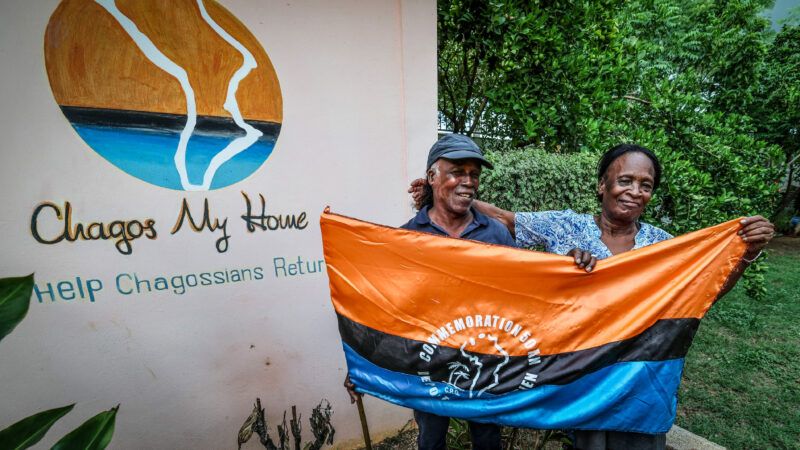
One of Michel Mandarin's last memories of his hometown was the U.S. government throwing all the dogs into a gas chamber. In 1967, the British authorities declared that people of the Chagos Islands were not "permanent inhabitants," and expelled them to make way for a new U.S.-British military base on the island of Diego Garcia. American naval engineers infamously killed the islanders' pets as a threat against staying.
This week, a British court ruled that people like Mandarin were really permanent inhabitants of the Chagos Islands, and they have a right to go back.
"There is no historical authority for a prerogative power to expel or permanently exclude a population of British subjects from the territory to which their citizenship belongs," British Indian Ocean Territory Chief Justice James Lewis wrote in his Tuesday ruling, denouncing the government's "inglorious" decision "to perpetuate the fiction that there was no settled or permanent population on the islands."
The Chagossian issue is one of the most stark underdog stories in modern times. On one side are several thousand exiles from a poor country, whom British officials dismissed as "some few Tarzans or Men Fridays whose origins are obscure." On the other side are the interests of a superpower government; Diego Garcia has been key to U.S. military operations in the Middle East, including the current Iran War. Recently, Chagossians found an unexpected ally in British conservatives, who oppose a plan for Britain to give up control of the island.
After an international court in The Hague ruled in 2019 that the Chagos Islands rightfully belonged to Mauritius, the British government agreed to give Mauritius the territory and rent it back with a guaranteed 99-year lease on Diego Garcia. The Biden and Trump administrations both pressured Britain to take the deal. From the U.S. perspective, it was a win-win scenario, bringing Mauritius closer to the U.S. (and further from China) with a bribe that Britain paid.
Win-win for everyone except Britain, which was paying for the privilege of losing territory. Right-wing politicians seized on the deal as an obvious liability for Prime Minister Kier Starmer's left-wing Labour Party. Conservative Party leader Kemi Badenoch called the planned handover "an act of great stupidity and a sign of total weakness" from the floor of Parliament. Reform U.K. leader Nigel Farage went further, accusing Starmer of "treachery."
Chagossians themselves were divided about the deal. Olivier Bancoult, chairman of the Chagos Refugee Group, who was exiled at age four, called the treaty with Mauritius "a sign of recognition of the injustice done against Chagossians." But Frankie Bontemps, chairman of the nonprofit Chagossian Voices, whose mother was exiled, said that the handover left the community "powerless and voiceless in determining our own future." As it turned out, the treaty would only allow Chagossians to visit or live on the islands outside Diego Garcia, with permission from the Mauritian government.
In February 2026, a group of British Chagossians made a last-ditch attempt to stop the treaty. Sailing from Sri Lanka on a yacht called No Excuse, and joined by former Conservative Party member of Parliament Adam Holloway, they set up a protest encampment on Île du Coin, on the edge of the Chagos Islands. Mandarin, one of the campers, had been removed from the island at age 14; his son told The Guardian that Mandarin cried when he saw Île du Coin again.
The British government filed an order to deport them from the Chagos Islands, which the campers challenged in court. The Supreme Court of the British Indian Ocean Territory ruled that there is no legal basis for keeping Chagossians in exile, though the "government has the legitimate right to control entry to specific locations, albeit with different concerns, and on different terms, for those with a right to abode," so the campers still need to go back and get a permit.
"I came here because I wanted to see my homeland again, I have been home sick for nearly 60 years. I wanted to show my son our islands. I wanted to find and visit the graves of my ancestors, something I have partially achieved this week with my son," Mandarin testified in court. "I never want to be removed again."
The story of those ancestors begins in the 18th century, when French settlers from the colony of Mauritius brought several dozen slaves to establish coconut plantations. Britain conquered both Mauritius and the Chagos Islands during the Napoleonic Wars. Slavery was abolished in 1835. Indian immigrants joined the local population, which swelled to about a thousand.
At first, "life and the conditions from slavery apparently changed little" after abolition, the anthropologist David Vine writes in Eviction From the Chagos Islands. "However, it appears that Chagossians gradually struck what (for a plantation society) was a relatively good work bargain." They developed a unique culture with a French-based creole language.
Where Chagossians saw a quiet life, Cold War military planners saw a society that was easy to crush. Taking stock of the "local disorders" around the Indian Ocean basin, from Arabia to Malaysia, the U.S. State Department proposed setting up military bases on "strategically situated Indian Ocean islands under British control" in a secret 1964 paper. The authors honed in on the Chagos Islands as the best candidate.
"They do not appear to us to be capable of supporting serious independence movements and probably are too remote and culturally isolated to figure plausibly in the plans of any mainland government," which allows them to be "put to the military service of the West in an emergency without delay, negotiation, or political restraint," the paper noted.
Britain agreed to implement those plans. It granted independence to Mauritius, but declared the Chagos Islands part of a new British Indian Ocean Territory. In April 1971, the authorities passed the British Indian Ocean Territory Immigration Ordinance #1, which made it illegal for nonmilitary personnel to stay on the islands. Under the logic that their ancestors only came to work on plantations, Chagossians were deemed "immigrants" on their own land. "We are able to make up the rules as we go along and treat the inhabitants as not 'belonging' to it in any sense," a British official privately admitted.
"Bulldozers uprooted palm trees, destroyed the coral reef with explosives and the corals ripped out were used to build the runway," reported the journalist Jean-Claude de l'Estrac in the book Next Year in Diego Garcia. "All this upheaval, along with the constant sound of military aircraft flying over the island, terrorised the Chagossians."
In case Chagossians had not gotten the message, British Commissioner Bruce Greatbatch issued orders to kill all the dogs on Diego Garcia in bizarre public cullings, to be carried out by U.S. troops. The Americans first tried shooting all the dogs, then began poisoning them with strychnine, then finally lured them into sheds filled with vehicle exhaust, before burning the corpses, Vine reports in the book Island of Shame.
"They put the dogs in a furnace where the people worked, and when their dogs were taken away in front of them, our children screamed and cried," Chagossian exile Lizette Tallate told The Guardian years later. According to court documents, Mandarin remembered the same thing happening on Île du Coin, where troops told the locals, "you'll be gassed too if you don't leave now."
The last ship full of Chagossians left Diego Garcia in October 1971, and the Chagos Islands were completely cleared of locals by April 1973. Bernadette Dugasse, a Chagossian emigrant living in the nearby Seychelles, witnessed waves of refugees arriving in the early 1970s. These exiles were reduced to begging, and the threat of rape hung over the heads of Chagossian girls, Dugasse wrote in Eviction From the Chagos Islands.
Meanwhile, the U.S. Navy continued to grow its presence on Diego Garcia, building satellite uplinks, port facilities, and an airport. The island became a staging ground for U.S. forces headed to the Middle East and a base for long-range bomber missions in Afghanistan, Iraq, and Yemen. It has also hosted crucial electronic surveillance equipment—and a possible secret CIA prison.
The growth of the base has created a need for hundreds of civilian maintenance workers. Rather than hiring the exiled Chagossians, the U.S. military instead imports foreign contractors from much farther away. The strict military control of the island keeps these workers isolated and precarious.
Indian contract workers told The Observer that they were flown to Bahrain on tourist visas, then transferred to Diego Garcia on a U.S. military flight without papers, essentially disappearing these workers from the map. In 2022, the Philippine government accused KBR of keeping Filipino workers trapped on Diego Garcia over a wage dispute by cancelling charter flights. KBR insisted that the flights were cancelled due to coronavirus conditions.
"Some Filipino workers here have stayed on the island for three years without going home. Think of the psychological impact," Father Gerald Metal, the chaplain to foreign workers on Diego Garcia at the time, told me by phone during the flight holdup. "I already counseled some people who were attempting to commit suicide."
However, the military nature of the island didn't seem to bother the Filipino workers or Metal, who said that "it's not really seen as something warlike, because at the end of the day, it's for the defense of the nation, not for anything offensive."
The British government doesn't agree. In the buildup to the current war with Iran in February this year, Starmer denied the U.S. military permission to fly out of Diego Garcia, on the grounds that an attack on Iran would be an act of aggression. U.S. President Donald Trump temporarily threatened to withdraw his support for the deal with Mauritius. After the U.S. launched its attack on February 28, Starmer declared his support for the "defensive" campaign to prevent Iran from retaliating. While it's unclear whether any of the U.S. fighter jets stationed at Diego Garcia are taking part in air raids, the 31st Marine Expeditionary Unit passed through the island on the way to the Middle East.
The protest campers on Île du Coin took advantage of the U.S.-British spat to advance their own claims. Mandarin's son Misley, who had declared himself First Minister of the Chagossian government-in-exile, posted a video message on February 23 giving his "blessing" to attack Iran from Diego Garcia. "If our homeland stands as a shield for America and its allies, then America must stand as a shield for our people," he added.
Although Diego Garcia has mostly put U.S. forces out of reach of their Middle Eastern opponents, that may not be the case forever. On March 21, the Iranian military launched two missiles at the island. One of the missiles was intercepted and the other failed mid-flight, but the attack showed that Iranian missiles had a larger range than the 2,000 kilometers previously believed. U.S. Secretary of War Pete Hegseth used the incident as a further justification for war. "For years, they told the world that their missiles could only range two [sic] kilometers. Surprise yet again, Iran lied," he said at a cabinet meeting.
Taken as a whole, the history of the Chagos Islands is quite dismal from the perspective of human freedom. The land was populated by slavery, then stolen from its inhabitants after emancipation by a capricious government. The purpose of this theft was to create a perfect dictatorship, a fortress run by indentured servants rather than citizens, to spy on and wage war against the region without dealing with the "political restraint" and "independence movements" of a free population.
No one can quite imagine an end to this situation. The Mauritian government, the aggrieved contract workers, and Chagossians themselves all seem to have accepted that Diego Garcia will remain a closed-off military base for the foreseeable future. But the success of the protest encampment shows that no situation is forever.
"We are making history right now," the younger Mandarin said on camera while landing on Île du Coin. "My daughter was born in Manchester. My grandkid will be born on this island."




