
The Hidden Costs of Elizabeth Warren's 'Ultra-Millionaire' Tax
The Massachusetts senator fails to consider how her tax would harm middle class Americans and slow economic growth.
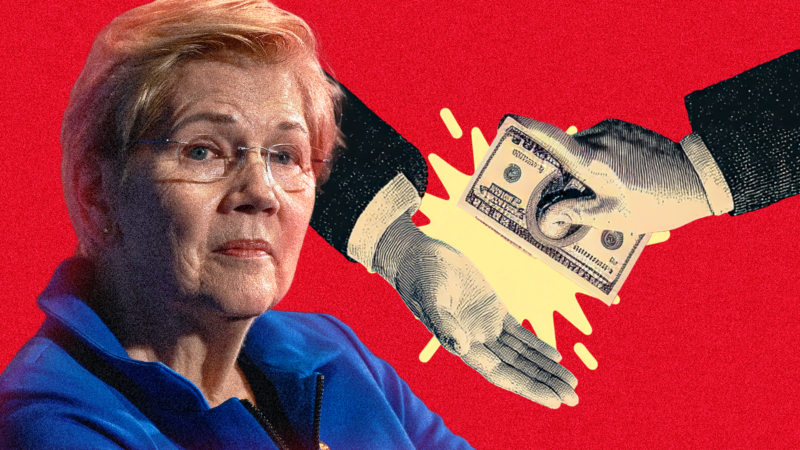
The Democrat campaign to confiscate wealth continued on Thursday when Sen. Elizabeth Warren (D–Mass.) introduced the Ultra-Millionaire Tax Act of 2026. The bill comes on the heels of a series of wealth taxes that have been enacted or proposed in states and the halls of Congress in recent weeks.
Warren's bill would impose a 2 percent annual levy on household and trust wealth above $50 million and a 3 percent rate on wealth above $1 billion. University of California, Berkeley, economists Emmanuel Saez and Gabriel Zucman estimate that approximately 260,000 American families would be subject to the tax. Assuming a 15 percent tax avoidance rate, the economists project the ultra-millionaire tax raising $514 billion this year and $6.2 trillion over the next decade. Instead of using the revenue to reduce the country's $1.8 trillion (and climbing) deficit, Warren proposes dramatically increasing social spending by instituting universal child care, free community college, Medicare expansion for those 55 and older, and paid family leave.
Despite Warren's claim that she is trying to promote "basic fairness" for "working people," her bill would make the middle class worse off.
The wealthy hold their fortunes primarily in illiquid assets: public equity (37 percent), private equity (29 percent), and real estate and luxury assets (3 percent). To pay an annual wealth tax, those subject to it would need to sell holdings they had no intention of liquidating, distorting markets. Moreover, forcing the sale of stocks in publicly traded companies increases supply and places downward pressure on share prices, thereby reducing the value of ordinary Americans' retirement accounts—401(k)s, Roth IRAs, and pension funds.
Of course, this assumes that a federal wealth tax is both legal and effective.
The Constitution allows the federal government to collect indirect taxes—duties, imposts, and excises (tariffs)—but prohibits it from imposing direct taxes. The lack of clarity surrounding the definition of "direct taxes" prompted the adoption of the 16th Amendment in 1913 to impose the federal income tax. Even if a wealth tax is not a direct tax and, therefore, constitutional, it would be ineffective unless those subject to it don't flee. History suggests such capital flight is likely.
In 1990, more than 12 European countries had wealth taxes. Today, only three remain. Chris Edwards, the head of fiscal studies at the Cato Institute, explains that France repealed its wealth tax in 2017 after it was found to cost the government twice as much revenue as it raised by encouraging capital flight. (The bill's imposition of a 40 percent exit tax on the wealth of those subjected to it suggests that Warren expects its passage would elicit out-migration.) Altogether, "European wealth taxes…tended to raise only about 0.2 percent of gross domestic product in revenue." Still, Saez and Zucman predict that Warren's tax would raise nearly nine times this share of gross domestic product (GDP). The Penn Wharton Budget Model (PWBM) suggests the Berkeley economists' outlook is rosy.
The PWBM estimated that the 2021 version of Warren's bill (which is essentially a carbon copy of her new piece of legislation) would raise roughly $2.1 trillion over 10 years—about one-third of Saez and Zucman's current forecast. Raising this revenue would not be costless, but would reduce wages and cause "GDP to decline by 0.6 percent in 2031 and 1.2 percent in 2050" by decreasing the amount of capital available for investment, per PWBM. Saez and Zucman's estimates assume that economic growth will be unaffected by Warren's wealth tax. (They make this assumption in their evaluation of California's proposed billionaire wealth tax.)
The United States already has the most progressive tax system in the developed world. Fleecing the rich further by confiscating their wealth might make for good sloganeering, but it would actually leave everyone worse off.
