
Miami Beach Woman Visited by Detectives Over a Facebook Comment Files Free Speech Lawsuit
The lawsuit alleges that the city has a history of silencing pro-Palestine speech.
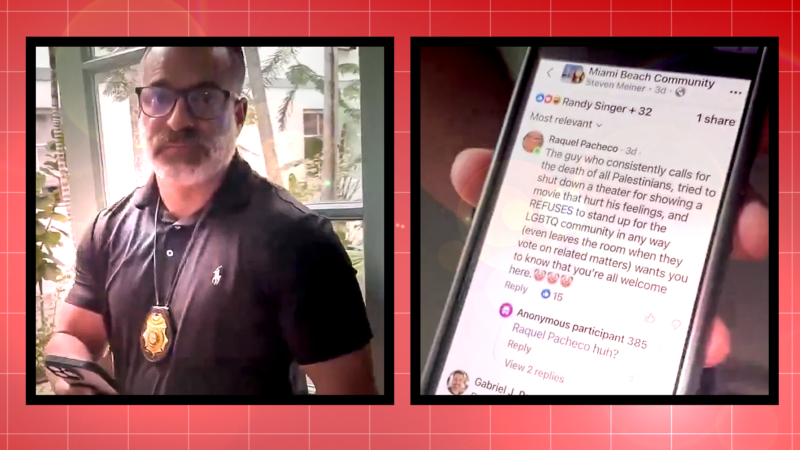
In January, two detectives visited Miami Beach resident and former political candidate Raquel Pacheco at her home to question her about her Facebook comment criticizing the city's mayor. She captured the moment on video, and the police visit quickly went viral, drawing attention from free speech advocates.
Now, those officers, the city of Miami Beach, the mayor, and other city officials are facing a federal lawsuit from the American-Arab Anti-Discrimination Committee (ADC) for violating Pacheco's First Amendment rights. The lawsuit seeks compensatory damages for the "distress, fear, humiliation and reputational harm she has endured."
In January, Pacheco commented on Miami Beach Mayor Steven Meiner's Facebook post, which said Miami Beach was a "safe haven for everyone." Under the post, Pacheco wrote, "The guy who consistently calls for the death of all Palestinians, tried to shut down a theater for showing a movie that hurt his feelings, and REFUSES to stand up for the LGBTQ community in any way (even leaves the room when they vote on related matters) wants you to know that you're all welcome here."
Two Miami Beach Police Department detectives later showed up at Pacheco's home, asking if she had posted the comment. Pacheco refused to answer the officers' questions without a lawyer present, Reason's C.J. Ciaramella reported at the time.
During the visit, one of the officers told Pacheco the post could "probably incite somebody to do something radical."
A few days later, Miami Beach Police Chief Wayne A. Jones released a statement defending his decision to send the officers to Pacheco's home, "given the real, ongoing national and international concerns surrounding antisemitic attacks and recent rhetoric that has led to violence against political figures." He stated he had directed the detectives to "initiate a brief, voluntary conversation regarding certain inflammatory, potentially inciteful false remarks" to ensure there was no threat to the mayor or broader community.
As Ciaramella noted in January: "Although police and politicians on the receiving end of inflammatory criticism may believe the threat is clear enough, there is a difficult First Amendment bar to clear to meet the legal standard for incitement." In Pacheco's case, her comments did "not include any call to action or the sort of imperative statements usually associated with incitement," wrote Ciaramella.
The ADC's lawsuit alleges that this is not the first time the city and its officials have violated the First Amendment rights of "individuals and groups who express support for the Palestinian people and/or criticize the State of Israel." Last March, Meiner sent a letter to the CEO of O Cinema, asking the theater to "reconsider" showing the Oscar-winning documentary No Other Land. In the letter, he called the documentary—which chronicles some of the destruction of a Palestinian community in the West Bank—an "antisemitic" and "hateful" piece of propaganda. After the theater (which rents its space from the city) still screened the movie, Meiner introduced a resolution to terminate the city's lease agreement. Meiner announced he was dropping the resolution during a Miami Beach City Commission meeting where the "vast majority of attendees" opposed Meiner's proposal, the Miami Herald reported.
Although the theater was able to continue operating and Pacheco was not arrested for her speech, the ADC alleges that the city's actions created a chilling effect on speech for both Pacheco and the "broader community watching the incident unfold online."
"[We] filed this case to ensure that the Mayor's message is rejected and that the Constitution's protections apply equally to all viewpoints, including those expressed in support of Palestinian human rights," the ADC said in a press release. "We call on civil liberties advocates, community leaders, and the public to stand in defense of Ms. Pacheco and the fundamental right to speak freely without fear of government retaliation."
