
How Not To Write About Space Exploration
Reach for the stars, but not for this book.
Open Space: From Earth to Eternity—the Global Race to Explore and Conquer the Cosmos, by David Ariosto, Knopf, 384 pages, $35
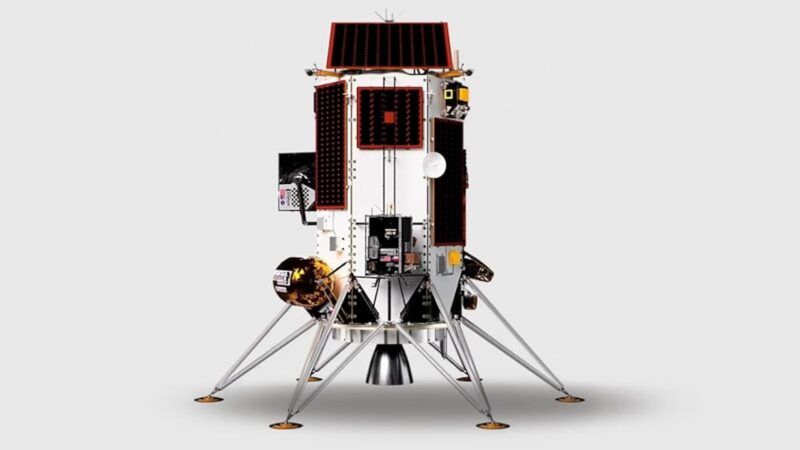
Two years ago, a Houston-based company you probably haven't heard of achieved what the United States government had not managed in over half a century: It placed a craft on the moon. The company is called Intuitive Machines, and its landing was a close thing. A sensor failure forced last-minute software overhauls and a white-knuckle descent; upon touching down, the vessel tipped over. But it worked.
The tale of Intuitive Machines' sleep-deprived engineers facing down one crisis after another is gripping. In his new book, Open Space, journalist David Ariosto tells it well.
Lamentably, the rest of the book is less moon shot, more train wreck.
Writing about the space industry for a general audience is no simple task. You must imbue your narrative with the awe that comes from gazing at the night sky, a quasi-mystical experience that resists reduction to words. You must also translate actual rocket science into plain English, along with orbital mechanics and around a dozen other technical fields. And you have to wrap in the petty human indignities—the government contracts, the corporate intrigue—without which nothing else happens. It takes a deft hand to weave it all together, to master both transcendence and logistics. Ariosto makes a game effort, and at times he offers some genuinely valuable journalism. But he comes nowhere close to making the entire book work.
Open Space feels like two books clumsily stitched together. The first half is built around Ariosto's access to figures within Intuitive Machines and the Chinese space industry—a rather incongruous pair. Intuitive Machines is trying to open the moon for business. China is racing to beat the United States to the moon and beyond. Ariosto ricochets between the two camps, with detours into cybersecurity, drug development in microgravity, and the promises and pitfalls of putting data centers in orbit.
This is not introductory material. NASA's Artemis program is crawling, at preposterous expense and with antiquated hardware, toward returning American astronauts to the moon. Open Space is not about that. SpaceX has made marvelous strides in developing and deploying reusable rockets and is building by far the best heavy-lift spacecraft in history. Open Space is not about that either. Blue Origin has finally gotten its act together and is now nipping at SpaceX's heels. On this, Open Space has nothing to say. Anyone unfamiliar with these foundational developments should instead reach for Christian Davenport's excellent Rocket Dreams.
Ariosto's introduction promises a sweeping account of mankind's push for the stars. But the book is too lopsided for that. It's more a mix of keyhole views and potted histories.
That said, it contributes where it can. Lost amid our contentious politics and the sheer pace of technological advance elsewhere, the achievements of Intuitive Machines—and of the other space startups this book surveys—have not gotten their due. Ariosto provides a moment in the sun for the entrepreneurs and engineers at scrappy companies who are seeking out, with grit and passion, the parts of the map marked Here be dragons.
The coverage of China is valuable too. China has twice as many STEM graduates as we do. It has detailed plans to build a network of AI-driven satellites, to establish a dominant presence at the moon's strategic chokepoints, to extract resources from asteroids, and more. Its space program—both state and, increasingly, private—enjoys stable funding and support.
This sounds formidable, and it is. But Ariosto is not naive about China's disadvantages. He notices, for example, how nothing that happens in the Chinese space industry escapes the meddlesome involvement of the People's Liberation Army, which often operates more as an extension of the Chinese Communist Party's political will than as a functional military.
And he is clear-eyed about why we should not want China to win the space race. He humanizes his Chinese sources, but he doesn't lose sight of the dictatorship's many misdeeds. China has a habit of crashing rockets on its own people's heads. It has blown up a satellite just to show it can, sending thousands of dangerous pieces of shrapnel into orbit. Its penchant for ecological devastation in its hinterlands, as well as for bullying its neighbors at sea, may be a preview of how it will behave at the final frontier.
The second half of the book is an exercise in speculation and futurism. Here Ariosto moves further to the fringes, interviewing people who spend their time thinking about how to survive on Mars, travel to other stars, or create antimatter. He engages with hardy perennials of space philosophy, such as Fermi's paradox (Where are the aliens?) and Drake's equation (a stab at quantifying a guess). He discusses the possibility of using nuclear explosions to propel spacecraft, quantum entanglement to send messages between star systems, and gravity-altering warp drives to travel faster than the speed of light.
Here again, Ariosto is not the best place to start. The reader looking to get acquainted with the mind-bending edges of the field should consult smarter and better-organized books, such as Michio Kaku's The Future of Humanity. Ariosto provides, at best, a modest update on our civilizational progress toward turning science fiction into reality.
There are some bright spots. His account of NASA's Double Asteroid Redirection Test—when scientists literally pushed an asteroid off course, proving that we could in principle do the same to protect Earth—is worthwhile. And he makes the important point that, as breakthroughs in AI, quantum computing, robotics, and materials science converge, we might be on the cusp of rapid growth in space exploration. Machines will design machines. Robots will build factories. Autonomous systems will coordinate production, transport, and discovery across vast distances.
If only Ariosto could help us picture it. Here as elsewhere, the book's flaws get in the way. The prose is clunky. The chronology is bewildering. Ariosto is particularly ill-served by his attempt to mimic a thriller novel, with short chapters bouncing around, each ending with an irritating faux cliffhanger. The result is not mounting tension but erratic drift. The relative emphasis on different topics is baffling. There are digressions on everything from the opium wars to McCarthyism, but next to nothing on how NASA's Space Launch System or SpaceX's Starship actually work.
Worse—unforgivable, really, in a book of this sort—Ariosto is simply bad at explaining technology. He doesn't simplify technical concepts so much as wave a hand in their general direction. Important context is often missing. (At one point, the reader must already know that United Launch Alliance's Vulcan rockets use Blue Origin's BE-4 engines.) Complex ideas are introduced with indifference. (Not familiar with the Standard Model of particle physics? With the differences between nuclear fission and fusion? The author is not about to help you.) Even at his most diligent, Ariosto describes technology at the level of a marketing team's press release.
The overall effect is one of centrifugal distraction. Ariosto almost never sees a topic through to completion. Just when he gains some momentum discussing the challenges of life on Mars, he veers into half-baked thoughts on whether the red planet will have unethical working conditions or indentured servitude. Even the shortest chapters smash together subjects as disparate as U.S. immigration policy, the Chinese housing market, and a visit to the CERN research laboratory. In one remarkable stretch of about three pages, Ariosto touches on—in this order—quantum computing; the communications lag across interstellar distances; improvements in space telescopes; the possibility of sending life to another planet and the morality of doing so; the difficulty of maintaining control over AI-powered space probes, given the aforementioned communications lag; the potential role quantum physics plays in the existence of consciousness; the mysterious origins of life; the creation of lab-grown organic tissue; and whether life can be established on another planet via bioprinting. Reach exceeds grasp at every turn.
Ariosto is a spirited cheerleader for the engineers, scientists, and researchers of the new space race. One wishes he could match their standards, their precision, their relentless willingness to iterate until everything is right. They need the help. Two of their self-appointed spokesmen are billionaires who persistently come off as crass and one-dimensional. For this and other reasons, bold space endeavors face a startling amount of public apathy and scorn.
As we strive for the heavens, we are short of people who can explain why we should. We need visionaries who can articulate both the practical and the spiritual case for space. Sages who can make vivid the redemptive promise of the cosmos. Leaders who can convey what Alexander knew: that to encounter the gods, one must venture beyond the end of the world.
David Ariosto's enthusiasm is earnest and charming. But his book is a missed opportunity.
