
Judges and Justices Should Be Independent, Trump Says, As Long As They Side With Him
The president says federal courts should not make decisions based on partisan considerations unless it benefits him.
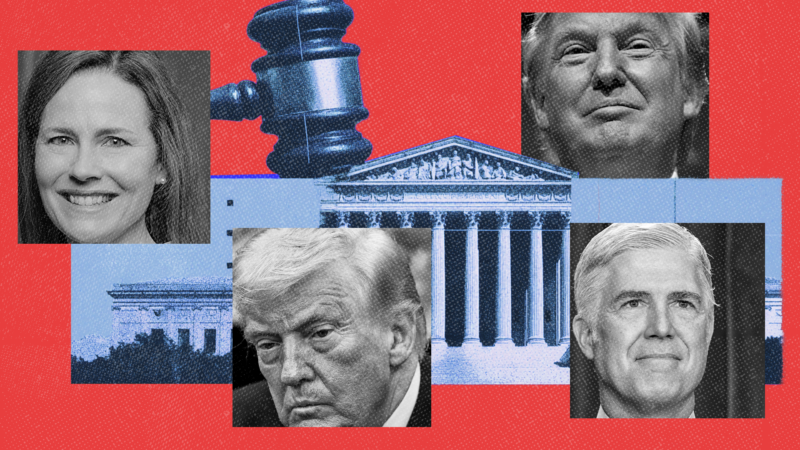
This week President Donald Trump rehashed his complaints about federal judges who rule against him, laying into the justices who rejected his "emergency" tariffs last month and lower courts that have hindered him in one way or another. Unlike his previous tirades in this vein, his recent comments acknowledge that there is such a thing as judicial independence. But Trump made it clear that he values that quality only to the extent that it corresponds with his own interests.
"The Courts treat Republicans, and me, so unfairly, always seeming to protect those who should not be protected," Trump whined in a Truth Social post on Sunday night. He cited a ruling by James Boasberg, chief judge of the U.S. District Court for the District of Columbia, who last week blocked grand jury subpoenas seeking evidence to support allegations that Federal Reserve Chairman Jerome Powell misused public funds while overseeing renovation of the central bank's headquarters in Washington, D.C.
Trump has repeatedly criticized Powell's policies and wants to replace him with a chairman who is more inclined to deliver the interest rate cuts he favors. But under federal law, the president can remove someone from the Federal Reserve's Board of Governors only "for cause"—a constraint at the center of Trump v. Cook, a case that the Supreme Court is considering. Trump's claims about the Federal Reserve renovation, which underlie the subpoenas that Boasberg quashed, seem to be aimed at meeting that standard.
"There is abundant evidence that the subpoenas' dominant (if not sole) purpose is to harass and pressure Powell either to yield to the President or to resign and make way for a Fed Chair who will," Boasberg wrote. "The Government has offered no evidence whatsoever that Powell committed any crime other than displeasing the President."
With that ruling, Boasberg committed the same crime. "How is this absolutely terrible Federal Reserve Chairman, Jerome 'Too Late' Powell, not even allowed to be investigated for the horrible job he does?" Trump wondered. "How is he allowed to be Billions of Dollars over budget, and years behind schedule, on the simple renovation of the small Federal Reserve Complex in Washington, D.C., where he created an absolute disaster—a money pit, and embarrassment to our Country for the whole World to see!"
Contrary to Trump's gloss, the project, which is supposed to be completed by the end of next year, is about $700 million over budget. The Federal Reserve attributes the overruns to several factors, including soil contamination, an asbestos removal challenge that was more extensive than anticipated, rising labor costs, and material expenses boosted by pandemic-related supply disruptions and Trump's tariffs.
Whatever you make of that account, there is no evidence that the spending constitutes a crime, which is the point that Boasberg was making. And in criticizing the judge's decision, Trump gave the game away by citing Powell's "horrible performance" in setting interest rates, a policy critique that has nothing to do with a violation of any criminal law.
Boasberg, a Barack Obama appointee, has been a thorn in Trump's side since last March, when he issued a temporary restraining order that blocked Trump's attempt to summarily deport alleged members of the Venezuelan gang Tren de Aragua under the Alien Enemies Act (AEA). After that intervention, Trump condemned Boasberg as a "Radical Left Lunatic of a Judge, a troublemaker and agitator" who "should be IMPEACHED!!!"
Contrary to the charge that Boasberg had intervened purely for political or ideological reasons, Trump's use of the AEA subsequently encountered resistance from the Supreme Court, a Trump-appointed judge in Texas, and the U.S. Court of Appeals for the 5th Circuit, which is not known for its radical left agitation. Trump nevertheless continues to portray Boasberg as "a Wacky, Nasty, Crooked, and totally Out of Control Judge" who "suffers from the highest level of Trump Derangement Syndrome" and "has been 'after' my people, and me, for years."
Boasberg is "a disgrace" to "our Legal Process," Trump said, because he "has displayed open, flagrant, and extreme partisan bias and contempt against Republicans and the Trump Administration. To preserve the integrity of the Judiciary, he should be removed from all cases pertaining to us, and suffer serious disciplinary action, as should numerous other Corrupt Judges that, unfortunately, our Country has had to endure! What Boasberg has done on the 'Too Late' Powell case, and many others, has little to do with the Law, and everything to do with Politics. He is exactly what Judges should not be!"
Judges, in other words, should be guided by the law and the facts, not by partisan considerations. Except when that principle works against Trump.
Immediately after castigating Boasberg, Trump reiterated his disappointment with the Supreme Court's February 20 decision in Learning Resources v. Trump, which rejected his claim of essentially unlimited tariff authority under the International Emergency Economic Powers Act (IEEPA). That "unfortunate and unwarranted TARIFF decision," he said, epitomized "our Highly Politicized Court System."
The logic here is hard to follow, so bear with me. In Learning Resources, the Supreme Court held that IEEPA does not authorize tariffs at all. The majority included Chief Justice John Roberts, a George W. Bush appointee, and two justices nominated by Trump himself: Neil Gorsuch and Amy Coney Barrett.
The day of that decision, Trump said Gorsuch and Barrett were "an embarrassment to their families" because they had revealed themselves as "fools and lapdogs for the RINOs and the radical-left Democrats." Did it make sense to describe the decision, which hinged on statutory interpretation informed by the separation of powers, as a reflection of "radical-left" thinking? No, it did not. But as Trump saw it, Gorsuch and Barrett had clearly been "swayed by foreign interests and a political movement that is far smaller than people would ever think."
Unlike Boasberg, Gorsuch and Barrett were not "Radical Left Lunatic[s]"—an epithet that reflects Trump's habit of deploying wildly inaccurate ideological labels against people who irk him. Gorsuch and Barrett nevertheless were kowtowing to "radical-left Democrats." But why would they do that?
Trump suggested an answer in another Truth Social post on Sunday, which he appended to his rant about Boasberg. Justices like Gorsuch and Barrett "go out of their way, with bad and wrongful rulings and intentions, to prove how 'honest,' 'independent,' and 'legitimate' they are," he said. That seems like the opposite of a "Highly Politicized Court System," since it means that justices are willing to rule against the president who appointed them if they think that is what the law requires. But in Trump's view, that is exactly the problem.
In their eagerness to demonstrate their independence, Trump complained, such justices "openly disrespect the Presidents who nominate them." Although "the Court knew where I stood" and "how badly I wanted this Victory for our Country," Gorsuch and Barrett had the temerity to disagree with Trump's highly dubious interpretation of IEEPA.
Democratic appointees are different in that respect, Trump said: "The Democrats on the Court always 'stick together,' no matter how strong a case is put before them." Or as he put it the day of the tariff decision, those justices "will automatically vote no," because "they're against anything that makes America strong, healthy, and great again." They are therefore a "disgrace to our nation," since "they're an automatic no, no matter how good a case you have."And that is obviously bad, for the same reason it is bad when Democratic appointees on lower courts rule against Trump: According to him, they are making decisions based on their political allegiances rather than the merits of the case.
Trump, in short, thinks judges should not be guided by loyalty to the president who appointed them or his party, unless that president is Trump. The main point is that Trump should always win, which is a clear enough principle but not one that is consistent with the rule of law.