

ICE Is Bringing Military Occupation and Recruitment Tactics to America
“We did this overseas, and it’s come home in every conceivable way.”
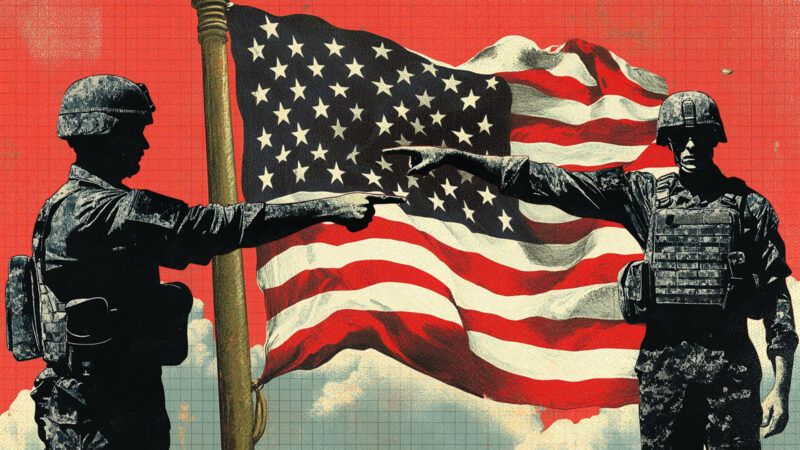
U.S. Immigration and Customs Enforcement (ICE) launched a yearlong $100 million recruitment campaign late last year. From removing age limits for applicants to offering $50,000 signing bonuses, ICE's "wartime recruitment" campaign is a full-on blitz.
The agency's recruitment methods have drawn a lot of critical scrutiny for at least two reasons.
First, the ads resemble wartime propaganda posters. One Instagram recruitment post, for example, features an image of Uncle Sam, fist clenched, saying, "Greatness is a Choice: Join ICE Now." A post on X features President George Washington in battle dress atop a rearing horse with the words "Defend the Homeland." In another post, an armored Lady Liberty urges ICE enlistment to "Protect Your Nation."
View this post on Instagram
Second, the imagery and language of many ads have raised concerns that ICE's recruitment methods are attracting far-right groups such as the Proud Boys and even neo-Nazis. An ad late last year, for example, prominently featured the phrase "America for Americans," a slogan long used by the Ku Klux Klan. ICE recruitment posts have been reshared by radical-right groups with responses like "message received."
View this post on Instagram
While ICE's parent, the Department of Homeland Security (DHS), denies deliberately targeting the far right to join the ranks of ICE, the agency has been remarkably clear that "wartime recruitment" is the appropriate phrase for its campaign. Another ad posted to social media states, "America has been invaded by criminals and predators." Speaking about illegal immigrants within the United States, President Donald Trump stated that "this is a time of war" and that he would "stop the migrant invasion," as though immigrants are a foreign military force. Now-former DHS Secretary Kristi Noem and other officials have echoed such sentiments.
America has been invaded by criminals and predators.
We need YOU to get them out. https://t.co/tqZ8y0E36q pic.twitter.com/7CVqGG6uLy
— Homeland Security (@DHSgov) July 29, 2025
If it's a war you want to fight, you need soldiers. Naturally, the DHS has targeted veterans.
Declaring that it "values the commitment, work ethic, specialized skills and experiences vets bring to the workforce," ICE is offering expedited pathways for veterans to join, including veteran internship programs and special hiring authority for disabled veterans. Veterans' applications earn explicit "preference" points over applications from their civilian counterparts.
ICE recruitment videos and other marketing materials contain strong military visuals. From tactical gear and weapons training to work on a shooting range, the DHS unequivocally frames ICE as a way for veterans to "continue serving."
ICE's overall recruitment drive has been remarkably effective. The agency has reportedly grown its ranks by some 12,000 over the last year, swelling its forces to nearly 22,000. ICE's push to employ veterans has been effective too. About a third of the agency's employees have prior military experience, and approximately 40 percent of deportation officers are veterans. Deportation officers are those directly responsible for conducting surveillance, locating, and arresting individuals of interest—in other words, interacting regularly with civilians.
It's easy to understand why ICE would want to fill its ranks with veterans. They have ample experience working within a rules-based chain of command, have demonstrated capacity to carry out tactical operations, have experience with reconnaissance, and have firearms training. Some may already maintain security clearances.
But the integration of veterans into ICE has a clear danger. The militarization of domestic forces perverts the functions of both the military and the civilian-facing forces, and it raises real concerns regarding further militarization of immigration enforcement.
Enemies, Foreign and Domestic?
The Founders recognized a clear need to distinguish between the military and those enforcing domestic laws. Historically, these groups have been trained to serve very different functions, and early laws made clear distinctions between police and military. In the mid-1800s, the Posse Comitatus Act explicitly prohibited the use of federal troops as a civilian police force.
Domestic law enforcement entities—police, sheriff's deputies, and even federalized organizations such as the National Guard, Customs and Border Protection, and ICE—are meant to serve as internal peacekeepers. They are to uphold domestic laws and protect the rights of the public. This includes perpetrators and victims of crime, citizens, and immigrants, regardless of their legal status.
For these domestic law enforcement groups, violence is to be used only as a last resort. Consider the mottos of many U.S. police departments. Phrases like "Protect and Serve" are common, as are slogans emphasizing community and service, underscoring these groups' intimate interactions with the communities they engage. While ICE does not have a singular motto, the agency emphasizes that its mission is "enforcing immigration laws to preserve national security and public safety." Homeland Security Investigations, a part of ICE, states that its core values are honor, service, and integrity.
By contrast, the military is tasked with fighting the enemies of the United States in international conflicts. It uses violence proactively to destroy enemies and advance the government's interests abroad. This is embodied by the Soldier's Creed, which reads in part: "I stand ready to deploy, engage, and destroy, the enemies of the United States in close combat."
The militarization of U.S. domestic policing operations is not new. For more than a decade, scholars, journalists, and other policy analysts have discussed how the integration of military tools, tactics, and institutional structures has come to be common practice within the United States.
For example, SWAT teams, now ubiquitous across the United States, were not introduced until the 1960s. Following the race riots in Los Angeles in 1967, a Vietnam veteran saw an opportunity to use his war training as a means of domestic crowd control. He proposed to incorporate the structures and tactics deployed by the Marine Corps' elite force reconnaissance units in Vietnam in Los Angeles. The idea stuck, and the first SWAT team soon became a permanent fixture. During the war on drugs, these units spread across the United States, with myriad negative consequences, including botched raids, injuries to both police and civilians, and deaths.
In addition to SWAT teams, the integration of surplus military equipment into state and local police departments (through initiatives such as the 1033 Program) equipped civilian police forces with tools designed for use against enemies abroad, with clear consequences. Recent photos from Minneapolis, with federal officers clad in heavy Kevlar with high-powered weapons, illustrate the widespread adoption of these tools.
These SWAT dynamics are relevant within the context of ICE as well. ICE's Special Response Teams (SRTs) are specialized, paramilitary units that are "ready to deploy." Like their counterparts in other SWAT units and throughout ICE, veterans are heavily recruited into SRTs.
Take a behind the scenes look at the training of ERO's Special Response Team (SRT). Read more about ERO SRTs: https://t.co/7W0Eylsdcu pic.twitter.com/Ziy5lEFcHR
— U.S. Immigration and Customs Enforcement (@ICEgov) March 28, 2019
Trained at Ft. Benning in Georgia, transported by armored personnel carriers, and equipped with military-style gear, assault rifles, and heavy "less lethal" weapons like pepper balls and flash-bang grenades, these units are modeled after U.S. Special Forces, not civilian police. Indeed, a recent $30,000 DHS contract revealed that members of SRTs would be undergoing sniper training.
As with SWAT teams, the outcomes were wholly predictable. In 2025, ICE launched 37 separate investigations regarding excessive use of force. Between 2015 and 2021, ICE agents were involved in at least 59 shootings—with 24 fatalities. While reporting requirements make it difficult or impossible to separate incidents involving SRTs from standard ICE units, the involvement of SRTs in the shootings in Minneapolis paint a grim picture. Other events point in a similar direction. In 2023, a federal judge awarded a $1.17 million settlement following a raid conducted by DHS paramilitary units in 2018. The judge ruled that agents had detained people without warrants, detained people without probable cause, and utilized excessive force. A slew of other civil lawsuits allege similar behaviors.
Some dismiss these concerns, arguing that domestic law enforcement officials—including ICE—need such tools to do their jobs effectively. But this is simply not the case. ICE is not encountering heavily armed enemies on some foreign battlefield; it is encountering civilians on the streets of the United States, including young children.
From the Barracks to the Streets
The integration of military tactics and equipment into immigration enforcement matters, but who is integrated matters too. Some might suggest that since veterans are former military and not on active duty, concerns about militarization are overblown. And it's true that such veterans are formally separated from the military. But there's more going on.
Just as the education, work, and other life experiences we possess are carried forward into our future endeavors, the same is true for military veterans. The training that taught members of our Armed Forces to engage with enemies of the United States in close combat doesn't disappear when they come home and return to civilian careers. The integration of military ideas and attitudes is a core component of the overall phenomenon of militarization.
Some of those issues might be mitigated if officials made a clear distinction between military operations and ICE operations. But as the ads and other statements referenced above show, they're doing the precise opposite. Veterans are being encouraged to bring the tools of foreign wars to the streets of the United States. They are, after all, fighting "invaders."
Some of these problems might also be lessened if veterans joining ICE received the training necessary to shift their mindset from one of interacting with foreign enemies to one of interacting with civilians. But this does not appear to be the case either. With the rapid increase in ICE's ranks, many have questioned the agency's ability to train so many recruits appropriately within such a short timeframe. Some agents receive as little as six weeks of training before being sent into the field.
Freelance journalist Laura Jedeed laid bare these concerns when she was hired to be an ICE deportation officer after just a six-minute interview—even though she hadn't received a background check, hadn't signed an affidavit that she'd not been convicted of domestic violence charges, and was unlikely to pass a drug test. Jedeed, a veteran of the war in Afghanistan, told Democracy Now! that the officer who interviewed her was clear that she wouldn't be "given a badge and a gun right away" but was emphatic that "we want everyone on the street with guns eventually."
The recruiter, she also said, was also a veteran, and he told her that "he had a lot of trouble assimilating, as a lot of veterans do. And so about six months later, he decided to go for law enforcement….He's been an ICE agent, he said, for about a decade….This is very sad to me and also emblematic of a problem we have where we use this language of terrorism and weapons of mass destruction and freedom and democracy at the barrel of a gun. We did this overseas, and it's come home in every conceivable way."
When you combine those factors—military tactics, military tools, military human capital—violent outcomes are predictable, like the deaths of Renée Good and Alex Pretti,
The language used by our leaders, the tools provided to immigration enforcement, and the human capital being recruited into immigration enforcement all point in one unmistakable direction: the continued militarization of domestic law enforcement. The line that once separated civilian peacekeepers from the military was a safeguard intended to help maintain a free society, not a trivial technicality. When domestic law enforcement, immigration or otherwise, is framed as "war" and carried out by those trained to conduct such operations, we cannot be surprised when the institutions of war come to be used at home—nor can we be surprised that violence and death are the outcomes.




