
Goverment Shutdowns Won't Stop Airport Security If Airport Security Isn't Run by the Government
Airport wait times balloon as the TSA remains impacted by the partial government shutdown.
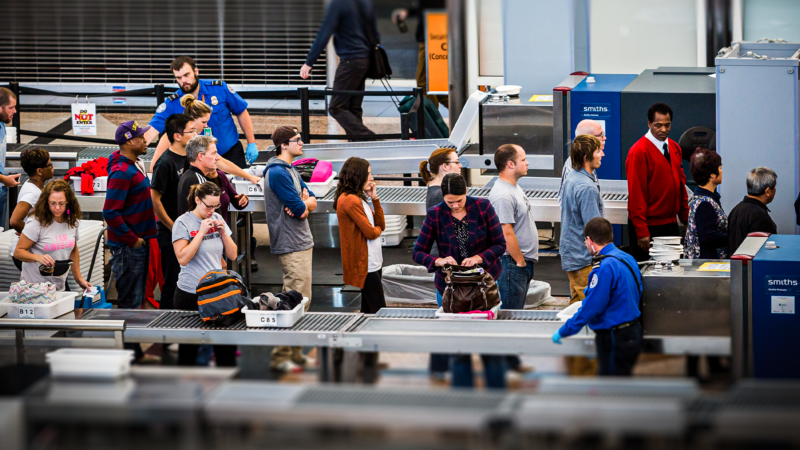
The partial government shutdown, which is now on its 33rd day, is revealing the folly of nationalized airport security in real time.
#MobileMike If you're planning to fly out of Fort Lauderdale-Hollywood International Airport, you might want to rethink it.
It's 3:30 AM and this place is already chaos. Lines everywhere, nonstop delays, and tons of cancellations. Staff looks overwhelmed, and passengers are just… pic.twitter.com/hmLw2ikzDo
— Mobile Mike (@MOBILEMIKE_) March 17, 2026
???? Travelers are encountering massive security lines at Newark International Airport and other airports across the country, due to the Dems shutdown.
— Breaking911 (@Breaking911) March 16, 2026
Airport wait times have dramatically increased all around the country, thanks to increased absenteeism of frontline Transportation Security Administration (TSA) employees who have been working without normal pay since February 14.
Wait times to get through security at Dulles International Airport, which are normally three minutes, were up to 75 minutes last Thursday, according to travel service Qsensor. Last Monday, wait times at Orlando International Airport were even higher—105 minutes—despite being less than 15 minutes usually.*
Before funding was cut for the Department of Homeland Security (DHS) on February 14, the callout, or unscheduled absence, rate of frontline TSA employees was only 2 percent, reports CBS News. That number has tripled to a nationwide average of 6 percent since their salaries have been withheld, and a high of 9 percent on February 23.
These employees, whose base salaries range from $34,500 to $55,500, only received a partial paycheck on February 28, and no paycheck whatsoever on March 14, according to CNN. Delayed payment has not only exacerbated callout rates but also prompted the departure of 366 of the roughly 50,000 Transportation Security Officers (TSOs), the TSA agents responsible for screening passengers at airports.
With fewer TSOs employed and more calling out, it's no surprise that, as of "Sunday, March 15 and Monday, March 16, callouts spiked over 50% in Houston and over 30% in New Orleans and Atlanta," according to the DHS.
But airport security personnel's salaries and Americans' travel plans did not always rely on the federal government.
Before 9/11, "airport security was handled by private contractors and paid for by the airlines," reports The Washington Post. The TSA was created by the Aviation and Transportation Security Act, which then-President George W. Bush signed into law in November 2001.
Although the TSA's raison d'etre is to prevent explosives and weapons from entering airplanes, it's not very good at even detecting these hazards. Before the DHS classified detailed results of such studies in 2017, a 2015 report published by the DHS Office of Inspector "found that undercover investigators successfully smuggled mock weapons or explosives through checkpoints 67 out of 70 times, a failure rate of 95 percent," explains Steve Swedberg, a policy analyst at the Competitive Enterprise Institute.
While the TSA may not be very good at screening threats to passengers' lives, they're quite adept at "riffl[ing] through luggage…and subject[ing] travelers to aggressive pat-downs of their genitals," notes Reason's Robby Soave.
There's a better way: private airport security.
At one point during a similar government shutdown in 2019, "10 percent of TSA officers failed to report for duty," according to The Washington Post. But at San Francisco International Airport, "operations were normal" because private contractors, who were providing screening services through the Screening Partnership Program, continued getting paid and continued showing up to work. The Post notes that "evaluations of the two programs by outside firms…have found no significant differences between the two systems." Citing a study from the Government Accountability Office, the paper found that "in some instances private contractors' costs were 2 percent to 19 percent lower than the TSA's."
Not only is private airport security a better way, but it is also popular outside the United States. "More than 80 percent of Europe's commercial airports use private screening, including those in Britain, France, Germany, and Spain….Canada uses private screening companies at all its major commercial airports," writes Chris Edwards, a budget expert at the Cato Institute.
The government's monopoly on security has disrupted business, recreation, and everything else. Thankfully, the solution is simple: privatize airport security.
*CORRECTION: This article originally mistated the date of delayed wait times at Orlando International Airport.
