Review: Resisting the Hive Mind Virus in PLUR1BUS
The protagonist in the Apple TV series does not want her consciousness absorbed into a collective human mind.
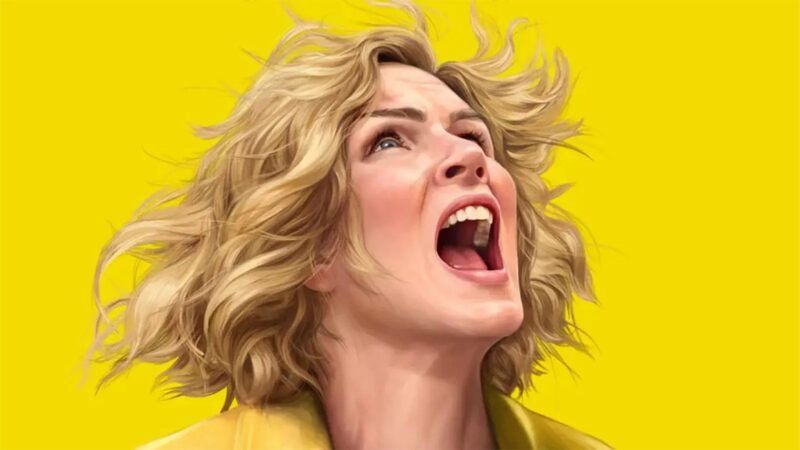
Would you trade your identity for utopia? Apple TV's science fiction series PLUR1BUS examines whether a perfect world is worth the loss of everyone's individuality.
When an alien virus turns the world's population into a hive mind, every person's consciousness is absorbed into one central entity, imbued with their collective memories and experiences. Human beings now think and act as one, collectively devoted to building the perfect world. They are so dedicated to pacifism that they won't even pick fruit from trees.
The only exceptions are 13 people who are inexplicably immune to the virus. Since their friends and family are still around, though they're now part of the hive, many of the 13 wish to join the collective. The collective, in turn, tries to help them do so.
But Carol (Rhea Seehorn of Better Call Saul) is not just immune to the virus but hostile to the concept of losing her identity. The collective respects her wishes and amiably caters to her every desire, but it becomes clear that whether she wants it or not, they hope to incorporate her eventually anyway—as they see it, for her own good.
Manousos (Carlos Manuel Vesga), perhaps the series' most fascinating character, opposes the new world order even more militantly than Carol does. On screen, Manousos embodies the principle that there's no such thing as a free lunch: He not only rejects every offer of the collective's assistance, but he insists on paying for anything he uses. Or, when he doesn't have enough cash, writing IOUs by hand.
Editor's Note: As of February 29, 2024, commenting privileges on reason.com posts are limited to Reason Plus subscribers. Past commenters are grandfathered in for a temporary period. Subscribe here to preserve your ability to comment. Your Reason Plus subscription also gives you an ad-free version of reason.com, along with full access to the digital edition and archives of Reason magazine. We request that comments be civil and on-topic. We do not moderate or assume any responsibility for comments, which are owned by the readers who post them. Comments do not represent the views of reason.com or Reason Foundation. We reserve the right to delete any comment and ban commenters for any reason at any time. Comments may only be edited within 5 minutes of posting. Report abuses.
Please to post comments
SPOILER ALERT: Her actions (inevitable as they were with today's writing) toward the end of the season make her a villain. She is effectively a rapist.
Why is it that modern writing gives no likeable characters? Most of the time I want to see the protagonist fail because they're so detestable. It's hard to watch a movie when you can't connect with the characters and there's no tension because the outcome is irrelevant.
Self-insertion. Writers are insufferable so the characters are as well.
It's Vince Gilligan's style. His protagonists are all psychologically damaged. Walter White in Breaking Bad, Saul Goodman in Better Call Saul, and Carol Sturka in Pluribus all have personality quirks that make achieving their respective goals harder for them.
The hive mind is the villain, not to be confused with the over seven million people joined with it. All of them are forcibly assimilated (like the Borg from Star Trek). The show does not explain the condition of "The Joined". Are they dead, in a coma, in perpetual bliss, or screaming in terror? All we see are smiling faces, but they may be simply imposed by the hive mind.
This is not a utopia, but a dystopia. Humanity is enslaved. Carol and Manousos are the reluctant heroes looking for a way to free humanity.
Agreed
A pretty skimpy review. The basic concept is in conflict with itself. On the one hand, the hive mind people have all their old memories. On the other hand, they are all happy as part of the hive. I don't see how that is possible; if they remembered their previous life, it would either be with horror that they had been individuals and they would want to forget all that, or it would be with horror that they no longer were individuals.
Not to agree with the premise or quality of the show, but this assumes the logic (and other) center(s) of the brain to be a simple, mechanical "on/off" switch when it's actually more like an LLM.
The phenomenon is known as confabulatory ideation or just confabulation. If the brain/consciousness witnessed how it migrated from horrid/blissful and/or self/other in either direction, then that's the explanation. If it doesn't, it either invents one by cobbling together plausibilities or conveniently skips over that sector when recalling.
This is pretty low-level too, when small infants stop playing peek-a-boo it's because their brain has begun, behind the scenes (both behind the stage and 'in the projector room') begun, filling in the gaps to support object permanence. Even dogs, having been deceived by the classic "fake throw" normally return to the place where they last saw the object to be thrown.
A, maybe-more-interesting-or-maybe-more-predictable conflict; one of the enraptured, intentionally or not, manages to find their way back.
Sounds like the hive mind is Saving (D)emocracy.
"Surprise" twist: the libertarians support a world without imaginary social constructs, humanity subsists on cheap scraps produced as the result of people conscripted by ideological indoctrination/anesthetization, and all humans become genderless, indistinct, perfectly equal and interchangeable clumps of cells.
Surprise-surprise twist: Somehow, Ron Bailey still winds up needing to ask his wife if it's acceptable to bud asexually.
Love the show. I assume there is an evil person behind the virus or whatever it is. My guess happy slavery?
I assume there is an evil person behind the virus or whatever it is.
Possible, but not necessarily. We don't the motivations of those on Kepler-22b who sent the signal. The scientists who find the signal are portrayed as naive or, in the case of Jenn (who becomes Patient Zero), just plain stupid.