Killing Drug Lords Won't End Mexico's Cartels. Ending the Drug War Might.
The death of El Mencho shows why decades of prohibition enforcement have only strengthened cartels.
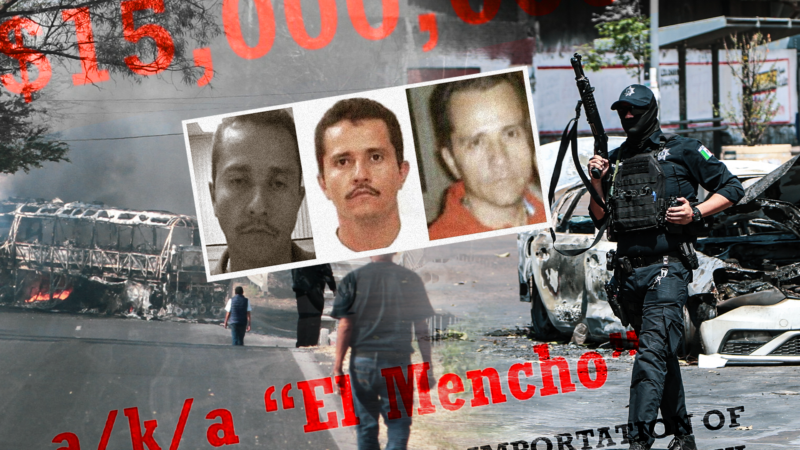
On a Sunday in February, Mexico's second-largest city ground to a standstill. Gunmen used burning cars as flaming barricades, shutting down traffic in and out of Guadalajara. Terrified zoo visitors sheltered overnight with the monkeys and kangaroos. Similar disturbances were recorded in 20 Mexican states.
The Jalisco New Generation Cartel (CJNG), one of Mexico's most powerful criminal organizations, unleashed mayhem after its leader, Nemesio Oseguera Cervantes, alias "El Mencho," was killed in a gun battle with federal troops. He was the Drug Enforcement Administration's (DEA) most wanted drug lord, with a $15 million bounty on his head.
"The nature of the unrest is not new in itself," says Sandra Pellegrini, senior analyst at Armed Conflict Location and Event Data (ACLED), pointing to how cartels have mobilized against government forces in the past. "The scale, however, is rather unprecedented and clearly demonstrates the CJNG's ability to coordinate at a fast pace, and at a nationwide scale."
According to the Mexican federal government, at least 89 people were killed, including 25 soldiers, a prison guard, a prosecutor, an unidentified woman, and 46 suspected gang members (some of whom may have been forcibly recruited into CJNG's ranks).
"President [Donald] Trump had been dialing up the pressure on Mexico to deliver these spectacular outcomes," says David Mora, senior Mexico analyst at International Crisis Group. "It was already admitted by the government that this operation had a lot of U.S. intelligence, so this was a powerful message to the U.S.: We can use your intelligence, we can sit down at the table and cooperate and plan, but Mexican forces can do it. We don't need U.S. troops on the ground here."
The operation also came at a sensitive moment, as the Trump administration asserts itself in Latin America in the name of fighting the drug menace—killing at least 151 suspected traffickers on drug boats in Caribbean waters without due process and abducting the president of Venezuela. Perhaps fearing what the American government might do next, Mexican authorities decided to act first.
In other words, Mexico is fighting America's war on drugs. While most Mexicans would welcome an end to the criminals who have been terrorizing their country for decades, the reasons heavily armed bandits are running amok are inextricably linked to their northern neighbor.
"Without a doubt, the United States has decided what Mexico's drug policy has been for decades," says Zara Snapp, co-founder and director of Instituto RIA in Mexico City.
The Roots of Prohibition
Over a century ago, an alliance of religious crusaders, misguided progressives, and outright bigots pushed prohibitionist laws in the United States that banned alcohol, opioids, cocaine, and eventually cannabis. The alcohol ban didn't work. By the late 1920s, New York City had more than 10 times as many speakeasies as licensed bars today.
While Prohibition failed to instill nationwide sobriety, it proved a boon for smugglers and bootleggers. Tequileros—literally, "tequila people"—smuggled booze across the Texas border on horses, donkeys, and mules, covering bottles with layers of hay to stop them from clanking and giving them away.
Some of those early smugglers went on to build criminal empires. One of them, Juan Nepomuceno Guerra, later founded what became the Gulf Cartel and its bloodthirsty breakaway faction, Los Zetas. Since the beginning, smuggling bosses were protected by police and politicians, who accepted bribes in exchange for looking the other way.
But the U.S. was not alone. Mexico also had its own version of prohibition.
"Since the 1850s, marijuana was widely believed to be a drug that produced outbursts of madness and violence," explains Isaac Campos, professor at the University of Cincinnati and host of the History on Drugs podcast. Smoking reefer, he adds, was seen as a backward habit mainly associated with lowlifes.
Mexico outlawed pot in 1920 for "degenerat[ing] the race." Opium and heroin followed six years later.
But in 1938, Leopoldo Salazar Viniegra, a Mexican doctor and psychiatrist, published "The Myth of Marijuana," a report arguing that stories about cannabis driving you crazy were untrue. A bit of an oddball who reportedly injected cannabis extracts into chickens' brains and graded students on pistol marksmanship, Salazar nevertheless persuaded open-minded government officials. In 1940, Mexico briefly legalized drugs, allowing opioid addicts to score a fix at specially designated clinics.
"That [policy] basically provided a safe supply of substances to people who were using very regularly, so they could consume safely," Snapp explains, adding that Salazar believed legalization could weaken the growing class of narcotraficantes.
The experiment lasted merely five months. Under pressure from America's Federal Bureau of Narcotics (FBN), the Mexican government repealed the policy and adopted even harsher drug laws.
This didn't stop the rise of the narcos; if anything, it encouraged them.
How the Drug War Built the Cartels
The counterculture explosion in the 1960s created an insatiable demand among pot-smoking young Americans practicing free love and New Age spirituality. Mexican farmers started sowing strains such as Acapulco gold to meet the booming market.
"What changes after the 1960s is the size of the market in the United States, and thus the amount of money on the line, and the increased pressure by the authorities on those markets, which incentivized criminal organizations to grow larger, more powerful, and more ruthless," explained Campos.
The hippie era provoked a fierce conservative backlash. Richard Nixon was elected on a law-and-order platform and vowed to crack down on dope, calling drugs "America's public enemy number one." In 1973, the FBN was rebranded as the DEA, which soon expanded its operations into Mexico.
One of the agents sent south was Enrique "Kiki" Camarena. Posted to Mexico in 1980, he began investigating the Guadalajara Cartel, the country's top drug ring at the time. Camarena led the Mexican army to Rancho Búfalo, a massive 1,300-acre weed plantation in the Chihuahua desert. The raid destroyed roughly 10,000 tons of marijuana—a financial blow to the cartel.
Someone had to pay. Camarena was snatched off the street and tortured to death over three days while a doctor pumped him full of drugs to keep him alive. His mangled corpse was later discovered in a plastic bag outside Guadalajara.
That's one version of the story. A more controversial theory holds that members of the Guadalajara Cartel were linked to the CIA, which allegedly allowed them to import drugs into the U.S. in exchange for using their airplanes to ferry weapons to the anti-communist rebels in Nicaragua. Conspiracy theorists believe Camarena was killed because he stumbled across the CIA operation.
Whatever the truth, the killing triggered a massive crackdown. Over the next four years, the Guadalajara Cartel leadership was rounded up. The narcotrafficking empire was split between its former lieutenants: Juárez was the domain of Amado Carrillo Fuentes, nicknamed the "Lord of the Skies" for his fleet of aircraft; Tijuana belonged to the Arellano-Félix brothers, who imported San Diego gangbangers as muscle; and Joaquín "El Chapo" Guzmán received Sinaloa. It wasn't long before they began turning on each other, setting the stage for the cartel wars that continue today.
Meanwhile, another U.S. intervention inadvertently strengthened the cartels. In the 1980s, the Reagan administration deployed a massive federal task force, backed by naval warships, to secure the Florida coastline, where speedboats laden with cocaine landed from the Caribbean. But American demand remained unchanged, so Colombian suppliers simply diverted their product through Mexico instead.
Instead of being paid in cash, Mexican traffickers increasingly received cocaine itself as payment, allowing them to become distributors in their own right. The shift transformed them from middlemen into some of the most powerful drug traffickers in the world, setting the stage for the violence that would soon engulf Mexico.
The War Escalates
For most of the 20th century, Mexico was governed by the Institutional Revolutionary Party (PRI), which maintained pacts with organized crime. But when the PRI gradually began losing power in the 1990s, the cartels could no longer rely on political protection and began building private armies.
In 2004, gunfire erupted in border towns between armed gangs from the Gulf and Sinaloa cartels. Among these was Los Zetas, a crew of elite Mexican commandos trained at Fort Bragg before offering their services to the Gulf Cartel. The Zetas applied military counterinsurgency tactics to gang warfare and were responsible for some of the darkest episodes of recent memory, including the massacre of an entire town in 2011.
The situation deteriorated further after 2006, when Mexican President Felipe Calderón took the term war on drugs literally and deployed the military against the cartels. As crime bosses were captured or killed, their henchmen struggled for power. Among them was El Mencho, once a lieutenant of the Sinaloa Cartel. After his boss's untimely passing in 2010, Mencho broke away from Sinaloa, forming the CJNG.
By trying to weaken the narcos, the drug war intensified competition between them instead, fuelling an epidemic of violence across Mexico. From 2007 to 2024, the country has recorded over 460,000 homicides; perhaps as many as two-thirds linked to organized crime. Another 130,000 people have disappeared, their loved ones unsure whether they're dead or alive. Search parties continue to uncover mass graves as families search burial sites for the remains of the missing.
Some of the worst bloodshed has erupted in border regions and port cities. In 2010, the DEA estimated that 70 percent of cocaine entering the United States passed through the El Paso-Juárez crossing. That year, over 3,000 people were murdered in Juárez as the city became a battleground between the Juárez and Sinaloa cartels. Among them were 15 innocent teenagers gunned down at a birthday party, after hitmen mistook them for rivals. Since then, there have been countless such massacres, but the bloodshed has become so routine that many barely register beyond local headlines.
Why the Drug War Keeps Failing
Over the course of Mexico's decades-long drug war, kingpin after kingpin has gone down. And yet, the overall picture remains the same. Drug deaths in America have finally started falling in the last two years. But why didn't they start falling 10 years ago, after the capture of El Chapo, who once boasted that he supplied "more heroin, methamphetamine, cocaine and marijuana than anybody else in the world"?
If anything, the opposite happened. Chapo's sons, the Chapitos, ramped up fentanyl production, while fatal overdoses soared to dizzying heights.
Paradoxically, tough enforcement sustains the cartels' business model. The risk premium created by prohibition is exactly why a kilo of cocaine costs merely $2,000 in Colombia but 10 times that sum when it reaches the U.S.
In the 1990s, Donald Trump seemed to understand this: "You have to legalize drugs to win that war," he told an interviewer. "You have to take the profit away from these drug czars."
There are examples of other alternatives. Cannabis legalization across much of the U.S. has already collapsed the cartel's marijuana exports, forcing many groups to pivot toward opioids instead.
Other countries have experimented with policies closer to the ideas proposed by Salazar nearly a century ago. In the 1980s and early '90s, hundreds of addicts gathered in Zurich's Platzspitz park, nicknamed "Needle Park," where overdoses were a nightly occurrence and dealers clashed over clientele. But after Switzerland regulated heroin in 1994, those scenes vanished. Prescribing controlled doses of heroin to addicts reduced disease, petty crime, and deadly poisonings.
Yet the current political momentum points in the opposite direction.
In his second term in the White House, Trump slapped Mexico with tariffs, threatened to deploy U.S. troops to combat cartels, and declared fentanyl a "weapon of mass destruction." The pressure is having an impact in Mexico. Eager to stay on the good side of her unpredictable northern counterpart, President Claudia Sheinbaum has intensified operations against the cartels.
"At ACLED, we have recorded that clashes between Mexican security forces and non-state armed groups increased by 26% in 2025 compared to the previous year," says Pellegrini. "We can correlate the intensification of security operations since the beginning of the second Trump administration with the heightened deployment of security officers at the border, the destruction of criminal assets, and arrests and the extradition of cartel leaders."
Unsurprisingly, the operation that killed El Mencho was guided by U.S. intelligence, including surveillance from a Predator drone hovering over his safehouse. To be sure, Nemesio Oseguera Cervantes was a bad man. But it remains to be seen if his death will only kick off yet another round of cartel warfare.