

California Billionaire Wealth Tax Would Cost the State $25 Billion, New Research Finds
"If Californians approve this measure in November, they may discover too late that the wealth they hoped to tax has already left the state—with jobs and economic opportunities not far behind."
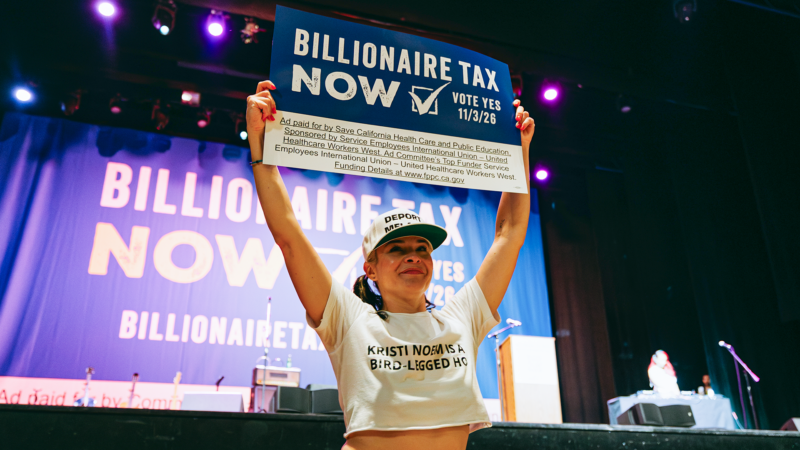
In November, Californians will consider a ballot measure to implement a 5 percent wealth tax on billionaires, which proponents say will generate $100 billion in revenue. It turns out the tax would probably cost the Golden State nearly $25 billion.
That's the result from a new study out of Stanford University's Hoover Institution, which was published earlier this week. In this study, researchers analyzed the reported and unreported departure of billionaires from the state, as well as flaws in the tax proponents' modeling, to find that the law would reduce revenue to the state's coffers.
"Over 100,000 simulations with varying discount rates, wealth tax revenues, and lost income tax revenues associated with departures, we find that 71% of scenarios in which the Act is instituted yields a negative [net present value], signaling the Act would generate a net cost to the state of California," the researchers wrote in a Thursday Substack post. The "average across these draws," they say, "is –$24.7 billion."
These results are not too surprising, considering the specifics of the ballot initiative. The measure would impose a (supposedly) one-time 5 percent tax on billionaire wealth to expand California's Medicaid program, which already costs the state over $45 billion a year; subsidize public education; and pay for public nutrition programs. It would also force billionaires to liquidate their wealth and investments, which would have negative consequences for employment, product quality, shareholder wealth and, consequently, the retirement accounts for many Americans.
Unfortunately for Californians, the impacts of the tax could be worse than what the Hoover team estimated. "Our income tax loss estimates are…conservative," the researchers say, because they assume that Californians with less than $1 billion in net worth will continue to pay "their California income taxes in full for the foreseeable future" rather than following billionaires out of the state, which is already happening.
Despite Gov. Gavin Newsom vowing to fight the tax, the proposed measure is already driving an exodus of the state's ultrarich. Google co-founders Larry Page and Sergey Brin, Palantir founder Peter Thiel, financier Don Hankey, film producer Steven Spielberg, and venture capitalist David Sacks have all fled the Golden State, many of them opting for tax havens like Florida and Texas. In January, venture capitalist Chamath Palihapitiya estimated that $1 trillion of billionaire wealth had preemptively fled the state before its tax obligation date of January 1, 2026.
The Stanford study is not the first to point out the obvious flaws with California's billionaire tax. A January analysis from the Tax Foundation found that, if the initiative passes, "California must brace for an exodus of founders and investors fleeing not just extraordinarily high tax burdens, but also the potential loss of the companies they created," as well as "a loss of jobs, startups, investment capital, and economic growth."
The Hoover study isn't all bad news for the tax's supporters; the researchers "estimate that the Act will collect approximately $40 billion in wealth taxes." While this might seem like a windfall, it's anything but, when one considers the lost income and tax revenue of $3.3 billion to $5.8 billion annually, as the researchers do.
"Even if one of the 29% of scenarios in our modeling where the [net positive value] is positive come to fruition, the amount of present value revenue would still be small," the researchers write. "Ultimately, taxation does not occur in a vacuum. If Californians approve this measure in November, they may discover too late that the wealth they hoped to tax has already left the state—with jobs and economic opportunities not far behind."




