
Politicians Consider Soviet-Style Controls on 3D Printers
Panic over guns drives government officials to propose restricting popular technology.
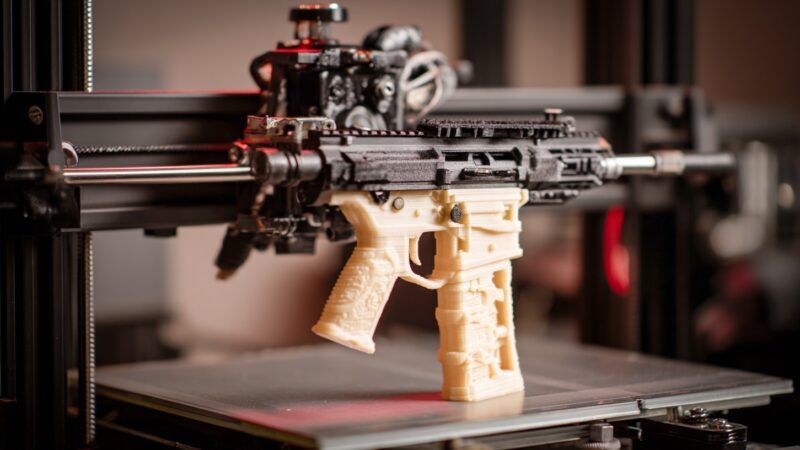
The old Soviet Union strictly controlled photocopiers, because they empowered individuals to share ideas that challenged state control. The restrictions ultimately broke down under the weight of mass defiance as people took advantage of every opportunity to distribute that which was forbidden by the government. Now, politicians in several states are channeling totalitarian policies of the past, this time with their eyes on 3D printers that can manufacture gun parts. Their intrusive rules are likely to suffer the same humiliating fate.
You are reading The Rattler from J.D. Tuccille and Reason. Get more of J.D.'s commentary on government overreach and threats to everyday liberty.
Making Your Printer an Agent of the State
"A new bill proposed in the California State Assembly could potentially require the makers of 3D printers to confirm that they are using algorithms or other technologies to prevent the printing of firearms," Bruno Ferreira reported last week for Tom's Hardware. "As with the Washington and New York bills, circumvention of these measures would be made illegal."
3D-printed guns have been a bugaboo of many politicians ever since Cody Wilson printed the first single-shot Liberator pistol in 2013. Wilson now sells the Ghost Gunner CNC (computer-controlled) milling machine that can produce gun parts—or anything else users want to make. And 3D-printed gun designs have moved on to semi- and full-automatic designs like the FGC-9 and Urutau that combine printed parts with components readily available from hardware stores anywhere on the planet. Among other uses, Myanmar rebels have deployed 3D-printed firearms to fight that country's authoritarian government.
Writing in The New York Times in 2024, Lizzie Dearden and Thomas Gibbons-Neff claimed that 3D-printed firearms are bringing the "American brand of libertarianism" to the whole world—that is, 3D printers (and CNC machines like the Ghost Gunner) empower individuals to challenge the state with the tools of self-defense just as photocopiers did with the printed word.
Copying Failed Soviet-Era Controls
"Since their introduction into the Soviet Union, photocopiers have been kept behind locked doors. Documents are carefully screened, copies closely counted and logs dutifully and routinely kept," the Deseret News noted in 1989 as that creaky totalitarian system entered its final days. But the story reported a failure of restrictions, not a success, as "Moscow officials recently conceded that controlling the reproduction of information has simply outstripped government resources."
Even before photocopier restrictions, the Soviet Union registered typewriters in a vain effort to control the dissemination of information. Officialdom lives in fear of any technology that empowers individuals. That concern applies, logically enough, not just to technology that eases the reproduction of information, but to any that simplifies the task of producing usable items.
In a 2018 RAND Corporation report on additive manufacturing (3D printing), authors Trevor Johnston, Troy D. Smith, and J. Luke Irwin observed that "the simplicity and low cost of AM machines, combined with the scope of their potential creations, could profoundly alter global and local economies and affect international security." They foresaw printers producing everything from "soles for Adidas shoes to replacement parts for nuclear weapons and the International Space Station." But they also pointed out that "point-of-sale consumption will no longer be an opportunity for governmental control of risky goods, such as firearms and drones."
Officials Panic Over Empowering Technology
That's exactly what governments in places like California fear. They've inflicted laws on the state that restrict who can own firearms and what firearms can be owned, and dictate bureaucratic hoops people must jump through to comply. In recent years, people have responded by making use of their skills, new technology, and black-market connections to acquire DIY "ghost guns."
"Law enforcement agencies across California are recovering record numbers of ghost guns," Alain Stephens reported in 2019 for The Trace.* "According to the ATF, 30 percent of all guns now recovered by agents in the state are unserialized."
At that time, California law already required state residents to register homemade guns but "compliance with the law is low," Stephens noted.
So, California moved on to targeting the technology that helps people produce what they want beyond state control, just as the Soviet Union went after photocopiers. This month, California Attorney General Rob Bonta and San Francisco City Attorney David Chiu sued private distributors of computer files that contain designs for gun parts, like Gatalog Foundation Inc. That's like taking publishers of "how-to" books to court.
"Gatalog is distributing blueprints for some of the world's most dangerous and untraceable weapons," complained Chiu.
Yes. And even before the internet, encyclopedias printed recipes for gunpowder. That's freedom.
But the attempt to regulate 3D printers doesn't just target publishers. It seeks to reach into homes, businesses, and workshops to control what people can do with the tools they purchase—Soviet-style. And California's efforts to regulate 3D printers echoes similar legislation in Colorado, New York, Washington, and elsewhere. Some of the bills, such as California's A.B. 2047, mandate that printers use algorithms to detect designs for forbidden objects. It would be "unlawful to knowingly disable, deactivate, uninstall, or otherwise circumvent any firearm blocking technology."
Workarounds 'Would be Easy To Develop, Distribute, and Implement'
It's easy to anticipate a contest between publishers of such files, looking to protect them from detection, and the algorithms' creators—inevitably resulting in false detection of "gun" files that are really designs for perfectly legal items. Inevitably, even people with no interest in firearms will jailbreak their printers, or illegally acquire unrestricted printers from out of state, to escape crippling controls
"Accurately identifying gun parts is incredibly hard, and the hackable nature of desktop 3D printers makes it trivial to circumvent any requirements to try," warns Michael Weinberg, Executive Director of New York University's Engelberg Center for Innovation Law and Policy.
He added that "any attempt to identify gun parts will miss many parts that are actually for guns, and may flag a number of parts that have nothing to do with guns." Meanwhile, "workarounds for a screening mandate would be easy to develop, distribute, and implement."
But that doesn't mean politicians won't try to cripple tools and technology that empower individuals. In doing so, they'll inconvenience not just people who want to evade the law, but anybody who sees value in the power to produce parts on demand. Such restrictions will make workarounds attractive and even necessary for everybody.
Soviet-style photocopier restrictions ultimately failed because they were intrusive and unwieldy, and people committed to evading them. Controls on 3D printers are destined to meet the same end.
*UPDATE: A characterization of The Trace has been removed.
