
How Communists Conquered China
The evidence tells a different story than you’ll find in the party's triumphant propaganda.
China was hermetically closed for decades after the Communist Party came to power in 1949. Even today, access to primary sources, not least party archives, remains haphazard at best. The party controls history, not only its own but also that of its erstwhile rivals.
Despite these restrictions, a formidable enterprise undertaken by the party from 1981 through 1989 offers us a window into the past. The Central Party Archives, under the control of the Central Committee, working in collaboration with provincial archives from every corner of the country, produced well over 300 volumes containing original party documents from 1923 to 1949. The volumes were printed in a limited edition with restricted circulation, meaning that they were intended for the eyes of senior party members only. Yet even though they could not be purchased in bookshops or consulted in public libraries, they found their way across the border into Hong Kong.
At 400–600 pages per volume, the collection represents an unparalleled foundation for anyone wishing to unearth more about the history of the Communist Party. Yet somewhat paradoxically, it has had only sporadic use by historians. The reason, perhaps, lies in another paradox: What becomes abundantly clear in one document after another is how marginal the Communist Party was in the history of China from its foundation in 1921 to the end of the Second World War in 1945. In Wuxi, the industrial city north of Shanghai where steam whistles and electric sirens alerted more than 100,000 workers to their shift, the party had just 25 members in 1929. One may point to relentless and bloody repression, but even before the Communists were forced underground in April 1927, the province of Zhejiang, with a population of 20 million, had no more than 2,600 members (roughly one in 7,700 people). Countless reports from other parts of the country complain of party members rarely paying their dues, displaying little interest in ideology, attending few meetings, and squandering local resources. Disciplined Marxist-Leninists they were not.
Some party branches existed merely on paper, as their representatives inflated numbers to claim more resources from the central authorities. Almost every European country, with the exception of Nazi Germany, boasted a larger number of Communists as a proportion of their overall population than any province in China. Even Portugal, despite ferocious repression under António de Oliveira Salazar, had some 25,000 members in 1934, or one person in 280, while in China before 1940 the figure was no more than one in 1,700, even if we accept the vastly inflated figures provided by the Comintern (the Communist International, an organization set up in 1919 in Moscow to promote worldwide revolution). This level was roughly equivalent to Communist membership in the United States, a country not generally considered a leader in the world Communist movement. Finland, where the party was illegal, boasted roughly 5,000 Communist Party members in 1935, equivalent to one in 700 people. Gansu province, a desperately poor part of the agrarian hinterland with 6.7 million inhabitants, claimed 264 adherents in 1939, not even one per 25,000 people. After an internal purge of members viewed as insufficiently committed to the cause, membership in Gansu dropped to 143 by the end of the year. Only after 1945 did the party begin to grow meaningfully.
Primary sources from foreign observers confirm the trend. One United States military attache, whose job it was to travel the country to assess the balance of military forces, pointed out in February 1934 that "belief in a danger from communism in China is not warranted by the facts": The party held less than 2 percent of China, excluding Mongolia, Manchuria, and Tibet. Among their possessions was the notorious Jiangxi Soviet, which issued its own stamps and currency, all bearing the image of the Communist leader Mao Zedong. The territory was poor, mountainous, and unproductive, and therefore highly undesirable. "Today not one large city, one port or one revenue producing area is under Communist control," concluded the attache.
The marginal nature of Communism would have been apparent to any newspaper reader in the republican era, a period of momentous change between the fall of the empire in 1911 and the advent of a Communist regime in 1949. Even key strategic moments were hardly frontline news, for instance the collapse in October 1934 of the Jiangxi Soviet after several campaigns of encirclement by the central government, forcing Mao and his followers to flee the region in a poorly organized retreat later called the Long March. One might suspect censorship, but the government was pleased to announce its victorious entry into Ningdu, Mao's red capital, on page 3 of the newspapers.
The voluminous reports filed by foreign consular authorities from every region in the country confirm the liminal position of the Communist movement. Competing for attention were a great many other organizations, from secret societies to local gangs and bandit groups, many preying on local villagers, a few recruiting them into their ranks. Some became large enough to act as a shadow government, finding a compromise with local communities and protecting them from other bandits. All along, well before the fall of the empire, suppression campaigns were intermittently launched, although they invariably came at a cost to the local population. Henan province—always poorer than its neighbours—had more than 50,000 bandits in the early 1920s, although Hunan had fewer than 2,000. As the consul general in Shanghai observed in 1920, local riots, mutinies of troops, and looting of towns chronically recurred in China. There were also constantly shifting relations and occasionally violent clashes between local, provincial, and central armies. There were full-fledged foreign wars, with a Sino-Soviet war involving hundreds of thousands of soldiers in 1929, not to mention Japan's 1931 invasion of Manchuria, followed by continuous infringements until war was declared in 1937.
Yet little of this is reflected in the existing literature. Whether scholarly volumes or popular books on the history of modern China, the narrative is all too often dominated by the Communist Party. At times it seems like a fairy tale: The country is racked by an unholy alliance of "imperialist powers" and "reactionary forces," the Communists mobilize the "peasants" by taking the land from the rich and distributing it to the poor, then they gradually unite the people in their fight against the Japanese invader and the fascist Nationalist Party, their arch-enemy led by Chiang Kai-shek. There is, no doubt, a great deal of variation, if not controversy, in this narrative, but at heart it follows the historical vision of the Chinese Communist Party.
The Communists did not wait until victory in 1949 to expunge the record and control the narrative. After they had wandered the south of the country in search of a new base for well over a year during the Long March, a mere 6,000 men and a few women arrived in northern Shaanxi in 1935. There they joined a roughly equivalent local force and established a new Red Army. After careful vetting, Mao invited Edgar Snow, a young, idealistic reporter from Missouri, to come and interview him. Every detail of the encounter was dictated: "Security, secrecy, warmth and red carpet." Snow spent several months at the Communist base, enthralled by the mythical version Mao offered of himself and his party. A few months later, an article appeared in the China Weekly Review in Shanghai, introducing the mysterious leader of the Chinese Communist Party to the rest of the world. Snow presented a ragtag group of red soldiers entrenched deep in the hinterland as a more viable alternative to the central government with its 1.7 million troops. Mao was the leader-in-waiting in a war of resistance against the Japanese invader.
It was all hubris. Red Star Over China, Snow's book-length account of Mao and the Communist Party, followed a year later, becoming an instant bestseller, translated into many languages. The book made Mao into a household name and became the basis for all subsequent accounts of the rise of the Communist Party, and by implication of the history of modern China. It is, at heart, a romantic tale of Communists fighting in the hills for freedom, a David and Goliath story in which sympathy goes to the boy with the sling.
Since the Communist Party controls the past, everything unrelated or inimical to its success has been consigned to oblivion. While its own party archives are replete with references to the Communist Youth League, a rival which was often far more popular, this organization, tasked with recruiting young people, is rarely evoked by official historiography in any detail. A whole range of alternative voices, including a rich tradition of democratic thought and practice that ran throughout republican China, has been relegated to the shadows after 1949. Nobody remains standing except Mao, armed with ideological conviction, against Chiang Kai-shek, fascist leader of the corrupt and brutal machine of government. Huge chunks of history have been censored, are entirely unknown, or remain untouched, and not just in the official historiography of the People's Republic. One can search the secondary literature in English in vain for a reference to the Sino-Soviet war of 1929, the largest military conflagration between China and a European power ever fought on Chinese soil. According to Michael Walker, who published a book on the topic in 2017, the list of historians of modern China who fail to mention the war in even a single sentence is "both long and impressive." Similar comments could be made about many other key events. As Robert Marquand pointed out, while history around the globe has been taken to task, queried, deconstructed, and reconstructed, China's triumphal version of its past "remains quaintly untouched," whether at home or abroad.
An abundance of primary material can help us navigate the murky waters of the past. Besides the enormous collection of internally circulated party documents mentioned above, one can consult the archives of the Nationalist Party, deposited on the outskirts of Taipei, as well as the personal records of Chiang Kai-shek. No study of the Communist movement in China can proceed without consulting the archival holdings of the Great Powers, not least Britain, France, and the United States. In Shanghai, the famous Sûreté, or Special Branch, had more than 2,000 staff, including special agents and translators. Part of their job was to keep tabs on Comintern agents, both local and foreign. Russian material is indispensable, including the holdings of the Comintern on China, made available in five volumes in Moscow from 1994 to 2007.
What emerges from an evidence-based approach? The keyword is violence, and a willingness to inflict it. Communism was never popular in China, no more so than in Finland or in the United States, and it was brought to the population at the barrel of a gun.
The Communist Party was founded in 1921 with help from the Comintern. The Comintern also had an interest in the Nationalist Party, a revolutionary organization established under a different name in 1912 after the Qing dynasty had been overthrown by a loose coalition of military leaders. These soon fell out, each controlling a different part of the country. Moscow offered men, money, and munitions, demanding in exchange that the Communists be allowed into their ranks. As the Nationalists set out to unify the country in a military campaign in 1926, the Communists in their midst encouraged mobs to loot and burn the property of wealthy merchants and landowners along the way. They also singled out foreigners as agents of imperialism, causing such havoc that Chiang Kai-shek was prompted to remove them from the ranks and end the alliance.
For years afterward, the Communists left a trail of destruction, surviving on loot and ransom as they laid siege to towns—burning government buildings, killing "class enemies," seizing their property, and distributing it to the troops. As the sources of plunder dried up and government forces came to the rescue, the Communists were forced to seek greener pastures elsewhere.
In 1930, the Communist Party began to change tack, attempting to hold territory in the hope of building up a conventional army. But they continually faced the same problem: how to abolish taxes and distribute the land in the name of communism while extracting enough revenue to feed their own troops. Time and again, they discovered that there was no magical surplus to be doled out. The result of land seizure was greater poverty for all, as farmers with even the slightest portion of wealth were forcibly dispossessed, scaring the others into hiding their assets and producing no more than the strict minimum required to survive. The Communists also carried out violent purges against an array of real or imagined enemies, whether villagers who spoke out against the regime's exactions or people suspected of fraternizing with the enemy. These tactics all militated against any productive economy, not to mention belief in the cause.
By 1936, after having been forced to meander through inhospitable terrain for over a year, both the Communist forces and their cause were spent. Moscow again intervened, saving them from annihilation. After Japan declared war in July 1937, Josef Stalin's Soviet regime began providing crucial logistical help to the Nationalists, who were once more forced to tolerate an alliance with the Communists.
Over the next few years, the Japanese army would do what the Communists were not in a position to accomplish, namely attack, destroy, or displace government troops from all major cities along the coast. The Communists, on the other hand, remained safely ensconced in the hinterland, a poor, dusty, and isolated mountain area on a loess plateau in Shaanxi province with a capital called Yan'an.
Violence was not merely incidental to the revolution. As Simon Schama observed of the French Revolution, violence was its engine from the very beginning, since revolutionaries undertake to demolish the old order. But a revolution is also based on a vision of a better future. The Communist Party made continual pledges and promises: Landlords would be reined in, foreigners booted out, capitalists held to account. In 1940, Mao published a pamphlet entitled On New Democracy, portraying the Communist Party as a broad front striving to unite all "revolutionary classes." He promised a multiparty system, democratic freedoms, and protection of private property. It was an entirely fictitious program, but one that held broad popular appeal, as tens of thousands of students, teachers, artists, writers, and journalists flocked to Yan'an in the following years. Soon after they arrived, the new recruits were forced to examine their own pasts and denounce each other. Thousands of suspects were locked up, investigated, tortured, purged, and occasionally executed, even as the propaganda continued to beam a message of justice and equality for all.
By 1945, Mao had fabricated a formidable propaganda machine, a tightly controlled party, and a sizable army of red soldiers, although he controlled only a fraction of the country. Stalin once more lent a hand, sending close to a million troops across the Siberian border to march toward Korea, occupying the strategically and industrially vital area of Manchuria along the way. The Russians stayed until May 1946, locking out the central government of Chiang Kai-shek, quietly handing over the countryside to the Communists and helping Mao transform his guerrilla fighters into a formidable fighting machine.
Attrition gradually emerged as the key approach, as the Communists showed greater determination than the government, waging a pitiless war of fire, famine, and sword. In May 1948, they began laying siege to cities in Manchuria, starving them into surrender. Changchun fell in October, after 160,000 civilians had died of hunger in a six-month blockade. Villagers, recruited under duress, were hurled in increasingly large numbers against enemy troops in what were called human waves, a tactic that would leave the United Nations troops overwhelmed a few years later in the Korean War. Throughout the civil war, which lasted from 1945 to 1949, millions of refugees tried to escape, pouring into government-occupied territory and burdening already stretched services to the breaking point. No one ever witnessed people fleeing toward Communist-controlled areas during the civil war.
Cities began to topple like dominoes, their leaders fearful of the consequences of resistance against the war machine built up by the Communists. Chiang Kai-shek and his government fled to Taiwan. By the end of 1949, after a long and bloody military campaign, the People's Republic of China was finally proclaimed. The Communist Party referred to its conquest of the country as a liberation.
For generations, historians have interpreted this "liberation" as a triumph of great social forces unleashed and harnessed by the Communists, who proposed a progressive vision more in tune with the spirit of the modern age. In reality, the Chinese Communist Party, not least their chairman, became more determined than their opponents in carrying out unrestricted warfare, devoid of any rules. They excelled in a very traditional pursuit of power, prevailing over their opponents through the amoral application of military strategy, including every ancient tactic prescribed by Sun Tzu and the other great strategists of the past: feign, lie, deceive, retreat, hit, run, sabotage; view everything as a means to achieving the end. And, when at long last in a position to attack, overwhelm the enemy in a war of relentless attrition. Most of all, believe in the cause.
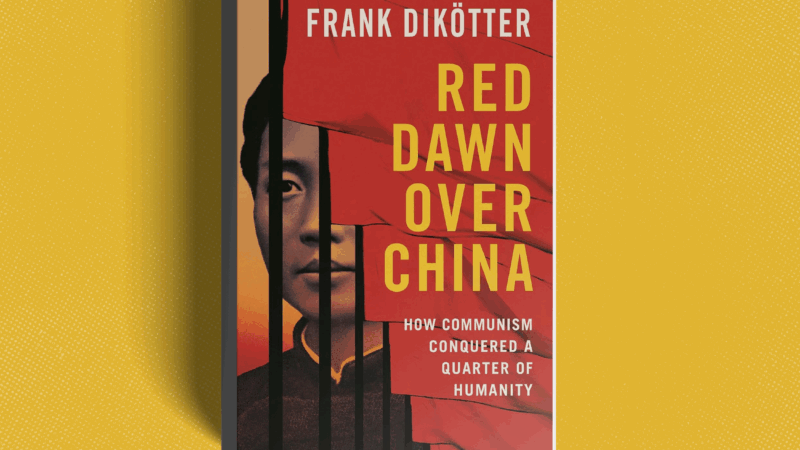
Adapted from Red Dawn Over China: How Communism Conquered a Quarter of Humanity (Bloomsbury), by Frank Dikötter. Copyright © 2026 by Frank Dikötter. All rights reserved.
