

D.C.'s Statue of a Confederate General Isn't What Its Critics Think It Is
Brigadier General Albert Pike is honored for his civic and philanthropic legacy, not his role in the Civil War.
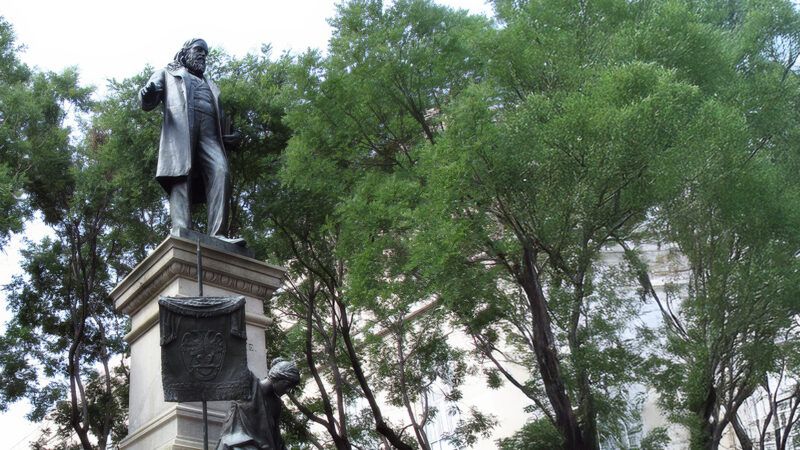
The National Park Service reinstalled Washington, D.C.'s only statue of a Confederate soldier in October 2025 as part of the Trump administration's effort to restore preexisting monuments in the capital. The depiction of Brigadier General Albert Pike was toppled by protesters in the summer of 2020, with many treating it as just another symbol of Confederate nostalgia. But it was erected to honor Pike's civic and philanthropic legacy, not his role in the Civil War.
Pike's bronze likeness was not donated by a Southern historical society or heritage league, nor funded by a Jim Crow–era government. It was privately commissioned by the Scottish Rite of Freemasonry of Washington, D.C., as part of a fundraising effort that began in the 1890s—years before the wave of Confederate monument construction. The statue honors Pike not for his service to the Confederacy but for his postwar work as a legal scholar, philanthropist, and advocate for the rights of indigenous tribes. This is emphasized by depicting him in civilian garb and holding a book rather than wearing his dress blues and brandishing a rifle.
Pike represented Native American nations in their claims against the federal government. He made various legal contributions in his home state of Arkansas, publishing The Arkansas Form Book, which helped standardize the state's legal codes. He also advocated for expanding access to quality education for those on the frontier.
The reaction to the reinstatement of Pike's statue ignores these other roles Pike played in American history and falsely lumps this specific monument in with every other Confederate memorial. Del. Eleanor Holmes Norton (D–D.C.), for example, referred to it as "morally objectionable" and "an affront to the mostly Black and Brown residents of the District of Columbia." Norton, who was at the forefront of attempts to move the statue as early as 1992, has again introduced legislation to permanently remove it.
The context surrounding the Pike statue is different from efforts in parts of the South to reerect Confederate war memorials and rename schools. It's an effort to restore the monument in alignment with its original purpose. In doing so, the National Park Service isn't celebrating Pike; it's complying with legal obligations to maintain, upkeep, and protect monuments located on federal land.
Public memory often shoehorns complex historical figures into two categories: virtuous heroes or irredeemable villains. This impulse depends on rejecting historical context in favor of theatrical certainty. Pike's life cannot be placed neatly into either box.
This article originally appeared in print under the headline "Why Did D.C. Reinstall a Confederate Statue?."

Editor's Note: As of February 29, 2024, commenting privileges on reason.com posts are limited to Reason Plus subscribers. Past commenters are grandfathered in for a temporary period. Subscribe here to preserve your ability to comment. Your Reason Plus subscription also gives you an ad-free version of reason.com, along with full access to the digital edition and archives of Reason magazine. We request that comments be civil and on-topic. We do not moderate or assume any responsibility for comments, which are owned by the readers who post them. Comments do not represent the views of reason.com or Reason Foundation. We reserve the right to delete any comment and ban commenters for any reason at any time. Comments may only be edited within 5 minutes of posting. Report abuses.
Please to post comments
Another example:
Jean Laffite was a pirate, a smuggler and a slave trader, and the US engaged him for critical help in the New Orleans campaign of the War of 1812. Not for nothing was he the most notorious Caribbean pirate ever. And he has a National Historical Park named for him: https://www.nps.gov/jela/index.htm
The pro-Confederates would have a lot more standing if they had erected statues of James Longstreet and William Mahone. They fought for the rights of freed people after the war. But even though both were legitimate Confederate heroes, and Mahone instrumental in the development of railroads in Virginia, there are almost no monuments to either. Pro-Confederates don't want non-racists to be remembered for good. Mahone committed the mortal sin of founding a multiracial political party and getting the poll tax repealed in Virginia. (It was brought back two decades later by Progressives, but that is another story!)
"reerect Confederate war memorials and rename schools"
Someone else on the internet suggested that we should rename Fort Hood and Fort Bragg for the Confederate generals in honor of their contributions to the ultimate Union victory. They were two of the worst generals either side had! Hood was successful at destroying an entire army at the battles of Franklin and Nashville -- his own! The battlefield site at Nashville is now mostly subdivisions; the Confederates don't want to be reminded of their deserved annihilation. (And the Union general who won those battles, George Thomas, was a Virginian who didn't turn traitor, making the defeat all the more embarrassing. A statue in his honor was recently dedicated in Fort Thomas, Kentucky.)
And like most CSA generals, served in the US army during the Mexican-American war. But libs probably hate that too because that is when 'the border crossed' all the illegals in America today.
Del. Eleanor Holmes Norton (D–D.C.), for example, referred to it as "morally objectionable" and "an affront to the mostly Black and Brown residents of the District of Columbia."
Brown? Tell me more about the 'brown' people slave trade in the US. Just goes to show you it is all performative. And the useful idiots just lap it up.


