

Iran Is Trying To Silence Dissent. Western Media Are Breaking Through Anyway.
Satellite broadcasting is a strategic counter to state censorship.
During his inaugural address, President Donald Trump declared that under his leadership, the U.S. would "stop all wars and bring a new spirit of unity to" the world. Thus far, he has mostly failed to deliver on this promise.
Since Trump's return to the White House, the U.S. has bombed Iran's nuclear facilities, conducted drone strikes on unsuspecting boats in the Caribbean, and extracted Venezuelan dictator Nicolás Maduro from his residence in the capital city of Caracas.
Now it appears that a new conflict could begin under Trump's watch. As Reason's Matthew Petti reported on Wednesday, "the United States is entering a self-inflicted crisis in the Middle East" with Trump ordering "a 'beautiful armada' into the region." The escalation comes after tense negotiations over Iran's nuclear program, regional policies, and domestic politics, according to Petti.
If the U.S. does intervene in Iran, it could be met with more cooperation from Iranians than it would have been in years past. In January, the country underwent weeks of protests fueled by the waning Iranian economy. "These protests are very pro-Western…and seem to be, you know, something that the United States might be able to contribute to," Iranian-British journalist Fardad Farahzad recently told Reason's Zach Weissmueller.
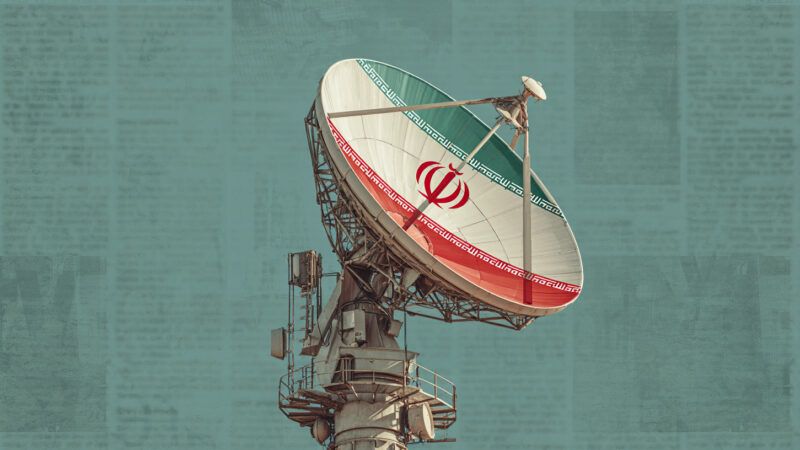
This pro-Western tilt has been driven, in part, by the Iranian regime's cutthroat media restrictions during this time of economic insecurity. Most outside media are censored, and Iran's domestic internet has been heavily restricted, an environment that has been amplified since January. Despite this blockade, the regime has not been able to stop all outside media from coming into the country. Farahzad's show, 24 with Fardad Farahzad, which airs on Iran International, has been able to come in with satellites. Despite the Iranian regime's attempts to jam the signal, it's technically impossible for it to block the entire country or all satellites. And even though it's illegal in Iran to have a satellite antenna, the vast majority of Iranians have one.
Farahzad's channel has been designated as a terrorist organization by the regime, namely because of its coverage of local protests and the Mojahedin-e Khalq—an Iranian opposition group with Marxist ties, which organizations such as CNN have also reported on—and the fact that Iran International takes some financial support from Saudi Arabia. This designation has endangered Farahzad, whom the regime was reportedly planning to assassinate in London in 2022. "You're basically risking your life, really," he said to Reason's Zach Weissmuller.
Iran tries to control media narratives. A recent media package by CNN's Frederik Pleitgen "gives a false picture of what's happening in Iran," according to Farahzad. In it, Pleitgen is led around in Tehran selectively and is only permitted to interview pro-regime witnesses about American intervention in the region. "This is a controlled environment; people are not free to express themselves," Farahzad said to Reason. The country is also one of the world's biggest jailers of journalists, according to Reporters Without Borders.
The situation in Iran is evolving rapidly. Amid what seem like stalled negotiations, threats of regional conflict that would further disrupt daily life for Iranians, and media and protest crackdowns, satellite network broadcasting such as Iran International and YourTime TV remain essential to everyday Iranians.




