
Washington's Millionaire Tax Is Economic Suicide
Washington has enjoyed decades of spectacular economic growth as a direct result of the absence of state income taxes. The new measure threatens to change all that.
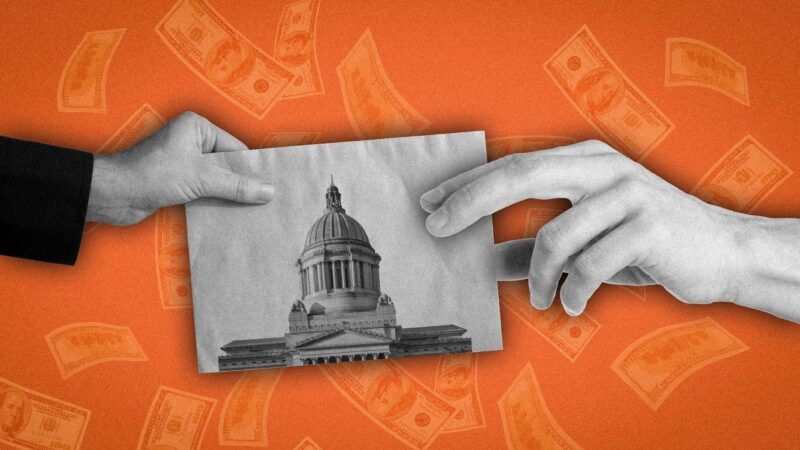
The state of Washington is contemplating passing a 9.9 percent tax on earned income over $1 million, which would remove it from the short list of states that do not have an income tax. Washington has enjoyed decades of spectacular economic growth and is home to some of the world's largest tech companies (including Microsoft and Amazon) as a direct result of the absence of state income taxes. The new measure threatens to change all that.
The state constitution currently prohibits an income tax. It treats income as "property," and the rules of taxation on property dictate that it must be applied evenly and capped at 1 percent (like traditional property taxes), unless voters approve it by supermajority at the ballot box. Washington passed a 7 percent tax on long-term capital gains above $250,000 in 2021, an action that was made possible by the strained legal argument that sales of securities constitute an excise on the exchange of capital assets. It's worth noting that the capital gains tax was really a bill of attainder aimed at one person: Jeff Bezos, and the Amazon founder escaped the taxes by changing his residency to Florida before the tax went into effect. The new proposed income tax, Senate Bill 6346, will treat capital gains as income, subjecting them to both the capital gains tax and the income tax.
To get around the unconstitutionality of the tax, which was established in a state Supreme Court case in 1933 (Culliton v. Chase), the state Supreme Court will have to overturn that case or re-characterize the millionaires' tax as an excise-based property tax. The latter was actually made more difficult with the passage of the capital gains tax, which was specifically based on transactions. The bill includes an "anti-referendum clause" that states that the tax is "necessary for the support of the state government and its existing public institutions," making the chance for repeal at the ballot box an uphill climb. It should also be pointed out that three state Supreme Court justices recently retired, allowing Democratic Gov. Bob Ferguson to significantly shape the court that will decide on the tax's constitutionality.
In fairness to the bill's architects, the tax is actually not a progressive tax, in the sense that there are brackets with successively higher tax rates. It is a flat tax that kicks in at $1 million of income. This tax is being framed as one that will only affect the rich, but without question, successive governments will introduce taxes at lower levels of income. The tax will facilitate a truly massive expansion of state government, as most new income taxes do, and will eventually touch virtually all Washington taxpayers, as all income taxes do. A 9.9 percent rate would be one of the highest in the country, below California and New York City, but comparable to New Jersey, Minnesota, and Hawaii. It will go from being a low-tax state to a punitively high-tax state overnight.
Georgia, Mississippi, Oklahoma, and Arkansas are all working toward reducing state income taxes with the goal of eliminating them entirely. Not coincidentally, these are Republican-dominated states. Rhode Island is in the process of raising income taxes, as are Virginia and, now, Washington. Not coincidentally, these are Democrat-dominated states. Red states are cutting taxes, and blue states are raising them. There is a saying in the financial world: Capital flows to where it is treated best. What we have seen since the Tax Cuts and Jobs Act in 2017 is a massive migration of people and capital to low-tax jurisdictions, after limitations were imposed on the deductibility of state and local income taxes. There is a reason why skyscrapers are going up in Nashville, Miami, and Austin. There is a reason why Florida, Texas, and much of the South have been on the receiving end of in-migration.
Another saying: There are no controlled experiments in finance. But there actually are: East and West Germany, North and South Korea, Chile and Argentina, and recently, Poland and the rest of Europe—low taxes, the rule of law, and property rights allow for economic growth and human flourishing. We have a controlled experiment playing out in real-time in the U.S. with the red and blue states. On a static basis, the blue states still have higher gross domestic product per capita, but the red states have higher growth rates and are catching up, while the blue states slowly lose their economic advantage. If New York City Mayor Zohran Mamdani gets his way and raises marginal tax rates to 16.8 percent in the city, the capital flight will accelerate, and it's possible that in 20 years, Miami will be the new financial center of the world.
As for Washington, the purpose of the millionaire tax is two-fold: as retributive justice, and a revenue grab. If it passes, it will succeed on both counts. Taxpayers with the means to relocate will, the tax will raise far less revenue than expected, and Washington will no longer be a sought-after destination for hungry entrepreneurs. It's not easy watching states commit economic suicide, but that's the benefit of America's system of governance: The states are free to compete for people, money, and resources.
