
Trump's Border Czar Tom Homan Demands Local Minnesota Jails Cooperate with ICE
Cooperation may get more ICE agents off the street, but it could make it harder for the state to enforce its laws.
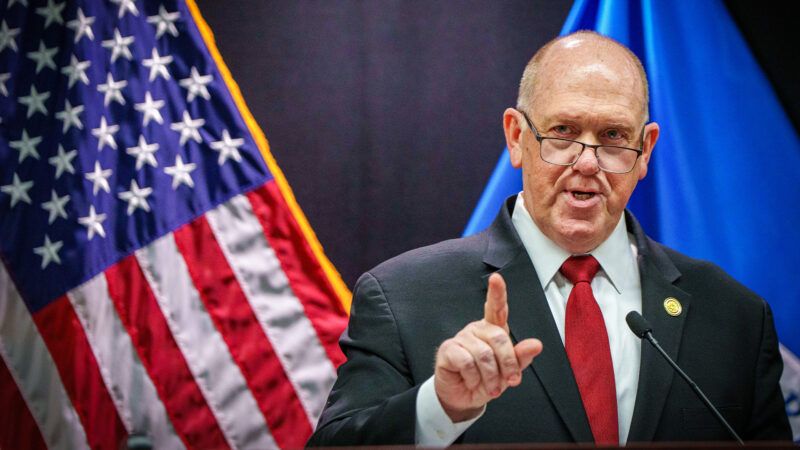
On Wednesday, President Donald Trump's border czar, Tom Homan, announced that 700 federal officers would be immediately withdrawn from Minneapolis following "unprecedented collaboration" between Immigration and Customs Enforcement (ICE), state prisons, and local jails in Minnesota.
Homan, who was sent to Minnesota last week to take over command of immigration operations after the fatal shooting of Alex Pretti, said during a Wednesday press conference that about 2,000 immigration officers will remain in the state. Although the ultimate goal is to return to the "normal operation footprint" of about 150 agents, Homan said ending Operation Metro Surge, the federal immigration crackdown in the Twin Cities, will require the "continued cooperation of state and local law enforcement and the decrease of the violence, the rhetoric, and the attacks against ICE and Border Patrol."
The decision comes shortly after news circulated this week that negotiations were underway to allow county jails to enter basic ordering agreements. Under these agreements, jails would be required to provide "reasonable access to all detainees or inmates" for immigration enforcement purposes and to potentially hold inmates for up to 48 hours after their scheduled release from custody at ICE's request, known as an immigration detainer, according to documents reviewed by the Star Tribune.
Such an agreement would reverse the policies that many Minnesota jails have been following since last year. In February 2025, Minnesota Attorney General Keith Ellison issued guidance, clarifying that state law "prohibits state and local law enforcement agencies from holding someone based on an immigration detainer if the person would otherwise be released from custody." But according to Homan, cooperation with ICE in Minnesota will not require county jails to hold anyone past their normal release time. Homan also emphasized that collaboration between ICE and jails is necessary for efficient immigration enforcement and fewer officers on the streets.
While it is true that local jails can significantly boost immigration arrest numbers, it remains unclear how many individuals in Minnesota's jails and prisons are subject to active ICE detainers. Although the Department of Homeland Security (DHS) claims that the state has more than 1,360 individuals with immigration detainers, state officials argue the number is closer to 300—the majority of which are in state prisons.
After reviewing 320 of the 486 people detained in the state who are listed on the DHS' worst of the worst database, Minnesota Department of Corrections Commissioner Paul Schnell said at least 68 had already been transferred to ICE from state custody, reports KARE11 News, a local NBC News affiliate. (Alarmingly, some of the names on this DHS list don't have any criminal history in Minnesota.) Schnell said the state will continue turning over inmates in its custody to ICE when the agency requests a detainer and as the inmates complete their prison sentence. He also said that his agency does not have the authority to transfer individuals any earlier. Doing so would effectively end their sentence, a move that would likely upset victims of violent crimes and their families, according to Schnell.
Questions also remain around how Operation Metro Surge will contribute to ICE's focus on "national security and public safety," according to Homan, particularly when it comes to local jails and individuals who have not yet been convicted of a crime. Having jails cooperate with ICE would more efficiently increase the agency's number of immigrant detainees by picking up undocumented immigrants already arrested by local law enforcement, but doing so undermines the criminal justice system and, by extension, public safety overall.
In December, for example, federal immigration authorities allowed Jeson Nelon Presilla Flores to self-deport, even though he had been charged in connection with a $100 million jewelry heist and had been in ICE custody since September. His deportation means Flores will effectively avoid trial, conviction, and any potential sentence, leaving victims frustrated and without closure.
It remains to be seen whether local jails will move to enhance their cooperation with ICE, and if Homan will respond by continuing to withdraw the roughly 2,000 agents still roaming the streets of the Twin Cities. These agreements may reduce the presence of armed federal agents in local communities, but could come at the cost of making it harder for the state to enforce its laws.
