
So Much for Abolishing the Department of Education
The Department of Education is getting a bigger budget, less than a year after President Donald Trump ordered the department's closure.
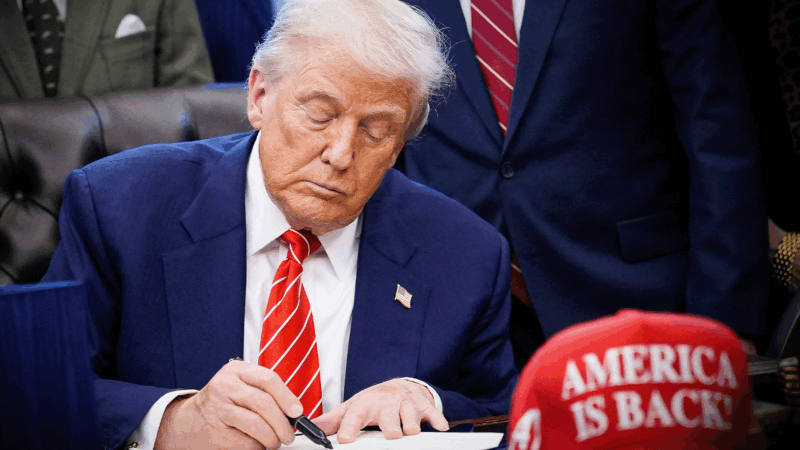
On the campaign trail in 2024, Donald Trump repeatedly pledged to close the Department of Education and return oversight of public schooling to the states.
Trump has a habit of throwing undercooked ideas around, but this wasn't one of them. Abolishing the Department of Education was part of the Republican Party's platform for the 2024 election, and was included in the goals of "Project 2025," the Heritage Foundation's blueprint for a conservative-controlled federal government in the wake of that election. That effort seemingly culminated with a March 2025 executive order signed by Trump that ordered Education Secretary Linda McMahon to take steps to close the department and return its functions to the states.
"I told Linda, 'Linda, I hope you do a great job in putting yourself out of a job.' I want her to put herself out of a job," Trump said at one point.
A year later, McMahon's job looks as secure as ever.
The omnibus appropriations bill that Trump signed on Tuesday to fund the federal government for the rest of the fiscal year directs $79 billion in taxpayer money to the Department of Education. That's a larger budget (by about $200 million) than the department had in fiscal year 2025, and it is $12 billion more than the Trump administration requested in its budget proposal for the year.
That's despite the fact that the department is in the process of offloading some of its programs to other parts of the federal government. In November, McMahon announced that the Office of Elementary and Secondary Education would be shifted to the Labor Department and the Indian Education Program would be moved to the Department of the Interior, among other things. Why does a smaller Department of Education require a bigger budget?
The bill Trump signed also includes language that prohibits parts of the department from being downsized or decentralized.
"None of the funds provided by this Act…may be used for any activity relating to implementing a reorganization that decentralizes, reduces the staffing level, or alters the responsibilities, structure, authority, or function" of the Education Department's budget office, the law reads.
The act also mandates that the department "shall support staffing levels necessary to fulfill its statutory responsibilities including carrying out programs, projects, and activities" funded by Congress.
Elsewhere, it also stipulates that "none of the funds made available in this Act may be transferred to any department, agency, or instrumentality" other than the ones indicated by the appropriations. That would seem to preempt the Trump administration's efforts to offload Education Department programs to other parts of the government.
None of that sounds like abolishing the Department of Education or returning its duties to the states. Indeed, even the attempt to shuffle the department's responsibilities to other parts of the federal government may now be stymied.
In one sense, this is a story about the obvious failure of Republicans in Congress and the Trump administration to follow through on a major promise made during and after the 2024 election.
It is also an illustration of the power of teachers' unions and other aspects of the educational bureaucratic complex, which were always going to fight to keep taxpayer dollars flowing.
And it is, ultimately, a lesson in the importance of making policy through Congress rather than relying on executive orders. Trump might have scored a temporary victory by signing that executive order in March of last year, but making serious changes in Washington will always require buy-in from lawmakers.
Several bills are floating around Congress that would significantly change or even abolish the Department of Education, but there seems to be limited support for those efforts. Rep. Thomas Massie's (R–Ky.) bill to terminate the department has 33 cosponsors, while Rep. David Rouzer's (R–N.C.) States' Education Reclamation Act has just a dozen cosponsors.
Without greater support in Congress, the effort to abolish the Department of Education was never very likely to succeed during Trump's term. Still, the department's bigger budget and the provisions restricting the already-limited efforts at diminishing the department's role are a disappointing reminder of the massive gap between the GOP's campaign trail rhetoric and the reality of what Republicans are delivering.
