
This California Family Is Suing for the Right To Drill for Oil on Their Own Property
“We’re standing up not just for ourselves, but for the principle that government must respect property rights.”
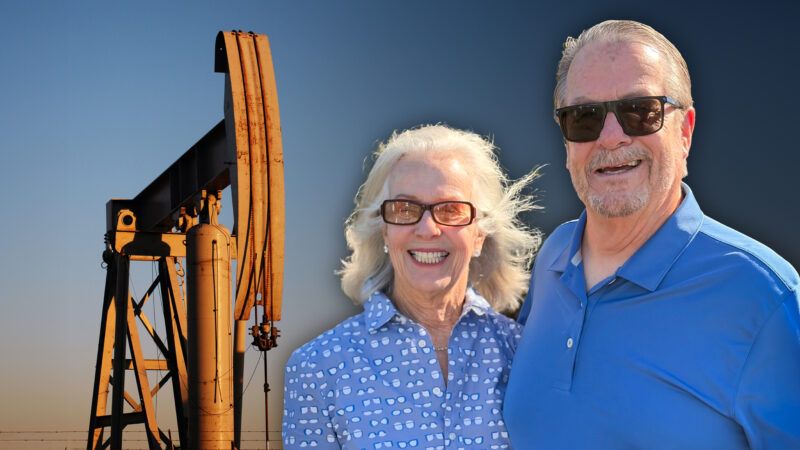
A lawsuit is underway in California, which could reshape energy production and property rights in the Golden State.
In 2022, Democratic Gov. Gavin Newsom signed Senate Bill (S.B.) 1137 into law, which prohibited oil and gas development within 3,200 feet of "health protection zones," including schools, homes, and hospitals. With the bill, California established the strictest setback limits in the nation—a title that was once held by Colorado, which prohibits fossil fuel drilling within 2,000 feet of homes and schools.
S.B. 1137, which went into effect in 2024, was sold as a solution to wean the state off fossil fuels and reduce pollution. Newsom described it as necessary to "protect California families." But not all Californians share the governor's sentiment. Last week, siblings John and Melinda Morgan filed a lawsuit against the state challenging S.B. 1137.
The suit centers around two parcels of land in Santa Barbara County that have been in the family for generations. After her husband built a successful career drilling oil wells in the Los Angeles area in the early 20th century, Helen Hancock—the Morgans' grandmother—established the Helen Leaf Hancock Trust. This trust was created to pass on generational wealth and included the mineral rights—but not the surface rights—to a pair of parcels in the Cat Canyon oil field, which now violate the 3,200-foot setback limit.
Owning the mineral rights to oil-rich land can provide a financial windfall to families. Unfortunately for the Morgans, capitalizing on these parcels has been a challenge. Throughout the years, oil companies have sought to develop the land, only to be stopped by the state. This includes attempts to plug and redrill existing wells on the land, and a proposed pipeline that was killed by the county.
Eventually, the Morgans were able to lease their mineral rights to two local oil and gas developers. The land, which has had some oil and gas drilling in years past, is not home to any active wells. Regardless, these companies have been paying the family a shut-in royalty, allowing the Morgans to cash in in the meantime. With drilling on these lands effectively outlawed, the two companies are "likely to abandon [their] lease[s]," according to the lawsuit, taking away a nest egg the Morgans were hoping to use in retirement and a legacy that they were hoping to pass on to their kids and grandchildren.
"It's like if someone gave you a car and said, 'Here, happy birthday,' and the next day they said you can't have it anymore," Melissa Morgan tells Reason.
"It's wiped out the entire estate," adds Paige Gilliard, an attorney at the Pacific Legal Foundation (PLF), a public interest law firm that is representing the Morgans in the case.
The lawsuit, which was filed in the U.S. District Court of the Central District of California, argues that by kneecapping the rights of property owners to meet its environmental goals, the state violated the Fifth Amendment's Takings Clause. This stipulates that private property cannot be seized for public use without "just compensation."
Based on Supreme Court precedent, it would appear that the Morgans have a strong case. In Pennsylvania Coal Company v. Mahon (1922), the Court determined that a regulation that prohibits a landowner from productively using their property violates the Takings Clause. Similarly, the Court ruled in Lucas v. South Carolina Coast Council (1992) that a regulation "goes too far" when it prohibits "all economically beneficial use" of a property. For the Morgans, who only own the rights to minerals beneath the ground of these parcels, the only economically beneficial use of this property is oil and gas extraction.
The clear property rights violations aside, there is a one-sidedness to the law that is also concerning: S.B. 1137 prohibits oil and gas extraction within half a mile of schools and homes, but if a town or developer wanted to build a school or home within 3,200 feet of an active oil rig, they could, which would shut down energy extraction in the process. Some might argue that the state forcibly ending this production and violating rights is necessary to address climate change. But this ignores the fact that California will continue to use oil regardless of the law and that the state prohibits the construction of the cleanest energy source available: nuclear power.
The Morgans also think this argument rings hollow. "We fully support responsible environmental stewardship, but good intentions can't justify taking away someone's property without compensation," they said.
The family may face a long legal battle before it receives relief. Luckily for them, they're not the only ones who are challenging the law. In January, the Justice Department also sued California, contending that S.B. 1137 would "'knock out' about one-third of all federally authorized oil and gas leases in California, amounting to unconstitutional state regulation of federal lands," reported Hayley Smith of the Los Angeles Times.
Regardless of the outcome of the case, the Morgans are hoping to show the state that "enough is enough."
"We're standing up not just for ourselves, but for the principle that government must respect property rights enshrined in the Constitution," they added.
