
Drug Dogs Should Not Be Unleashed To Authorize Apartment Searches, a SCOTUS Brief Argues
The 4th Circuit held that the doorstep of an apartment did not qualify as protected "curtilage" under the Fourth Amendment.
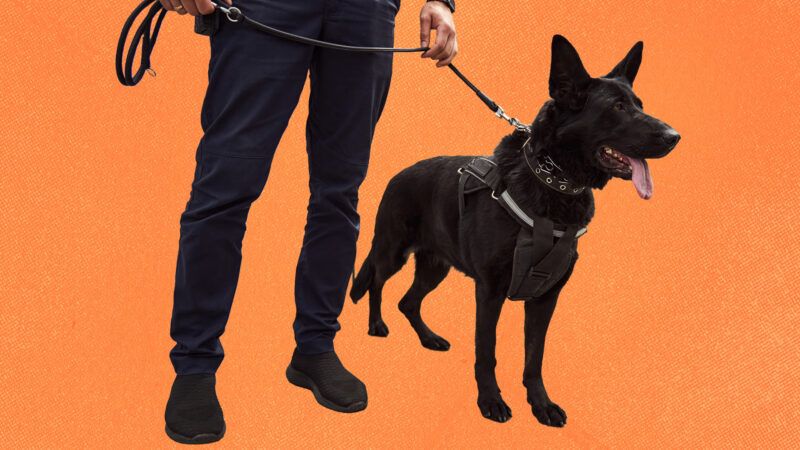
In the 2013 case Florida v. Jardines, the Supreme Court held that police violated the Fourth Amendment when they deployed a drug-detecting dog on the front porch of a house without a warrant. But last year in United States v. Johnson, the U.S. Court of Appeals for the 4th Circuit said that was not true when police deployed a drug-detecting dog at the doorstep of an apartment.
The 4th Circuit was wrong, the Cato Institute argues in a brief urging the Supreme Court to review that decision. The appeals court's ruling "impermissibly curtails constitutional protections in the domestic setting where they matter most," say Cato lawyers Matthew Cavedon, Dan Greenberg, and Laura Bondank. "This Court has repeatedly explained the importance of Fourth Amendment protections for both the home and the area 'immediately surrounding and associated with' it."
The special status of that area, known as the "curtilage," was the justification for the Supreme Court's ruling in Jardines. Contrary to what the 4th Circuit held, Cavedon et al. argue, "the fact that other tenants have access to a common hallway—one steadfastly locked against outsiders who might seek to enter—does not remove the privacy afforded to the curtilage."
The case involves Eric Tyrell Johnson, a Maryland man who was convicted of federal drug and gun charges based on evidence discovered during a 2019 search of his apartment in Owings Mills. The warrant for that search, in turn, was based on a dog's "alert" after it sniffed the bottom of the door to Johnson's apartment. Johnson unsuccessfully sought to exclude the evidence from the search by arguing that the dog should not have been brought to his doorstep without a warrant.
That argument seems consistent with Jardines. "The officers were gathering information in an area belonging to [Joelis] Jardines and immediately surrounding his house—in the curtilage of the house, which we have held enjoys protection as part of the home itself," Justice Antonin Scalia wrote in the majority opinion. "And they gathered that information by physically entering and occupying the area to engage in conduct not explicitly or implicitly permitted by the homeowner." Quoting the Court's 1986 decision in California v. Ciraolo, Scalia noted that "this area around the home is 'intimately linked to the home, both physically and psychologically,' and is where 'privacy expectations are most heightened.'"
The 4th Circuit did not think that principle applied to the area immediately in front of Johnson's apartment. "It distinguished the recessed alcove outside the front door of Johnson's apartment home from the front porch of a single-family home, holding that the curtilage doctrine does not afford Fourth Amendment protections to the former," Cavedon et al. note. That distinction, they argue, gives short shrift to the privacy interests of people who live in apartments.
"For people living in apartment homes, the hallway is 'intimately linked to the home both physically and psychologically,'" Cavedon et al. write. "A hallway in an enclosed, multi-unit apartment building 'is not a public place.'" Rather, "it is a private space intended for the use of the occupants and their guests, and an area in which the occupants have a reasonable expectation of privacy." For many people, "the locked apartment building offers a respite from the outside world," the Cato brief notes. "It excludes all but a small number of neighbors, invitees, and staff."
Cavedon et al. warn that "denying people living in apartment homes the full-fledged protection of the curtilage would impact millions of Americans." In this case, they note, "the police obtained a warrant based on the dog alert, broke in Johnson's front door with a battering ram before 5 o'clock in the morning, and comprehensively searched his home. All of this would have been plainly unconstitutional under Jardines had the dog sniff occurred instead at the front door of a single-family home."
The insecurity blessed by the 4th Circuit disproportionately affects "poor, black, Hispanic, and disabled Americans" because they are especially likely to live in apartments, Cavedon et al. note. And it is especially troubling in light of the Supreme Court's prior rulings in cases involving drug dogs.
In the 1983 case United States v. Place, which involved a luggage search at an airport, the Court held that an inspection by a canine narc does not qualify as a "search" under the Fourth Amendment because it reveals nothing more than the presence of contraband, possession of which does not implicate any legitimate privacy interests. The Court reiterated that conclusion in the 2005 case Illinois v. Caballes, approving the use of drug dogs during routine traffic stops, provided it does not "unreasonably" prolong the driver's detention. And in the 2013 case Florida v. Harris, the Court explicitly held that an alert by a properly trained dog is enough, by itself, to supply probable cause for a vehicle search.
Those conclusions are dubious, the Cato brief argues. "The Court's precedent concerning dog sniffs ignores the role these play in triggering comprehensive searches," Cavedon et al. write. "That precedent is also undermined by recent evidence showing that the infallible drug-detection dog is a myth."
In practice, police dogs frequently alert even when drugs are not present, whether because of residual odors, confusion of one odor with another, or conscious or subconscious cues from their handlers. The Cato brief mentions a drug dog in Washington state that always alerted to vehicles during traffic stops, triggering searches that found drugs just 29 percent of the time. That dog "is not an outlier," Cavedon et al. say, noting research finding false-positive rates as high as 80 percent.
This evidence, the Cato brief argues, suggests the Supreme Court erred in concluding that "drug-detection dogs reveal nothing but contraband in which a person has no legitimate privacy interest." It also suggests the Court was wrong to treat a dog's alert as sufficient for probable cause, which requires a "fair probability" that contraband will be discovered. Depending on the circumstances, University of North Carolina at Chapel Hill law professor Richard E. Myers has shown, even a well-trained dog could be wrong more than 80 percent of the time.
The Supreme Court "has never extended Place and Caballes to the home context, and in the years since those decisions, judges and scholars have recognized the untenability of those decisions' assumptions about drug-detection dogs," Cavedon et al. write. "As a matter of law, dog alerts end up exposing private areas, and as a matter of fact, they often occur even where there is no contraband. Yet the Fourth Circuit chose to extend Place and Caballes to the home, finding that 'a dog sniff is not a search—period.' Without intervention by this Court, nothing will stop law enforcement from routinely using dog sniffs as the key to unlock Americans' apartment homes. These decisions should not be unleashed for the home setting."
The implications of the 4th Circuit's reasoning are far-reaching, since multi-unit buildings account for more than a quarter of the country's housing. "Homes under a common roof should enjoy the same Fourth Amendment protections as those beneath their own eaves," the Cato brief concludes. "The people who live within apartment homes, whether due to the accidents of life or the realities of need, are no less entitled to constitutional privacy than are householders."