

Deploying Troops to U.S. Cities Cost Half a Billion Dollars in 2025
Maintaining a uniformed domestic security force is pricey in terms of life, liberty, and dollars.
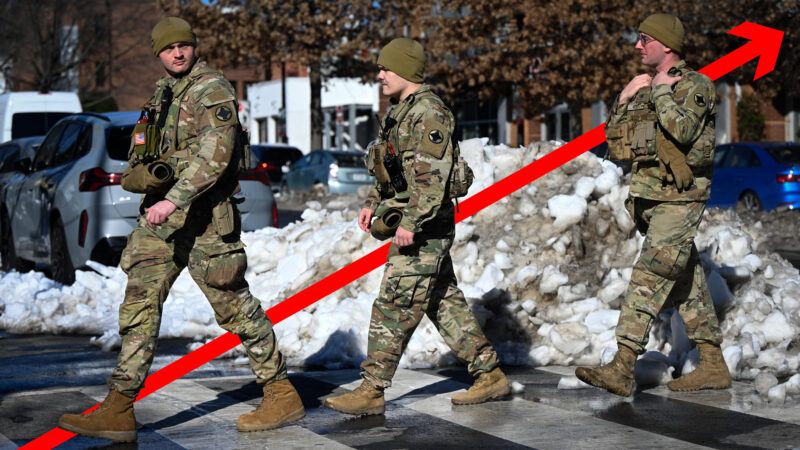
After threatening to invoke the Insurrection Act to put down sometime-violent protests in Minneapolis with military force, President Donald Trump appears to have backed off, standing-down the troops slated for deployment. That's a win for domestic peace, reducing the chances of worse conflict on city streets than we've already seen over the past year. It's also a boon for taxpayers, given the high price tag—a half-billion dollars to date—that comes with deploying soldiers to patrol American communities.
You are reading The Rattler from J.D. Tuccille and Reason. Get more of J.D.'s commentary on government overreach and threats to everyday liberty.
Military Occupation of American Cities
In response to vigorous resistance to the Trump administration's often-brutal immigration enforcement, the federal government several times deployed National Guard and active-duty military personnel to American cities. In the name of suppressing crime (in the nation's capital) and protecting federal personnel and property, the president sent or attempted to send troops to Democrat-led cities including Chicago, Los Angeles, Memphis, Portland, Oregon, and Washington, D.C. The deployments look as much like schemes to humiliate the president's political opponents as they resemble enforcement of federal policy.
Judicial responses to the deployments have been mixed, though leaning toward deep skepticism. A federal judge ruled that use of the National Guard and Marines in Los Angeles violated the Posse Comitatus Act, which restricts domestic use of the military. The U.S. Supreme Court blocked military deployments to Chicago, also with reference to the limited permissible use of the military. Now, with tensions rising, the White House looks to be pausing its efforts to militarize immigration enforcement.
Given the conflict we've already seen related to immigration enforcement, including the shooting deaths of Renee Good and Alex Pretti by federal agents, that's a relief to those of us hoping to avoid worse social unrest and to avert—or at least delay—what appears to be a looming national cataclysm. But at a time of rising federal deficits and debt and semi-serious attempts to slash government expenditures, stepping back from sending troops into the streets could also save money.
Deployments Come With a High Price Tag
"Since June 2025, the Administration has deployed National Guard personnel or active-duty Marine Corps personnel to six U.S. cities: Los Angeles, California; Washington, D.C.; Memphis, Tennessee; Portland, Oregon; Chicago, Illinois; and New Orleans, Louisiana," the Congressional Budget Office (CBO) responded to a query from Sen. Jeff Merkley (D–Ore.). "The Administration has also kept 200 National Guard personnel mobilized in Texas after they left Chicago. CBO estimates that those deployments (excluding the one to New Orleans, which occurred at the end of the year) cost a total of approximately $496 million through the end of December 2025."
The CBO analysis makes clear that calculating future costs is a bit speculative because of variables that are unknowable ahead of time. These include the size of potential troop deployments, duration of their stay, and expenses that might be greater or lesser depending on locations where troops could be sent. Also, legal challenges to the domestic use of the military might raise costs or lower them. That said, the CBO can look to costs incurred in 2025 and extrapolate to similar situations going forward.
The High Cost of Future Occupations
"The factors CBO used to estimate the costs of deployments in 2025 suggest that continuing the ongoing deployments at their size as of the end of 2025 would cost $93 million per month," the report noted. "More generally, deploying 1,000 National Guard personnel to a U.S. city in 2026 would cost $18 million to $21 million per month, depending mainly on the city's cost of living."
To arrive at its figures, the CBO looked at the cost of transporting, feeding, and lodging troops while they're deployed. In the case of National Guard troops the costs are particularly high because they are added to the federal payroll, while active-duty personnel are already being paid.
"When National Guard members are called to federal service, they are compensated at the same rate as personnel in the military's active component," the report explained. "Using DoD's 2025 budget documentation, CBO estimates that the increase in military personnel costs associated with activating National Guard troops—that is, the average increase in costs when changing Guard personnel from nonmobilized to mobilized status—is approximately $95,000 per person per year, or $260 per person per day."
Those costs aren't just a matter of pay; they also reflect the expense of benefits for Guard personnel and their dependents—healthcare, in particular—with such costs put at $9,100 per person per year, or $25 per person per day. Mobilizations, as the CBO points out, typically last longer than actual deployments. Each day Guard troops spend on duty brings them closer to qualifying for Veterans Administration benefits including education and disability (if they're injured while in uniform).
These costs add up. While the CBO puts the costs of new urban deployments between $18 million and $21 million per month in each city, maintaining the nearly 3,000 troops currently deployed to pricey Washington, D.C. comes in at $55 million a month.
Additional Costs to Life, Liberty, and Political Culture
Basically, maintaining a domestic security force to enforce locally unpopular policies and to intimidate political enemies is really expensive. It's an expense that raises tensions in a country already simmering with partisan hatreds, in which people openly discuss "national divorce" and don't debate whether America's near-term political future will be violent, but just how violent.
It shouldn't be forgotten that deploying military troops to patrol our own communities is expensive in terms of life and liberty, foremost. The lives lost—in Minneapolis and elsewhere—to conflict between the public and federal agents underline that point. And imposing something akin to martial law inherently makes a place and its residents less free than they are in the absence of such an occupation. That can only be justified in the most extreme circumstances, when order has been lost—a point hard to argue when it's the government and its agents who threaten order.
But at a time of a bloated federal government that spends wildly beyond its means, with the national debt at over $38 trillion and rising, it's important to emphasize that military occupation of our own cities is very expensive. We can't afford the government we have. Letting that government deploy troops to the streets is an unnecessary and unacceptable additional burden.




