Jeffrey Epstein Brokered Secret Meeting Between Qatari and Israeli Leaders
The late sex trafficker brought together former prime ministers from both countries while trying to help Qatar out of its diplomatic isolation.
Qatar and Israel are bitter rivals. While the Israeli government blames Qatar for backing "hatred, antisemitism and terror," the Qatari monarch accuses Israel of "genocide." And the war of words briefly became a hot war last year, as Israeli warplanes bombed Qatar to kill Hamas officials living there.
But in 2018, leaders from the two Middle Eastern states were brought together by one man: Jeffrey Epstein.
The late sex predator arranged an unreported meeting between former Qatari Prime Minister Hamad bin Jassim bin Jaber Al Thani and former Israeli Prime Minister Ehud Barak in 2018, files released by the U.S. Department of Justice on Friday revealed. (Al Thani, better known as HBJ, is a member of the Qatari royal family.) The meeting came as Epstein worked behind the scenes to resolve the 2017 crisis in the Persian Gulf.
In June 2017, Saudi Arabia and the United Arab Emirates blockaded and reportedly threatened to invade Qatar over its support for Islamist rebels and its hosting of Turkish troops, pitting U.S. partners against U.S. partners. Epstein, who cultivated extensive ties to leaders across the Middle East, tried to insert himself into back-channel negotiations to resolve it.
Neither Barak nor the Qatari embassy responded to a request for comment. Although HBJ, Barak, and other figures Epstein talked to about the crisis were out of government, Epstein clearly believed that they still had influence in the Gulf.
"I am keeping our primary goal in mind. in that regard I know that HBJ would like to sit with MBS in a face to face. . IF your guy can organize, i think it would be a good step," Epstein wrote in a July 2017 email to Anas al-Rasheed, a Kuwaiti professor who used to be a cabinet minister. (MBS is the nickname of Saudi Crown Prince Mohammad bin Salman.) That "goal" seems to have been an end to the split among Gulf states.
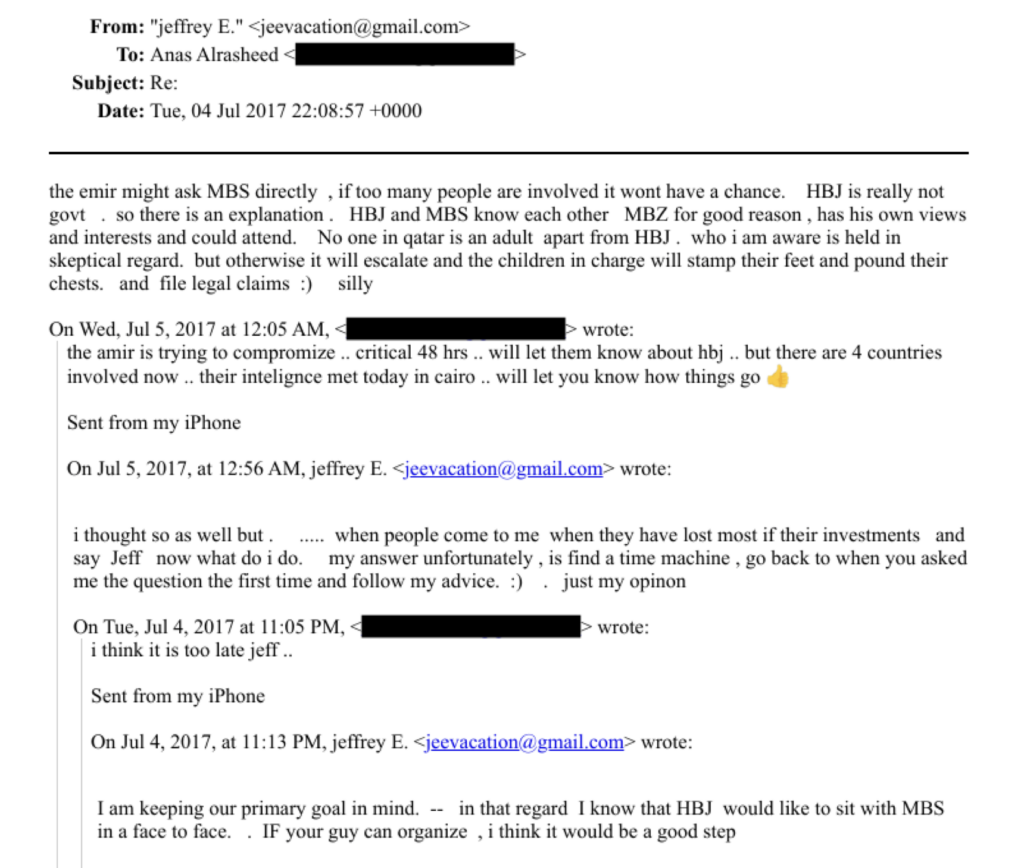
In a follow-up email, Epstein clarified that HBJ wasn't officially speaking for the Qatari government but was the only "adult" left in the Qatari elite. It's not clear from the emails whether the meeting between HBJ and MBS went through. Al-Rasheed did not respond to a request for comment.
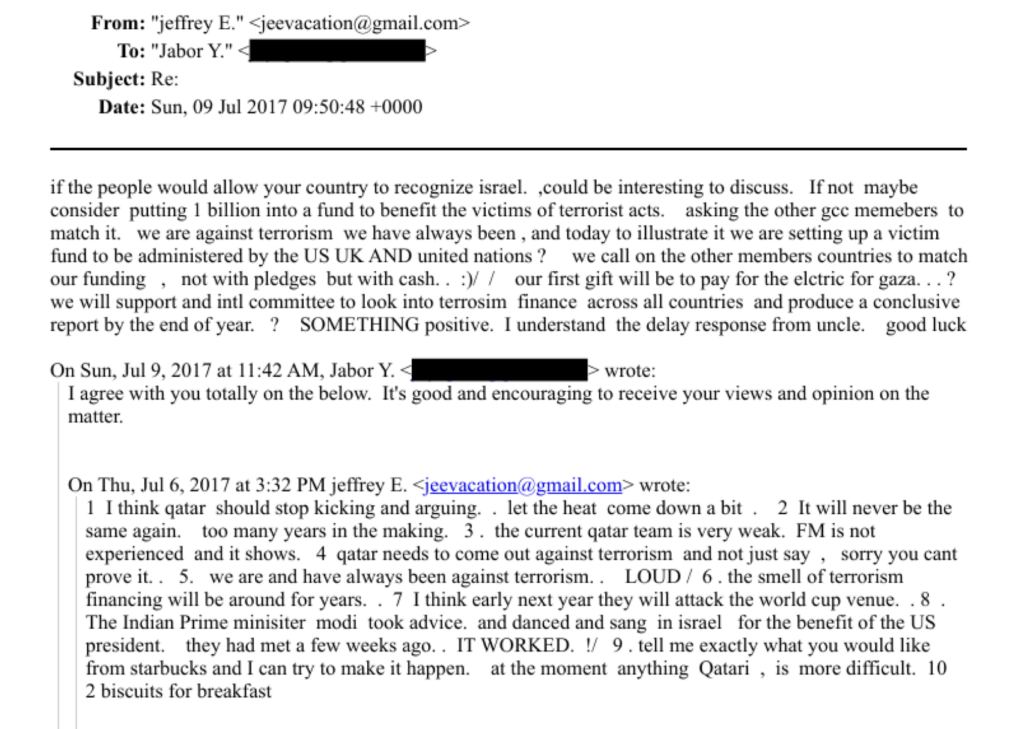
"I think qatar should stop kicking and arguing.. let the heat come down a bit," Epstein wrote to Jabor Y., a man who had previously managed Epstein's meetings with HBJ, in July 2017. Epstein implied that courting Israel could be the key to breaking out of Qatar's isolation.
Jabor Y. also appears under the name Jabor Al Thani in some emails. The files released by the Department of Justice include a permit request from Jabor Yousef Jassim Al Thani, a businessman and member of the royal family, for Epstein's private jet to land in Qatar. The same royal appears with Epstein in a set of photos released by congressional investigators last year. He did not respond to a request for comment.
"The Indian Prime minisiter modi took advice. and danced and sang in israel for the benefit of the US president. they had met a few weeks ago.. IT WORKED.!" Epstein added in that email. Indian Prime Minister Narendra Modi was visiting Israel at the time the email was written, a few weeks after Modi visited the United States. In other emails released on Friday, an Indian businessman with ties to Modi asked Epstein for help connecting India's "leadership" to figures in the Trump administration ahead of Modi's visit.
Epstein, who died while awaiting trial for sex trafficking in 2019, was similarly well connected to all sides of the Gulf. He befriended the influential Emirati businessman Sultan Ahmed bin Sulayem, who even ordered DNA test kits for the royal family of Dubai using Epstein's address. MBS reportedly gave Epstein a Bedouin tent as a welcome gift during a visit to Saudi Arabia. The emails released Friday show that Epstein was having real estate discussions with HBJ, who retired as Qatar's prime minister in 2013.
One of Epstein's close business partners was Barak, a decorated general who served as prime minister of Israel from 1999 to 2001 and as defense minister from 2007 to 2013. Epstein wrote to Barak in 2015 about his personal interest in the intersection between the business, military, and intelligence worlds.
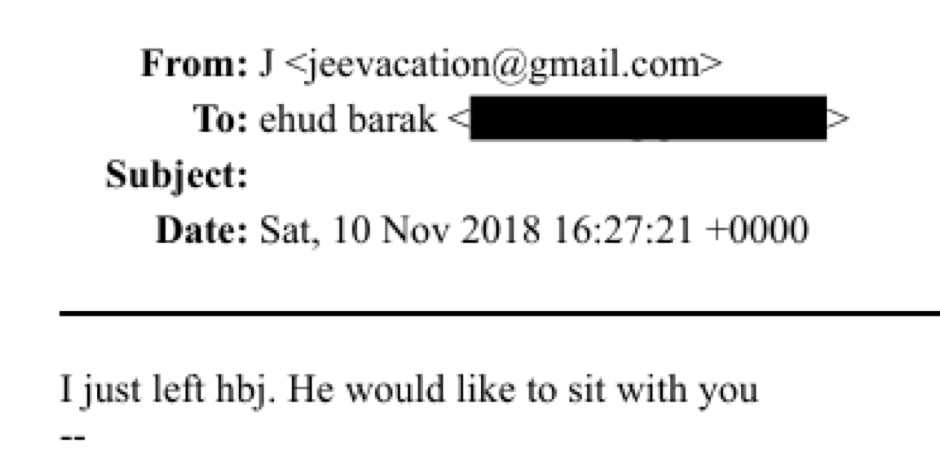
A little over a year into the Gulf crisis, Epstein brokered the meeting between HBJ and Barak. In November 2018, Epstein wrote to Barak: "just left hbj. He would like to sit with you." Then he wrote an email introducing Barak and Jabor Al Thani.
"So many=fascinating and disturbing events following each other on the global and o=r regional arenas. And so much to discuss," Barak wrote to Jabor Al Thani, noting that he had met HBJ in the past and was eager "to find a way to resume contact."
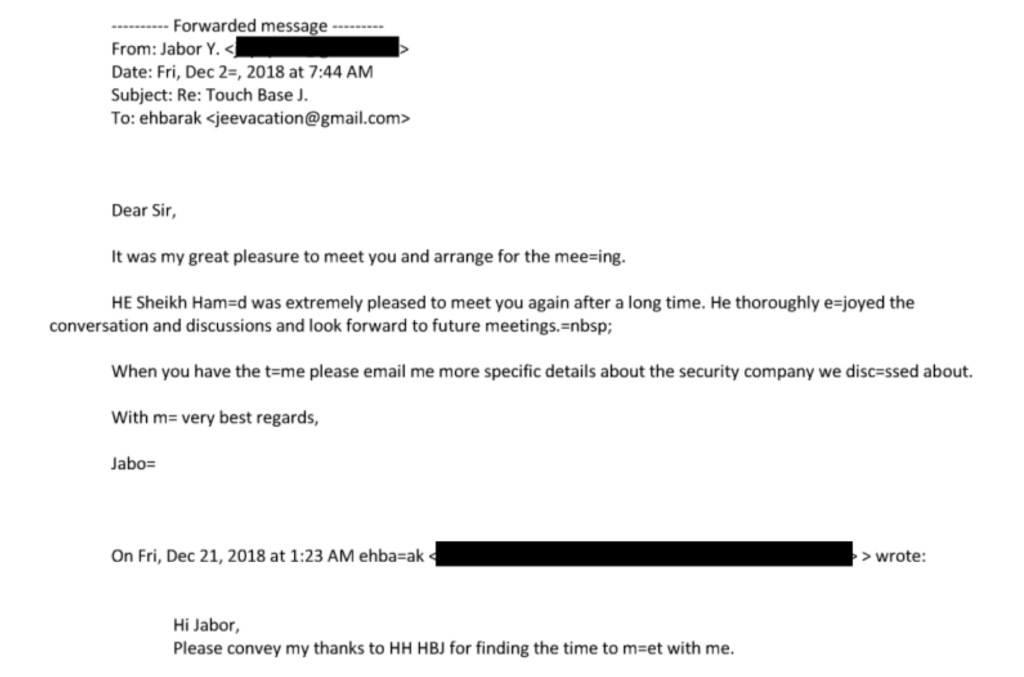
The group agreed that Barak would meet HBJ—without Epstein—on December 20 at One Hyde Park, an ultra-posh apartment building in London partially owned by HBJ. After the meeting, Jabor Al Thani wrote a thank-you note to Barak and CC'd it to Epstein. The only clue to the content of the discussion was Jabor Al Thani asking for "more specific details about the security company" they discussed.
At the time, Barak and Epstein were working together on a security tech startup called Carbyne, which promises to integrate emergency dispatchers with real-time location tracking and video surveillance feeds sourced from citizens' phones. (Barak left Carbyne in 2020.) Separately, Epstein was talking to bin Sulayem, the Emirati businessman, about expanding Carbyne into Dubai and having bin Sulayem join as an investor.
Yet the relationship was not just about making money; Barak and Epstein also used their business ties to set up diplomatic back channels. Blurring the lines between business deals, political leverage, and personal companionship was how Epstein operated. In 2010, when Epstein asked an unnamed associate about buying a Syrian or Lebanese bank, the associate wrote back, "I have a good contact in Syria…but sex better in Lebanon."
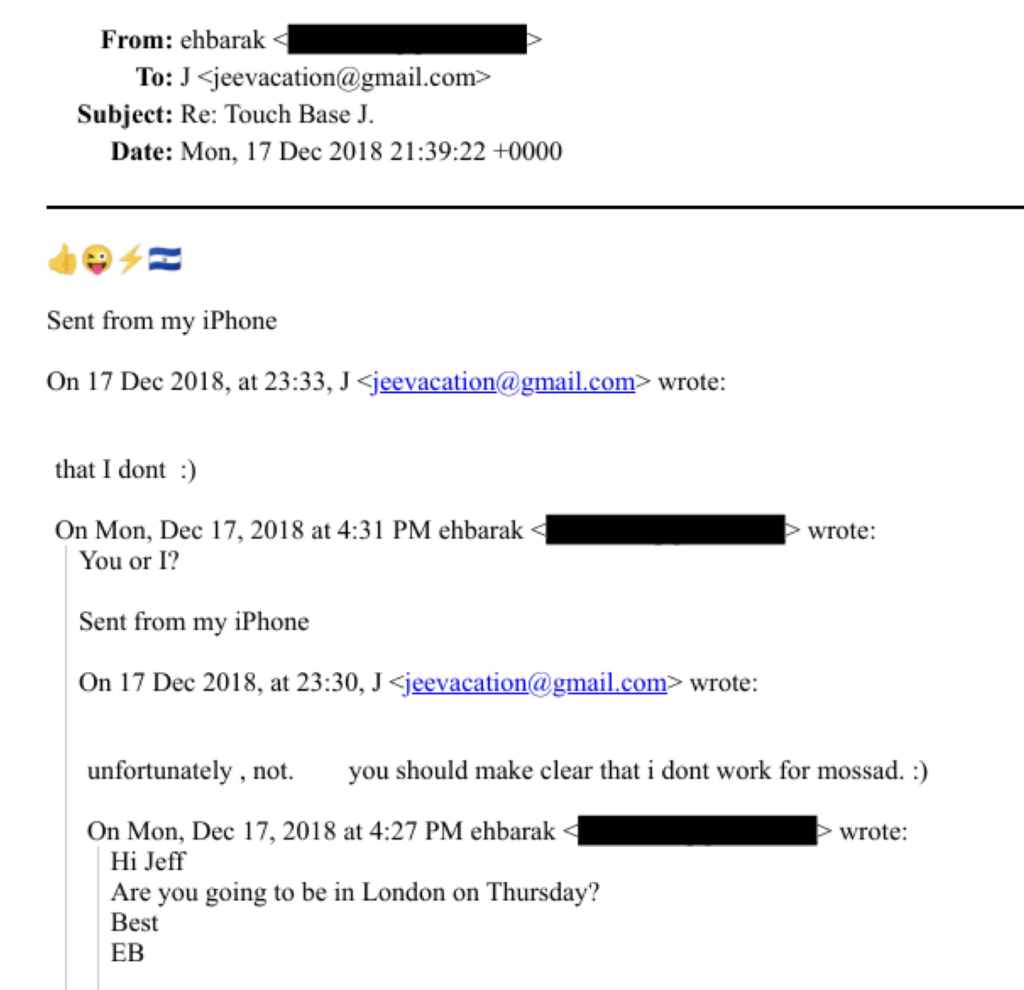
In emails leading up to the Barak-HBJ meeting, Epstein gestured toward the persistent rumors that he was a spy. He asked Barak to "make clear" to the Qatari side "that i dont work for mossad," the Israeli foreign intelligence agency. Epstein added a smiley face to the end of the message. Barak responded with a series of emojis: thumbs up, tongue sticking out, lightning bolt, and Israeli flag.
"Epstein tried to aggrandize his role and his activities and so on. I regret ever meeting him. I was introduced to him in 2003 in a public event with [the late Israeli Prime Minister] Shimon Peres and with hundreds of Americans," Barak told an audience at the Halifax International Security Forum in November 2025, in response to a question about Epstein's role in Israeli politics.
While Epstein was joking with Barak about being a Mossad agent, he was also working to cultivate some goodwill for Qatar with Steve Bannon, who had served as the Trump administration's chief strategist from January 2017 to August 2017. Bannon secretly met with Saudi and Emirati leaders just before they launched their blockade, and he publicly attacked Qatar after leaving the White House.
But he seemed receptive to Epstein's overtures on Qatar's behalf. "When you see Jabor you can tell him, I told you he is my arab brother. And tell HBJ that I told you that he and Ehud Barak are head and shoulders above the rest. They will then know you are family," Epstein wrote in a November 2018 text message to Bannon. "Done," Bannon replied.
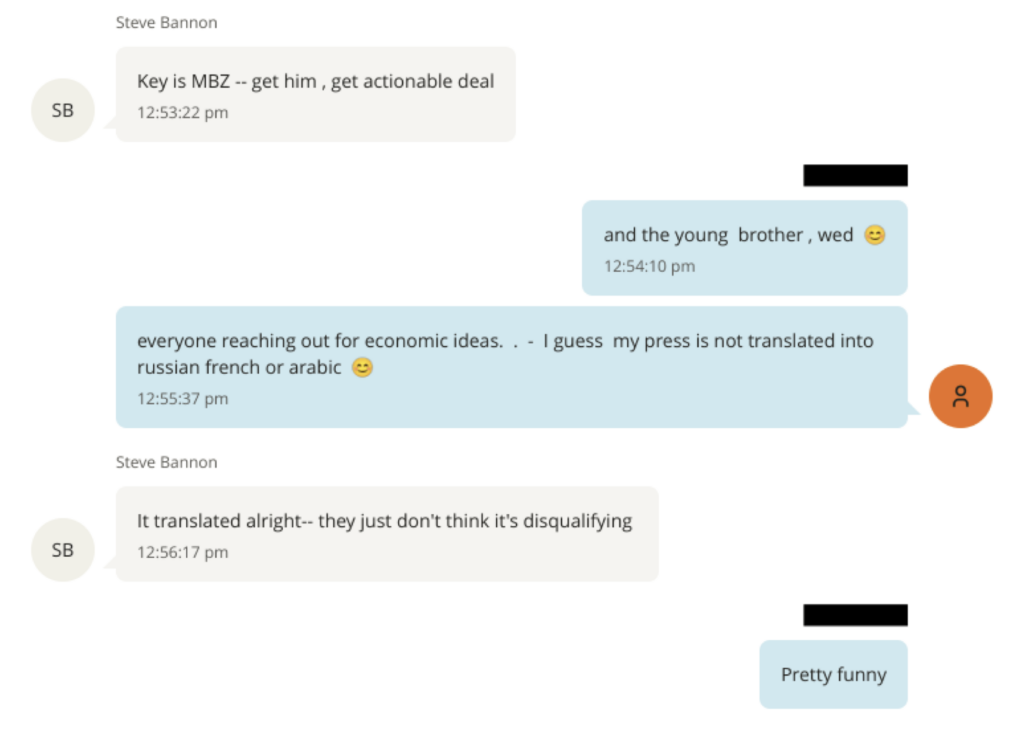
On December 11, 2018, Epstein asked Bannon to "explain to your boys that the lynchpin in the middle east is Qatar , blockade lifted. they can help on many fronts. many." Bannon responded that Emirati President Mohammed bin Zayed is the "key" to an "actionable deal."
Epstein noted that "everyone reaching out for economic ideas" and joked that "my press is not translated into russian french or arabic," apparently referring to the mounting sex abuse allegations against him.
"It translated alright-- they just don't think it's disqualifying," Bannon replied. He did not respond to Reason's request for an interview.