
There Are No Good Reasons To Subsidize Sports Stadiums. Governments Keep Doing It Anyway.
“If we stop funding all sports stadiums tomorrow, then the world wouldn't change hardly at all," says one economist.
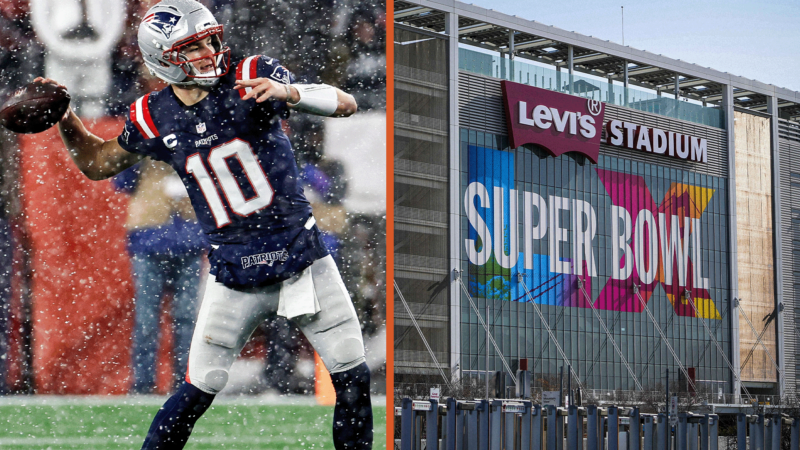
This year's Super Bowl between the Seattle Seahawks and the New England Patriots will feature several interesting story lines: Sam Darnold's redemption arc, Mike Vrabel's coaching job, and the Seahawks hoping to avenge themselves for the infamous Malcolm Butler interception. With the betting line in Seattle's favor at press time, it seems the public is hoping to cash in on a Seahawks win. But there are reasons why freedom-loving football fans should be cheering for New England: the Patriots are one of a handful of NFL teams that play home games in a privately funded stadium.
Of the NFL's 32 teams, only five—the New York Giants, New York Jets, Los Angeles Chargers, Los Angeles Rams, and the Patriots—did not receive government subsidies to build their home stadiums. While it may now be common for ultrarich team owners to receive lavish subsidies to build new stadiums or upgrade existing ones, this hasn't always been the case. "Almost all stadiums that were built at the beginning of the 20th century were private stadiums," economist J.C. Bradbury recently explained to Reason's Eric Boehm. Up until recently, "owners would have been laughed at if they went to the local city council or county commission and asked for money to help them build a stadium," Bradbury adds.
This is clearly no longer the case. In recent years, state governments have greenlit millions of dollars for stadium projects for the Buffalo Bills ($850 million) and the Tennessee Titans (a record $1.26 billion). Last year, the Washington Commanders announced they would build a new $3.7 billion stadium in the nation's capital, with a cool $1 billion coming from D.C. residents.
What might justify such flagrant levels of subsidies? Pride in the local sports team is certainly one reason. But oftentimes lawmakers push this funding as a way to boost local economies; not only will these stadiums bring in revenue through games, but also through events and concerts, the argument goes.
If stadiums are meant to revitalize the economy, they are dropping the ball. In a 2022 paper, J.C. Bradbury, along with economists Dennis Coates and Brad Humphreys, noted that "nearly all empirical studies find little to no tangible impacts of sports teams and facilities on local economic activity, and the level of venue subsidies typically provided far exceeds any observed economic benefits." As the Center for Economic Accountability points out: "Sports compete with other local businesses for consumers' entertainment dollars, rather than creating 'economic development' out of thin air."
This public spending comes with tradeoffs. "We see these people spending money in and around stadiums, but what we don't see is their foregone spending, that is, they'd be spending it elsewhere in the community," says Bradbury.
It also comes with corruption. "This pervasive lack of transparency in the planning and negotiation process around stadium subsidies also creates an environment where corruption can flourish," writes John C. Mozena, a senior fellow at Reason Foundation, the nonprofit that publishes Reason. In 2023, former Anaheim, California, Mayor Harish Sidhu "pled guilty to four federal felonies while the city was negotiating a stadium deal with the Los Angeles Angels baseball team" and admitted to "pass[ing] inside information to the team's negotiators and attempt[ing] to influence the city's decisions in favor of the Angels in return for an expected $1 million campaign contribution from the team," according to Mozena. This scandal ultimately led to the cancellation of the Angels' new stadium deal.
Despite all of the evidence of why stadium subsidies are a losing play, these wealth redistribution schemes aren't going away anytime soon. Ohio lawmakers are hoping to spend $600 million on a new stadium for the Cleveland Browns, and last year, Oregon's Legislature approved $800 million in state bonds for an MLB stadium in Portland, even though no professional team has announced plans to move to the state.
Ending public support for these projects would protect taxpayers and hardly impact professional teams. "If we stop funding all sports stadiums tomorrow, then the world wouldn't change hardly at all," says Bradbury. "Basically, just these wealthy owners would say, 'OK, I guess I gotta fund it myself."
