The Postal Service's 'Next Generation' Electric Delivery Vehicles Cost $22,000 More Than Other Electric Vans
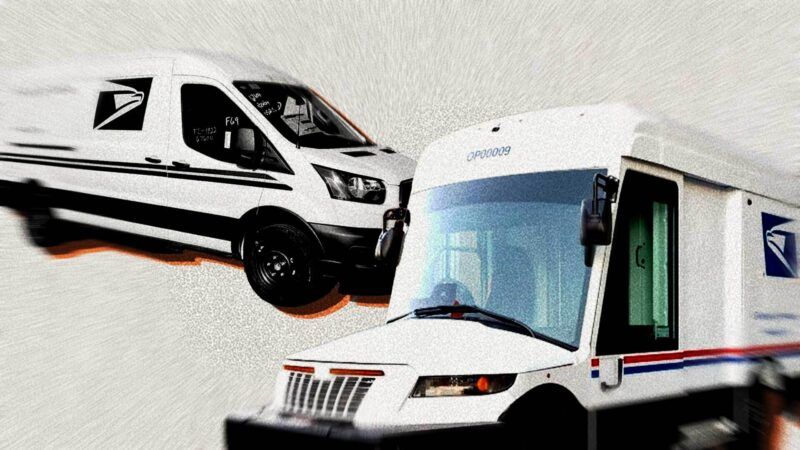
With commercial off-the-shelf vehicles readily available, cheaper, and already used in its fleet, why did the USPS decide to commission its new trucks from Oshkosh Defense?
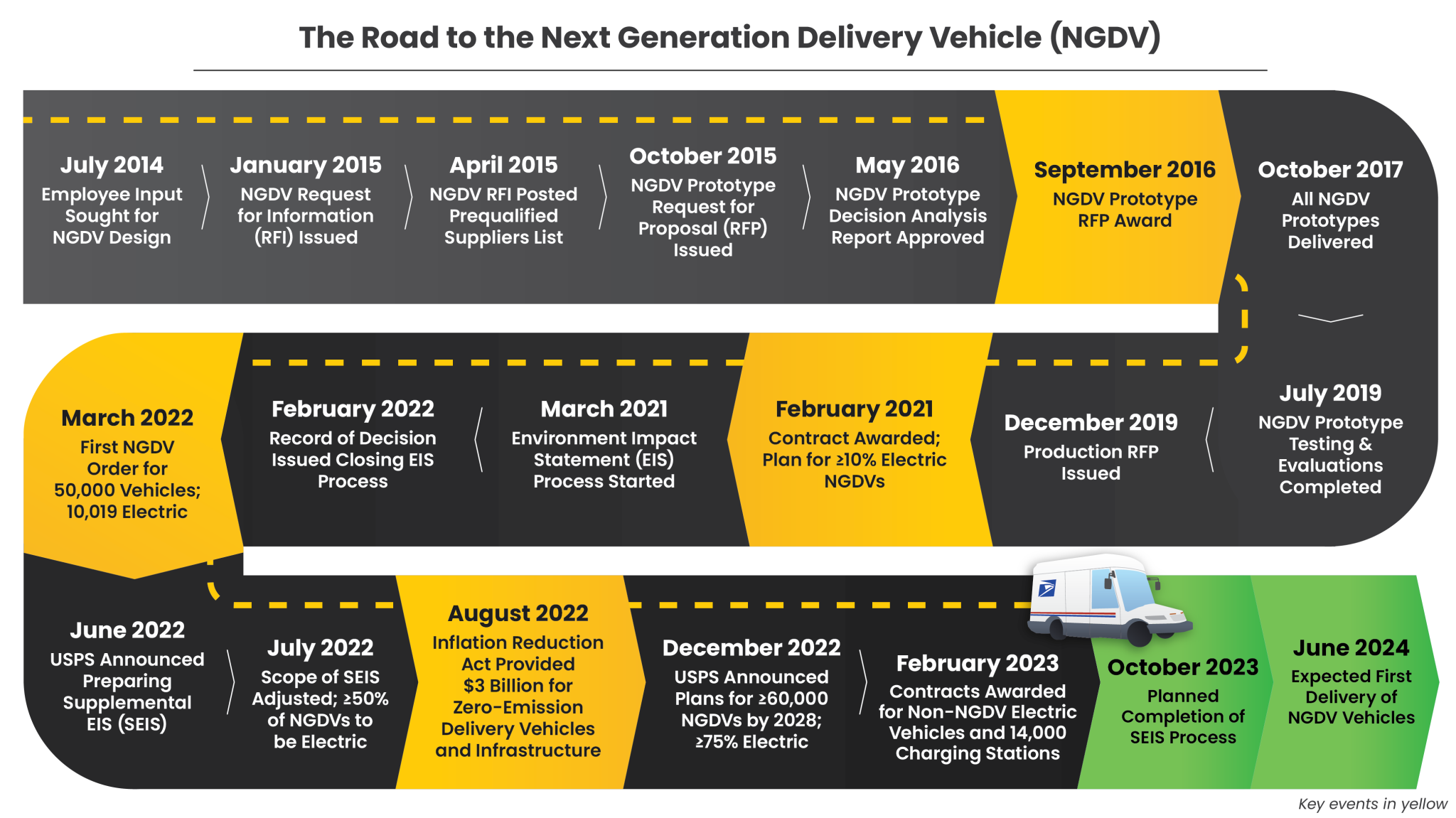
In 2014, the United States Postal Service (USPS) began replacing its fleet of delivery vehicles. In the almost 12 years since, only about 6 percent of its 51,500 custom-built delivery vehicles have been delivered. The Postal Service says the rollout will last at least two more years.
The signature USPS delivery truck is the Grumman Life Long Vehicle (LLV), which first entered service in 1986. Designed to last over 20 years, some have now been in service for twice as long, and don't include many modern amenities, like air conditioning and airbags. Maintaining the LLVs beyond their best-by date involved reverse-engineering the 130,000-strong fleet for discontinued parts, according to The Washington Post. In 2014, the USPS began its $9.6 billion fleet upgrade by announcing the Next Generation Delivery Vehicle (NGDV) program.
Oshkosh Defense, which produces rather mean-looking tactical vehicles for the American military (and has never before produced a delivery van), was awarded a multibillion-dollar contract in February 2021 to produce the NGDV for the Postal Service over 10 years. The Post details the production nightmare that ensued. After repeated delays, setbacks, and quadrupling the minimum number of electric NGDVs, thanks to a generous $3 billion subsidy from the Inflation Reduction Act, Oshkosh had only delivered 612 of 35,000 e-NGDVs by November 2025, and only 2,600 of the 16,500 internal combustion engine NGDVs.
The Postal Service agreed to pay Oshkosh $77,692 per e-NGDV and $54,584 per NGDV in March 2023. To put these numbers in context, FedEx's fleet of Mercedes-Benz Sprinter vans is considerably cheaper, costing $50,830 for the baseline 2026 Sprinter and $61,180 for the 2026 eSprinter. (The Sprinter debuted in 1995 and the eSprinter rolled out in 2019, two years before the USPS awarded its Next Generation Delivery Vehicle contract to Oshkosh.)
Paying almost $80,000 per vehicle should have rung alarm bells, but what makes this situation worse is that the USPS knows cheaper alternatives exist. 21,000 of the Postal Service's new fleet are commercial off-the-shelf vans like the Ford E-Transit (whose 2026 model starts at $54,855). In 2023, there were nearly 40,000 Mercedes-Benz Metris vans (which start at $41,495) in its fleet. It's unclear why the agency decided to get bogged down with Oshkosh at all. Whatever the reasons may be, price is not one of them.
What comes as no surprise is that a generously subsidized quasi-governmental agency is wasting money and time on a boondoggle.

Editor's Note: As of February 29, 2024, commenting privileges on reason.com posts are limited to Reason Plus subscribers. Past commenters are grandfathered in for a temporary period. Subscribe here to preserve your ability to comment. Your Reason Plus subscription also gives you an ad-free version of reason.com, along with full access to the digital edition and archives of Reason magazine. We request that comments be civil and on-topic. We do not moderate or assume any responsibility for comments, which are owned by the readers who post them. Comments do not represent the views of reason.com or Reason Foundation. We reserve the right to delete any comment and ban commenters for any reason at any time. Comments may only be edited within 5 minutes of posting. Report abuses.
Please to post comments
Follow the money - - - - - - - -
Check campaign 'donations' of the corporation, and of it's officers.
Look into the goings on between the defense contracts and this one.
And squint real hard to figure out if we can Blame Biden, because he took office a whole month before the contract was awarded.
Or is the USPS corrupt no matter who is involved in the government?
the individual agencies are corrupt
Government is corrupt, and invites private players to be corrupt.
Sounds like you just want federal law enforcement to larp and put on a show!
Postal vehicles are unique. They need to be smaller that other delivery vans to be able to get near mailboxes and around parked cars. They also need the steer wheel on the other side. This means that the effort to design and retool factories for the postal vehicles can't be used for other vehicles. There is also only about 50k of them produced. $80k for them is not bad at all. Many consumer cars/SUVs/Trucks are over $80k.
Of all the things to get outraged over with government spending, this one does not make the cut.
most of the vans already are available as right hand steer in other parts of the world so ordering them would have been no problem
Hogwash to it all, as evidenced by UPS, FedEx, Amazon, and other package delivery vans having no problem delivering the goods. Considering how many newish subdivisions don't even have mailboxes at individual houses, the USPS has it easier than the package carriers.
Half my town, a decade after I moved here, still doesn't get home delivery.
*And* the local post office has not expanded how many PO boxes it has available either.
And yet the Post Office already buys commercially available vans that are not unique. Your starting premise is wrong.
Yes, they do need to get near mailboxes and around parked cars. So do lots and lots of other delivery vehicles. Yes, they work better with a right-hand drive. It's not required, though. (My mother-in-law was a rural postal carrier back in the day and drove her regular left-sided car from the right seat. It was a reach but possible back in the days of bench seats.) And even if it was required, as Ron points out, right-hand drive versions are easily available around the world. The re-tooling to convert a car to the other drive is minor - certainly much, much less than the cost of building an entirely new vehicle.
I'll concede that fixing this won't solve the federal budget deficit all by itself. But that logic leads to paralysis. The longest journey begins with a single step. Why do you think we should not take this step?
"Your starting premise is wrong." Sums up every Molly post.
My thinking was along those lines. Comparing a Sprinter to a rural delivery mail truck is apples and oranges. They don't actually do the same thing.
Walz +7
Oshkosh won them over by submitting their design created by a crack team of 4 year old engineers. Ensuring postal workers continue to look like dorks for the forseeable future
You gotta pay extra to look that bad.
Looks like a beluga whale with mongolism had a baby with an autobot from the transformers.
Does it come with the "Go Around: If it was meant to be fast, it wouldn't be shaped like a brick" bumpersticker?
Doesn't matter. Just repeat 'the fraud is not widespread and it's mostly white men'.
Fascism at its finest. See also, Amtrak's need for special rolling stock, despite off-the-shelf options perfectly serving much larger passenger rail systems.
why did the USPS decide to commission its new trucks from Oshkosh Defense?
You're gonna make me say it aren't you? [sigh] Because electric vehicles are just. really. popular.
Who cares that specifically for freight hauling the $/lb./mi. makes EVs fundamentally more expensive? We've got a federal jobs program to modernize and electrify!
In fairness, the low-speed, start-stop driving that postal delivery vans do is pretty much the ideal condition for EV/hybrid over gas-only engines. On a $/lb·mi basis in those conditions, they outperform gas engines.
They are nevertheless wildly unpopular for regular car owners because the rest of us don't drive that way. (Other reasons too but that's a big one.) By my own calculations (based on my driving conditions and style) of total cost of ownership, a Prius is not the cost-effective solution until gas consistently exceeds $4/gal.
The calculation for a pure EV is harder to describe because it can become cost-effective when either gas prices go up or electricity prices go down. Regardless, breakeven is quite a bit away from current prices.
Agreed. A plugin hybrid for rural delivery seems reasonable to me.