

Venezuela's Acting Dictator Is Delcy Rodríguez, a Maduro Regime Ally With a History of Human Rights Violations
Trump chose to work with a sanctioned regime insider rather than the country's elected opposition.
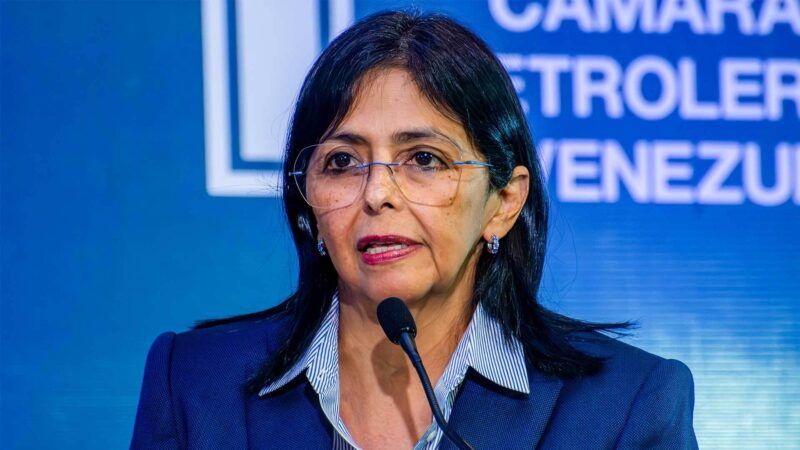
When U.S. special forces captured Venezuelan dictator Nicolás Maduro in a predawn raid on Saturday, it should have been a moment of triumph for Venezuela's democratic opposition. But rather than endorsing the leadership of Edmundo González, whose victory in July's 2024 election was stolen by Maduro, President Donald Trump announced he'd work with Delcy Rodríguez, Maduro's vice president for the past six years. After Trump called her "gracious" and claimed she was "essentially willing to do what we think is necessary to make Venezuela great again," the Maduro-controlled Supreme Court swiftly appointed her as acting president on Saturday, once again sidelining the elected opposition.
Rodríguez is neither gracious nor a reformer. She's a self-identified communist who has held key positions under both former dictator Hugo Chávez and Maduro, Venezuelan political writer Paola Bautista de Alemán tells Reason. In 2017, Maduro tapped Rodríguez to be president of the illegitimate constituent assembly that usurped the powers of the elected National Assembly to silence the opposition. Later that year, Maduro appointed her to the "Anti-Coup Command," tasked with taking measures against alleged coup plotters and terrorists, labels routinely applied to peaceful opposition figures.
As vice president, she oversaw the agencies responsible for repression and mass human rights violations. From 2018 until April 2021, Rodríguez exercised direct hierarchical control over the Bolivarian National Intelligence Service (SEBIN), Venezuela's feared intelligence service responsible for domestic surveillance and counterintelligence. Under Rodríguez's leadership, the SEBIN acted as a political police to prosecute perceived enemies of the Maduro regime, including opposition leader Freddy Guevara, whom the agency detained in 2021, two days after Rodríguez publicly accused him of being involved in gang violence. Former SEBIN Director General Cristopher Figuera testified to the United Nations that he communicated with the vice president "practically every day," including updates on wiretaps and surveillance of politicians.
In 2020, the U.N. concluded there are "reasonable grounds to believe" Rodríguez "knew or should have known" of crimes committed by SEBIN officials, including arbitrary detention and torture. Despite having the authority to prevent these crimes, she failed to do so.
In addition to human rights violations, Rodríguez has been accused of corruption and bribing international officials, as seen in the "Delcygate" scandal. Spanish investigators believe Rodríguez orchestrated a scheme in 2020 to sell 104 bars of Venezuelan state gold to Spanish businessmen through corrupt Transport Ministry officials. The deal allegedly took place at Madrid's airport, where Rodríguez met with Spanish Transport Minister José Luis Ábalos despite being banned from entering E.U. territory.
The alleged operation extended further. After receiving $62 million in Spanish state aid in March 2021, Spanish airline Plus Ultra allegedly used the funds to repay "loans" to accounts linked to Venezuela abroad. Investigators believe the scheme laundered proceeds from both gold sales and embezzlement of Venezuela's food distribution program—meaning funds meant to feed hungry Venezuelans may have been funneled into European bank accounts.
On top of this, there are accusations from former Venezuelan officials about Rodríguez's role in the Cartel de los Soles, the narco-trafficking network allegedly run by senior regime figures. Former Venezuelan General Cliver Alcalá Cordones, now serving a federal prison sentence in the United States after pleading guilty to narcotics-related charges, sent a damning letter to Trump in December 2025. Published by The Dallas Express, the letter claimed that Rodríguez and her brother Jorge, president of Venezuela's National Assembly, are the cartel's real leaders, managing illicit gold revenues and narco-trafficking proceeds.
Rodríguez's track record has earned her sanctions from the U.S., European Union, Switzerland, and Canada for corruption and undermining democracy. In 2018, the U.S. Treasury froze her assets and added her to the Specially Designated Nationals list for her role in solidifying autocracy in Venezuela. The E.U. sanctioned her the same year for actions that "undermined democracy and the rule of law in Venezuela."
By supporting top officials of Maduro's illegitimate regime, the Trump administration is missing a chance to work with the local political leaders who have both legitimacy and popular support.
When Maduro was captured, González and María Corina Machado, the opposition leader who won the 2025 Nobel Peace Prize and dedicated it to both the Venezuelan people and Trump, immediately called for González to assume his constitutional mandate as the legitimately elected president. David Smolansky, González's official spokesperson, laid out the opposition's vision: free political prisoners, restore democratic order, and welcome back the millions of Venezuelans forced into exile by the regime's failures. Instead, Trump chose to work with Rodríguez, effectively sidelining Venezuela's democratically elected opposition and forcing them to watch the U.S. partner with the very regime that stole their victory.
It's unclear whether Rodríguez will become a reformer who leads the country from Chavismo toward democracy or an authoritarian consolidator with American backing. Venezuelan trust isn't in Rodríguez, as Bautista, the Venezuelan writer, notes; it's in Trump's ability to use force, or the threat of force, to compel democratization. That's a precarious foundation for building a democratic transition.
Trump is betting he can foster a transition of power by partnering with a sanctioned regime insider whose résumé includes overseeing a torture-linked intelligence service, alleged narco-trafficking operations, and an international bribery scheme. What could possibly go wrong?




