
Trump Wants To Seize Greenland Because He Doesn't Understand Trade
Presidents should try to nudge the world toward more trade and less war whenever possible. Trump is doing the opposite.
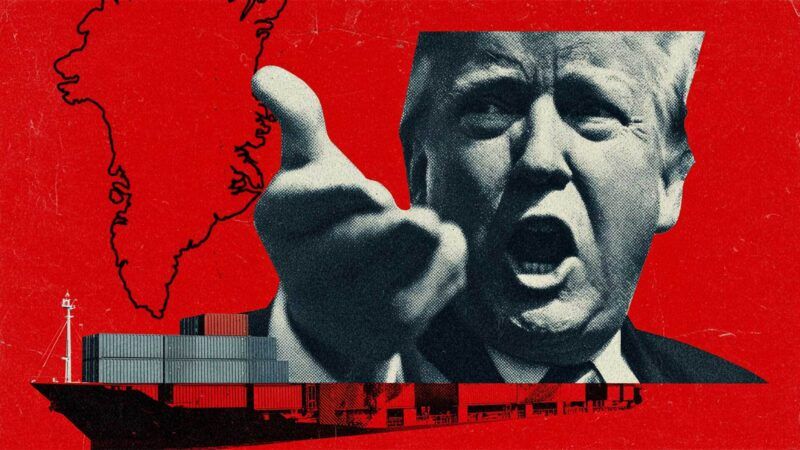
Imagine for a moment that you have the misfortune to be elected president of some nation. A neighboring nation possesses valuable natural resources that you'd like to have. How to proceed?
You could seize those resources by force. Certainly that's been a common method across much of human history. Hire some thugs to take what you want. Have them beat up the other guy if he gets in the way. Give your thugs uniforms and an internal hierarchy, and you might fool some people into believing the whole thing is more legitimate.
Alternatively, you could offer the other nation some of your own resources in exchange for the ones you want. Things go even more smoothly if you let the people in your country offer their resources in exchange for the stuff in the other country that they want. If you happen to be president of a country with the world's reserve currency, this deal gets better yet: Instead of offering your own resources, your people can probably just trade money for the things they want, and the other country will be happy to accept.
Everyone gets what they want and no one has to fight over it.
Unfortunately, President Donald Trump does not seem to understand this on a fundamental level. Again and again, Trump has shown that he views free trade as a suckers game. Why should everyone end up better off when he could win while others lose?
The Trump administration's renewed impulse to seize Greenland—on the heels of a military attack aimed at seizing Venezuelan oil production—is the latest example of this. It's also perhaps the riskiest, given that Greenland is a part of Denmark (even though it has been semiautonomous since 1979) and Denmark is a member of NATO.
In an interview on Monday, Trump adviser Stephen Miller refused to rule out the use of military force to seize the island. "Nobody's going to fight the United States militarily over the future of Greenland," Miller said. "We live in a world…that is governed by strength, that is governed by force, that is governed by power."
This may be a bluff, but we should be clear-eyed about the threat. Miller is talking about a military attack by the United States against Denmark, a longtime ally and fellow member of NATO. Per NATO's rules, an attack against one member is treated as an attack against all, and as such, all NATO members would be required to respond. That's unlikely to happen, so the effective result would be the "collapse" of NATO, as Danish Prime Minister Mette Frederiksen put it this week.
Should NATO have been restructured or abolished long ago, once the Soviet Union and its Warsaw Pact were no longer around? Absolutely. Is an attack by one NATO country against another the proper way to go about restructuring the alliance? Good gravy, no.
So why is the Trump administration threatening such an insane thing? One possible answer is that Greenland has resources America needs. And, indeed, Greenland does have valuable mineral deposits and might be sitting atop a reserve of natural gas and oil. Gee, if only there were some way to get at them without having to resort to force!
But the most valuable resource Greenland possesses is likely its spot on the map. When the Trump administration talks about Greenland as being vital for national security purposes, that's because it is adjacent to Russia—use a less traditional map to understand how—and crucial to controlling airspace around the Arctic. (Trump and his allies are also recently spouting off some manifest destiny–esque nonsense about controlling "our" hemisphere, but that's a less practical consideration.)
Admittedly, land is harder to trade than many other resources. Still, the principle is the same: You can take land by force, or you can offer something you have for something you want. America has spent the past century creating global institutions—like NATO—to discourage the former and encourage the latter, and that's worked out quite well.
It is that cooperative approach that explains why the U.S. has stationed troops and built airbases in Greenland since striking a deal with Denmark in 1951. Everyone wins: America gets a stronger foothold in the Arctic and first alert defense against Russian nukes, and Denmark (a tiny country that's not a national security threat to anyone) gets protection by being a part of NATO and allies with the United States.
There is no good reason—absolutely none—for Trump to blow up that arrangement and seize Greenland by force.
Finally, here's the most important thing about free trade that Trump fails to grasp: It is voluntary and consensual.
Rolling into Greenland with guns blazing—or making enough threats that Denmark eventually hands the island over to avoid that possibility—is the exact opposite of that. Trump's centralized, nationalistic view of the world has no room for individuals or their consent. What do the people of Greenland want? What do the people of Denmark want? Heck, most Americans are not very keen on the idea of their government seizing Greenland. It's not quite accurate to say that no one wants this—some very powerful people unfortunately do—but this would be something that the U.S. government would be doing against the will of most of the individuals involved in the transaction. That should matter—a lot.
In fairness, it is encouraging to see that the Trump administration is putting together an offer that will reportedly be presented directly to the semiautonomous government of Greenland. The Economist reports that the deal includes giving Greenland the same status as the Marshall Islands and some other small Pacific islands.
The people of Greenland have the right to vote on their own future. If Trump's deal is accepted, then Denmark (and others) should stand aside. But it certainly seems like that deal would have had a better chance of being accepted without all the bellicosity that has gone along with it.
Again, one of the glorious things about free trade is that no one points a gun (or the whole U.S. military's terrifying arsenal) at you to make a deal happen. Individuals buy and sell things when and how it makes sense for them to do it. Yes, it is impossible to apply that logic to every aspect of international geopolitics, but presidents ought to nudge the world toward more trade and less war whenever possible. Trump is doing the opposite.
That is happening, at least in part, because Trump doesn't understand the value of free trade. Everything happening with Greenland is downstream of that grievous problem.
