
The Contradictions of Supply-Side Socialism
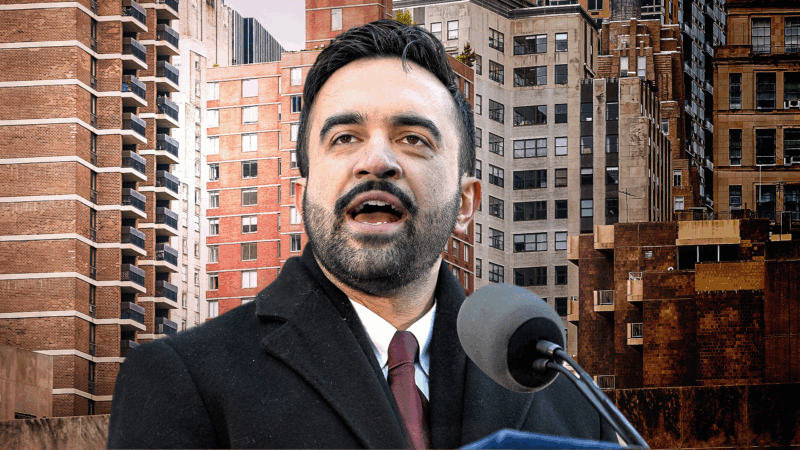
Zohran Mamdani signs executive orders to speed up new construction. His housing policy picks also want to abolish private property.
Happy Tuesday, and welcome to the first Rent Free of the New Year. This week's newsletter includes stories on:
- Newly inaugurated New York Mayor Zohran Mamdani's first housing policy moves
- Congress' dueling housing supply bills
- Yet another cautionary rent control tale in suburban Washington, D.C.
Mamdani's First Housing Moves Highlight the Contradictions of Supply-Side Socialism
Zohran Mamdani has been mayor of New York City for less than a week, and he's already issued several executive orders related to housing and staffed up housing roles within his administration.
The new mayor's moves so far include all the contradictions one might expect from a self-proclaimed socialist who says he wants to freeze the rent and get the city (including its private sector developers) building again.
Rent Free Newsletter by Christian Britschgi. Get more of Christian's urban regulation, development, and zoning coverage.
Two of Mamdani's executive orders directly address that latter goal. One creates a Streamlining Procedures to Expedite Equitable Development (SPEED) task force dedicated to identifying and removing bureaucratic barriers to new housing construction and leasing.
The second creates the Land Inventory Fast Track (LIFT) task force that will identify city land that can be used for housing construction.
Both are fine ideas. They're also not exactly novel.
Mamdani's predecessor, Eric Adams, likewise convened task forces to speed up the city's permitting process and to identify city-owned land that could be used for housing.
In December 2022, Adams' Building and Land Use Approval Streamlining Taskforce (BLAST) released a "Get Stuff Built" report that proposed 111 bureaucratic tweaks and reforms designed to cut the permitting timeline in half.
Around 90 of the proposed reforms were within city agencies' power to enact unilaterally. A solitary six-month progress report released in June 2023 listed 16 of those 111 reforms as complete.
By September 2025, Adams' effort to build housing on city land had led to 10 housing projects on city-owned land totaling 1,000 units of new housing.
Perhaps a Mamdani administration will be able to squeeze more juice out of new task forces.
But as the Manhattan Institute's Eric Kober details in a new report, substantially increasing new supply will require more comprehensive legislative changes to city zoning and permitting laws.
The end goal of those reforms, like many of the zoning reforms the City Council passed under the Adams administration, is to induce private developers to add more units to the housing-starved city.
Several of Mamdani's other initial housing moves may well make them less likely to do that.
On his first day in office, Mamdani appointed Cea Weaver, a tenant activist and one of his campaign advisers, to lead the city's Office to Protect Tenants.
A few days later, the New York Post reported on Weaver's long history of hard-left social media commentary. She's called for seizing private property and derided homeownership as a "weapon of white supremacy."
People who pay close attention to New York housing politics won't be shocked by any of Weaver's unearthed comments.
People should watch this 2021 Reason documentary on New York's disastrous eviction moratorium, which includes an interview with Weaver, who argues that landlords who are being bankrupted by their inability to remove delinquent tenants are just the cost of doing business.
In addition to appointing Weaver, Mamdani has directed city agencies to host a series of "rent ripoff" hearings, in which tenants will be given a public forum to complain about conditions in their buildings.
Mamdani, beginning his administration by appointing communists and scheduling housing struggle sessions designed to demonize landlords, might not be the most surprising development. It's not entirely unprecedented either. Former Mayor Bill de Blasio liked to talk about seizing private property from time to time.
It's nevertheless worrisome for anyone who does care about private property protections. It's also maddeningly hypocritical.
Weaver was a primary proponent of New York's 2019 rent stabilization law that made it much more difficult for landlords to fund maintenance and building improvements through higher rents.
As recent lawsuits and reports have highlighted, the result has been declining housing quality and a growing number of units sitting empty because their owners cannot finance needed, often city-mandated repairs.
Neither Mamdani nor Weaver can expropriate private housing all by themselves. The U.S. Constitution provides some protection against that. They can, however, scapegoat landlords for problems that are caused by overbearing regulation.
Certainly, one doesn't expect either to support productive reforms to New York's rent regulations and tenant protection laws that might lead to an improvement in housing quality.
On the margins, individual property owners might look at the hostility of the new city administration to their property rights and decide that leasing out an existing unit or building a few more isn't worth the risk.
Congress Considers 2 Major Pieces of Housing Legislation
A major bipartisan housing reform bill failed to clear Congress last year, but hopes are high that similar legislation will become law in 2026.
Last year, the Senate banking committee unanimously passed the ROAD to Housing Act, a lengthy piece of legislation that includes a number of pro-supply tweaks to existing federal grant programs. (Read Rent Free's breakdown of the bill here.)
The ROAD to Housing Act seemed set to become law when it passed the full Senate as an amendment to that year's National Defense Authorization Act (NDAA).
Ultimately, House Republicans on the Financial Services Committee stripped the ROAD to Housing Act out of the NDAA in December, preventing the bill from clearing Congress.
But, just a few weeks later, the House Financial Services Committee approved a very similar piece of legislation, the Housing for the 21st Century Act, on a 50–1 vote.
The Bipartisan Policy Center has a useful explainer piece comparing the House and Senate housing bills.
With the two relevant committees both approving similar housing bills unanimously or near-unanimously, and affordability being the political buzzword of the day, it seems quite likely that some version of supply-side housing reform will pass this Congress.
In Montgomery County, Another Cautionary Rent Control Story
Housing production has plummeted in Montgomery County, Maryland, which borders Washington, D.C., following the implementation of a local rent control ordinance.
In 2023, the county council approved a rent control policy that caps annual rent increases at the lesser of inflation plus 3 percent or 6 percent.
To avoid impacting new supply, the bill exempts buildings constructed after 2000 for a period of 23 years. Nevertheless, developers appear to be skittish about starting new projects in the country.
At his local news blog, Montgomery Perspective, Adam Pagnucco notes that multifamily housing permits have fallen by some 96 percent since the implementation of rent control. County planning officials report that the multifamily projects that are getting permitted are generally for-sale units.
Quick Links
- For a similarly themed but generally sunnier assessment of Mamdani's early days, read Matt Yglesias' column from today.
- ICE raids slow home construction in South Texas.
- The Department for Housing and Urban Development flags $5 billion in questionable rent assistance spending, out of a $50 billion total, in its latest financial report.
- New Jersey's Fair Share Housing Center reports widespread compliance with the state's new affordable housing law, which (broadly speaking) requires municipalities to zone for additional housing.
- The Los Angeles Times reports on a new survey finding that seven out of 10 people displaced by last January's Palisades fires have not returned to their homes. Home rebuilding has been a painfully slow process, despite local officials' promise of streamlining rebuild permits.
