
Did Marco Rubio Lie to Congress About Venezuela?
His explanation for why the Trump administration attacked Venezuela without congressional authorization does not stand up to scrutiny.
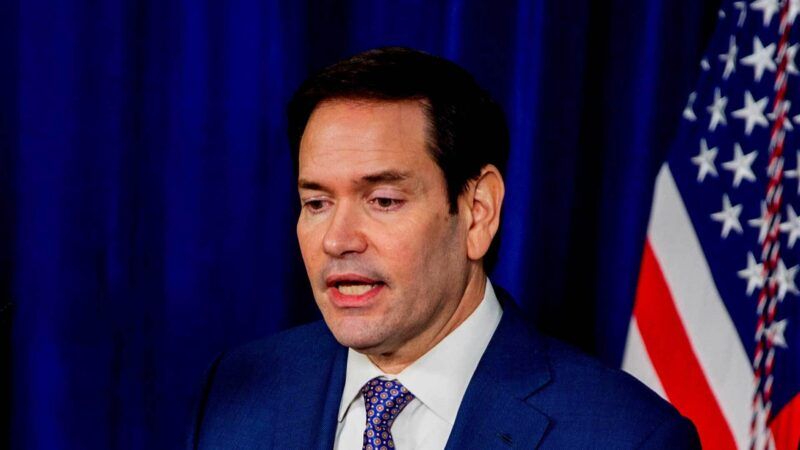
As the Senate considered a resolution that would have blocked the Trump administration from using military force against Venezuela, Secretary of State Marco Rubio reportedly gave a classified briefing to key members of Congress.
In that November briefing, Rubio "indicated that the administration is not currently preparing to target Venezuela directly and didn't have a proper legal argument for doing so," The Washington Post reported at the time. Similarly, CNN reported that administration officials told lawmakers that "the US is not currently planning to launch strikes inside Venezuela and doesn't have a legal justification that would support attacks against any land targets," and that the legal justification offered for strikes against suspected drug boats traveling near Venezuela "does not extend to land targets."
In the early hours of Saturday morning, however, American forces did attack a land target in Venezuela: Fort Tiuna, the military compound where Venezuelan leader Nicolas Maduro was holed up. According to the BBC, at least four more targets in and around Caracas were hit during the operation.
On Sunday, reporters asked Rubio about the obvious gap between what he (and other officials) told lawmakers in November and what had just unfolded in Caracas.
Rubio told the Post that the administration would need congressional approval only if it "was going to conduct military strikes for military purposes." And this, he insisted, was not a military strike but "a law enforcement operation."
That claim seems to contradict the description offered by President Donald Trump at his press conference on Saturday morning. Trump described Maduro's capture as an "extraordinary military operation" unlike anything since World War II. The administration also trotted out Defense Secretary Pete Hegseth and General Dan Caine to describe in detail how U.S. forces had breeched Venezuelan defenses and successfully captured Maduro in an operation that lasted more than two hours and involved more than 200 troops.
Rubio offered another defense to ABC's The Week.
"You can't congressionally notify something like this for two reasons. Number one, it will leak. It's as simple as that. And number two, it's an exigent circumstance. It's an emergent thing. You don't even know if you're going to be able to do it," he said. "It had to be at the right place at the right time with the right weather, and all things like that. So those are very difficult to notify, but the number one reason is operational security."
Both of those excuses fail to hold water, because they misunderstand Congress' role in approving military action.
The Trump administration did not need Congress to sign off on specific operational choices: the time, location, forces involved, and so on. What the Constitution and relevant statutes require is that Congress authorizes the use of the military. That could have been done without jeopardizing any specific mission.
Think about Iraq. Congress approved the use of military force in October 2002. Congress did not need to approve the operational details of the invasion in March 2023. That's the purview of the executive branch, but only after getting permission from Congress.
In this case, if Congress had approved the use of military force against Venezuela, then the Trump administration could still have planned Saturday's operation with all the necessary secrecy. What would have leaked? The idea that America was about to invade Venezuela? Yes, but that's been obvious for months now. A congressional vote would hardly have made it any more obvious, but it would have made the whole thing more legitimate.
Now Rubio is facing accusations that he lied to members of Congress during the November hearing.
"Secretaries Rubio and Hegseth looked every Senator in the eye a few weeks ago and said this wasn't about regime change. I didn't trust them then and we see now that they blatantly lied to Congress,'" Sen. Andy Kim (D–N.J.) posted on X. "Trump rejected our Constitutionally required approval process for armed conflict because the Administration knows the American people overwhelmingly reject risks pulling our nation into another war."
"Rubio said that there were not any intentions to invade Venezuela," Rep. Gregory W. Meeks (D–N.Y.) told The Washington Post. "He absolutely lied to Congress."
All that said, the reporting on that November hearing suggests that the administration was deliberately leaving the door ajar to do what happened last weekend. CNN reported at the time that Justice Department was working on "a justification for launching strikes against land targets without needing to ask Congress to authorize military force."
If such a justification exists, now would be a good time for the administration to make it public.
The question of whether Rubio lied to Congress is ultimately a question for Congress to settle. At a minimum, he and the rest of the administration seem to have misled lawmakers in the lead-up to Saturday's operation.
And even if the capture of Maduro is understood as merely "a law enforcement operation," then drawing that distinction should only underline this crucial fact: Constitutionally speaking, Congress must give its approval before the U.S. military can carry out further operations in Venezuela.
