
Britons Are Beginning To Admit It: Their Beloved National Health Service Is Broken
“Free” healthcare costs a lot in personal time and taxpayer money.
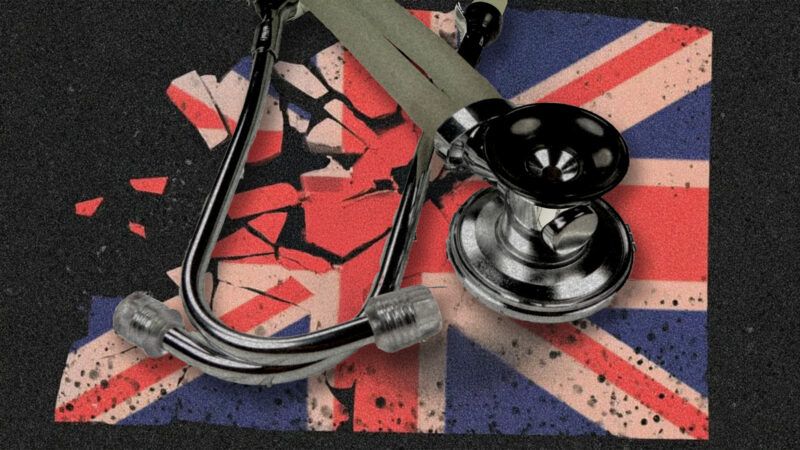
The day after the United Kingdom's general election last year, newly appointed Labour Secretary of State for Health and Social Care Wes Streeting proclaimed that Britain's socialized health care system was "broken."
Streeting's statement, while certainly correct, would have been political suicide just a few years ago. Criticism of the National Health Service (NHS) has long been seen as heretical. As in other religions, heretics were judged not on the merit of their criticism, but on the mere fact that they dared challenge received wisdom. As former Conservative chancellor Nigel Lawson put it in 1992, "The National Health Service is the closest thing the English have to a religion."
During the COVID-19 lockdowns, we were encouraged to stand outside our homes and "clap for the NHS" every Thursday. Some overly excited clappers even decided that wasn't quite enough to show their adoration for our health care system, and so out came the pots, pans, spoons, and other kitchen utensils.
Criticism of the NHS has remained extremely taboo. When I suggested in 2023 that the NHS was perhaps not the best health care system in the world, the left-wing tabloid paper The Mirror ran two stories about my "shocking" views. I even received death threats.
And yet, in just a few years, the Overton window appears to have shifted. The idea that the NHS isn't the world's best health care system is becoming more and more politically acceptable. Recent polling by YouGov suggests that more Brits now believe the NHS provides worse health care than other European countries, with the percentage increasing from 16 percent in 2019 to about 27 percent in 2025. The British Social Attitudes survey shows that, in 2024, just one in five adults (21 percent) were "very" or "quite" satisfied with the way the NHS runs. This is a steep decline of 39 percentage points since 2019, and marks the lowest level of satisfaction recorded since the survey began in 1983.
Perhaps the various high-profile stories of shockingly poor NHS treatment have driven some of this change. Nowhere is this more striking than in the Lucy Letby case.
Letby, a 35-year-old NHS nurse, was convicted of murdering seven babies and attempting to murder seven others at the Countess of Chester Hospital from June 2015 through June 2016. Her prosecution was subject to countless debates, with many people claiming she was actually innocent. Leading the media defence of Letby was journalist Peter Hitchens, who claims the babies were not murdered but died because they were "already very ill and received inadequate treatment."
How can we not tell the difference between serial baby murder and normal NHS care?
The idea that the NHS used to be the best system in the world but has only recently begun to fail remains common. When London Theatre reviewed Nye, a play about the birth of the National Health Service, the critic found it "bittersweet watching [Aneurin "Nye"] Bevan's fight to bring the NHS into being at a time when years of cuts have left it crumbling, and when its heyday can already be looked back on as something of a fever dream."
But the NHS is far from the best health care system in the world, and has never been the best. The most popular explanation for its shortcomings, echoed in that Nye review, is that the NHS is struggling because it is now underfunded. Yet public spending on the NHS has increased in real terms by an average of 3.7 percent since the 1950s. Health care represented 43.1 percent of total government spending on goods and services in 2024, an increase from 31.6 percent in 1997.
Government health care spending is so high in the U.K. that it has become the source of amusing ridicule. An account on X called Days of NHS Spending puts into context just how much the health service costs British taxpayers. For example, "the NHS spends Russia's entire military budget once every 150 days." If the NHS itself were a military, it would have the third-highest budget in the world, surpassed only by the U.S. and China.
The idea that the NHS is "underfunded" is simply untrue. But the only solution most politicians ever offer for our health care woes is to spend more money.
By almost every available measure, the NHS performs poorly in comparison to other systems. Take avoidable treatable deaths: In 2019, the U.K. had an avoidable mortality rate of 71 per 100,000 people. This is the lowest it has ever been, down from 84 in 2010 and 120 in 2001, yet it's still the second-highest avoidable mortality rate in Western Europe.
Even the 2023 Commonwealth Fund Survey, probably the international ranking that is most positive toward the NHS, ranks the U.K. ninth out of 11 in "health care outcomes."
Four-hour waits at emergency rooms and month-long delays to see a general practitioner have become part of life. Wait times have fluctuated over the years. According to the British Medical Association, the total number of people on NHS wait lists fell until 2010, then steadily increased until 2019. But even at that 2010 low point, British wait times were about twice as long as Dutch wait times for the same procedure. The Commonwealth Fund study found that the U.K. had among the longest wait times to see a specialist. Only 37 percent of people who needed specialist care in the past two years got an appointment within a month. Australia, Germany, the Netherlands, Switzerland, and the U.S. performed better, with 46 percent to 64 percent seen within a month. Only Canada reported a lower percentage than the U.K.
The NHS was founded on the promise that health care would be universally accessible and free at the point of use. But with wait lists this long and routine care difficult to obtain, is it really "universally accessible"? And when the tax burden is at its highest level since World War II, does it really matter if you aren't paying at use?
Not only is dissatisfaction with the NHS rising, but the public is slowly waking up to the fact that there could be better systems out there. The fact that the health secretary is now willing to call the NHS "broken" reflects this shift. Now, possibly for the first time in British history, Social Health Insurance (SHI) systems are becoming part of the mainstream debate. The BBC ran an article comparing the NHS to Germany's health care system, saying that the "jury is very much out on whether copying a different country's health system is really the way forward." Politico ran a piece titled "Is it time for the U.K. to (whisper it) ditch the NHS?"
The mere suggestion that marketized health care systems could provide better outcomes is no longer heresy. As is the case in every market, competition and choice allow for the most efficient allocation of resources. These systems empower patients with the ability and freedom to choose.
The Netherlands, for example, transitioned from a socialized system to a competitive, market-based, private SHI system. Sweden has started to allow private companies to set up medical practices. Most of Europe has some form of competitive market in health care, and spends much more on capital and long-term investment than the U.K.
The Australian example is particularly interesting. In 2019, Australian health care spending as a percentage of gross domestic product was 9.3 percent, just a few points below the U.K. Despite similar levels of spending, Australian health care outcomes outperform Britain's. Ovarian, lung, pancreatic, liver, stomach, and colorectal cancer survival rates are all higher in Australia than in the U.K., by as much as 10 percent in some cases. Australia's pancreatic cancer survival rate is nearly 75 percent higher than the U.K's.
Competition and choice drive innovation, efficiency, and responsiveness. When providers must compete for patients, they have incentives to improve quality, reduce wait times, and invest in cutting-edge treatments. Choice empowers patients rather than forcing us into a monopoly system where our only option is to wait and hope.
Americans who offer rose-tinted visions of universal health care systems would be wise to look at what happens when you actually implement one. The U.S. system is far from perfect and is far less market-driven than most people think. But the NHS is certainly not an alternative to be envied.
