

Britons Are Beginning To Admit It: Their Beloved National Health Service Is Broken
“Free” healthcare costs a lot in personal time and taxpayer money.
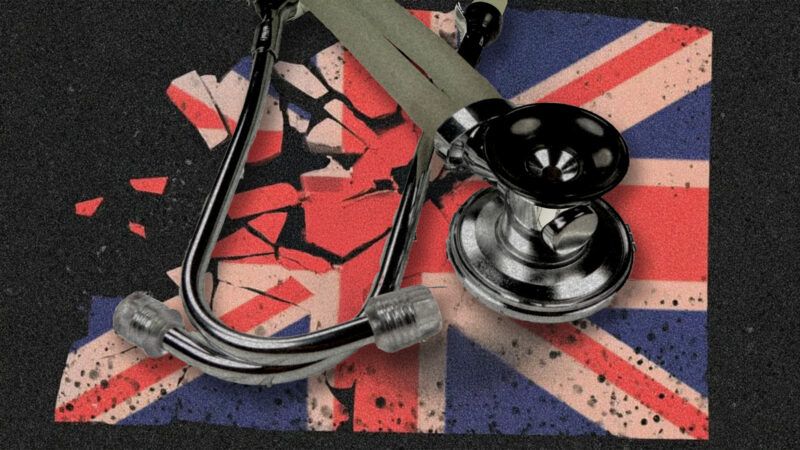
The day after the United Kingdom's general election last year, newly appointed Labour Secretary of State for Health and Social Care Wes Streeting proclaimed that Britain's socialized health care system was "broken."
Streeting's statement, while certainly correct, would have been political suicide just a few years ago. Criticism of the National Health Service (NHS) has long been seen as heretical. As in other religions, heretics were judged not on the merit of their criticism, but on the mere fact that they dared challenge received wisdom. As former Conservative chancellor Nigel Lawson put it in 1992, "The National Health Service is the closest thing the English have to a religion."
During the COVID-19 lockdowns, we were encouraged to stand outside our homes and "clap for the NHS" every Thursday. Some overly excited clappers even decided that wasn't quite enough to show their adoration for our health care system, and so out came the pots, pans, spoons, and other kitchen utensils.
Criticism of the NHS has remained extremely taboo. When I suggested in 2023 that the NHS was perhaps not the best health care system in the world, the left-wing tabloid paper The Mirror ran two stories about my "shocking" views. I even received death threats.
And yet, in just a few years, the Overton window appears to have shifted. The idea that the NHS isn't the world's best health care system is becoming more and more politically acceptable. Recent polling by YouGov suggests that more Brits now believe the NHS provides worse health care than other European countries, with the percentage increasing from 16 percent in 2019 to about 27 percent in 2025. The British Social Attitudes survey shows that, in 2024, just one in five adults (21 percent) were "very" or "quite" satisfied with the way the NHS runs. This is a steep decline of 39 percentage points since 2019, and marks the lowest level of satisfaction recorded since the survey began in 1983.
Perhaps the various high-profile stories of shockingly poor NHS treatment have driven some of this change. Nowhere is this more striking than in the Lucy Letby case.
Letby, a 35-year-old NHS nurse, was convicted of murdering seven babies and attempting to murder seven others at the Countess of Chester Hospital from June 2015 through June 2016. Her prosecution was subject to countless debates, with many people claiming she was actually innocent. Leading the media defence of Letby was journalist Peter Hitchens, who claims the babies were not murdered but died because they were "already very ill and received inadequate treatment."
How can we not tell the difference between serial baby murder and normal NHS care?
The idea that the NHS used to be the best system in the world but has only recently begun to fail remains common. When London Theatre reviewed Nye, a play about the birth of the National Health Service, the critic found it "bittersweet watching [Aneurin "Nye"] Bevan's fight to bring the NHS into being at a time when years of cuts have left it crumbling, and when its heyday can already be looked back on as something of a fever dream."
But the NHS is far from the best health care system in the world, and has never been the best. The most popular explanation for its shortcomings, echoed in that Nye review, is that the NHS is struggling because it is now underfunded. Yet public spending on the NHS has increased in real terms by an average of 3.7 percent since the 1950s. Health care represented 43.1 percent of total government spending on goods and services in 2024, an increase from 31.6 percent in 1997.
Government health care spending is so high in the U.K. that it has become the source of amusing ridicule. An account on X called Days of NHS Spending puts into context just how much the health service costs British taxpayers. For example, "the NHS spends Russia's entire military budget once every 150 days." If the NHS itself were a military, it would have the third-highest budget in the world, surpassed only by the U.S. and China.
The idea that the NHS is "underfunded" is simply untrue. But the only solution most politicians ever offer for our health care woes is to spend more money.
By almost every available measure, the NHS performs poorly in comparison to other systems. Take avoidable treatable deaths: In 2019, the U.K. had an avoidable mortality rate of 71 per 100,000 people. This is the lowest it has ever been, down from 84 in 2010 and 120 in 2001, yet it's still the second-highest avoidable mortality rate in Western Europe.
Even the 2023 Commonwealth Fund Survey, probably the international ranking that is most positive toward the NHS, ranks the U.K. ninth out of 11 in "health care outcomes."
Four-hour waits at emergency rooms and month-long delays to see a general practitioner have become part of life. Wait times have fluctuated over the years. According to the British Medical Association, the total number of people on NHS wait lists fell until 2010, then steadily increased until 2019. But even at that 2010 low point, British wait times were about twice as long as Dutch wait times for the same procedure. The Commonwealth Fund study found that the U.K. had among the longest wait times to see a specialist. Only 37 percent of people who needed specialist care in the past two years got an appointment within a month. Australia, Germany, the Netherlands, Switzerland, and the U.S. performed better, with 46 percent to 64 percent seen within a month. Only Canada reported a lower percentage than the U.K.
The NHS was founded on the promise that health care would be universally accessible and free at the point of use. But with wait lists this long and routine care difficult to obtain, is it really "universally accessible"? And when the tax burden is at its highest level since World War II, does it really matter if you aren't paying at use?
Not only is dissatisfaction with the NHS rising, but the public is slowly waking up to the fact that there could be better systems out there. The fact that the health secretary is now willing to call the NHS "broken" reflects this shift. Now, possibly for the first time in British history, Social Health Insurance (SHI) systems are becoming part of the mainstream debate. The BBC ran an article comparing the NHS to Germany's health care system, saying that the "jury is very much out on whether copying a different country's health system is really the way forward." Politico ran a piece titled "Is it time for the U.K. to (whisper it) ditch the NHS?"
The mere suggestion that marketized health care systems could provide better outcomes is no longer heresy. As is the case in every market, competition and choice allow for the most efficient allocation of resources. These systems empower patients with the ability and freedom to choose.
The Netherlands, for example, transitioned from a socialized system to a competitive, market-based, private SHI system. Sweden has started to allow private companies to set up medical practices. Most of Europe has some form of competitive market in health care, and spends much more on capital and long-term investment than the U.K.
The Australian example is particularly interesting. In 2019, Australian health care spending as a percentage of gross domestic product was 9.3 percent, just a few points below the U.K. Despite similar levels of spending, Australian health care outcomes outperform Britain's. Ovarian, lung, pancreatic, liver, stomach, and colorectal cancer survival rates are all higher in Australia than in the U.K., by as much as 10 percent in some cases. Australia's pancreatic cancer survival rate is nearly 75 percent higher than the U.K's.
Competition and choice drive innovation, efficiency, and responsiveness. When providers must compete for patients, they have incentives to improve quality, reduce wait times, and invest in cutting-edge treatments. Choice empowers patients rather than forcing us into a monopoly system where our only option is to wait and hope.
Americans who offer rose-tinted visions of universal health care systems would be wise to look at what happens when you actually implement one. The U.S. system is far from perfect and is far less market-driven than most people think. But the NHS is certainly not an alternative to be envied.

Editor's Note: As of February 29, 2024, commenting privileges on reason.com posts are limited to Reason Plus subscribers. Past commenters are grandfathered in for a temporary period. Subscribe here to preserve your ability to comment. Your Reason Plus subscription also gives you an ad-free version of reason.com, along with full access to the digital edition and archives of Reason magazine. We request that comments be civil and on-topic. We do not moderate or assume any responsibility for comments, which are owned by the readers who post them. Comments do not represent the views of reason.com or Reason Foundation. We reserve the right to delete any comment and ban commenters for any reason at any time. Comments may only be edited within 5 minutes of posting. Report abuses.
Please to post comments
Every socialist idea fails.
Only in reality.
but those aren't real socialist ideas....it will be (D)ifferent this time. Top Men and all.
Next thing you know will have hoards of filthy Brits invading NYC to sign up for Mamdanicare.
It wasn't that long ago the USA had the best healthcare in the world.
...then the [D]emocratic [Na]tional So[zi]alist[s] showed up
and indoctrinated the sheeple that a 'Gun' to their head would make them healthy.
How 'dumb' is that?
Get it through your heads leftards; 'Guns' don't make sh*t and Guns is the only tool in 'governments' toolbox.
The US certainly never had the best healthcare in the world after the 1950's-1970's. Our fall in 'healthcare ranking' - and relative life expectancy - is due to other countries (more socialized - but more importantly FAR more competent/accountable) improving their health outcomes. There are tons of different measures of health (eg mortality rates in different age brackets) but they all show the same thing - the US has not significantly improved health outcomes for 50 years. Everyone else HAS improved health outcomes.
Now if 'we'/you don't give a shit that health is a pursuable outcome beyond the individual in the US, then lean the fuck into our status quo (worse than mediocre outcomes, extremely high costs). Make a case that health care is no more significant than blue v pink curtains. Otherwise you're just spouting moronic shit.
"then lean the fuck into our status quo (worse than mediocre outcomes, extremely high costs)"
Right. Isn't that what I just said.
The Socialism of Healthcare isn't working.
Exactly how DUMB does a person have to be to think/blame the status-quo of our healthcare as going towards free-market? Or exactly how DUMB does a person have to be to think doing MORE of the same thing will cause the opposite result as what it has done?
I've got farm animals a heck of a lot smarter than that.
England has more people in prison for social media posts than Russia. They are a totalitarian socialist hell hole.
As I've said here before, it is time to break off diplomatic relations and military cooperation with the UK. We no longer have common interests. They should be considered an enemy state. The future of US relations with Europe is in Eastern Europe.
We should also be rounding up and executing all our Marxists here.
So you're interest in permawar for the next 1000 generations
The U.S. system...is far less market-driven than most people think.
Between Medicare, Medicaid, Tricare, insurance provided for government employees, and free medical care hospitals are required to provide, we're already about halfway to socialized medical care in the US. Most employed people have insurance subsidized by their employer. Only a small fraction of Americans are buying their own insurance on the private market.
Most employed people have insurance subsidized by _taxpayers_ _AND_ their employer
And it still isn’t enough.
The US system is not really 'half way to socialized'. We simply have the worst of all possible worlds. Things ARE as bad as possible where no one on the planet views our system as anything but a very expensive piece of shit.
We cover in a socialized way only those parts of the population (old, dying, too disabled to work, too destitute to pay anything) for whom there is no possible 'market solution'. For the same cost (and far worse outcomes) as every other country pays for their entire population. And rather than allow a system competing at the state/muni level, we insist that all solutions emanate centrally from the biggest most corrupt entity on Earth at the federal level.
"...We simply have the worst of all possible worlds..."
RTFA, shitforbrains.
You’re such a goddamn moron. As fucked up as our system has become (thanks to you, and people like you) e still have excellent survival rates for heart disease and cancer compared to places like Britain (dead last in the civilized world).
If you want to make things better, then turn on your democrat fellow travelers. As you are all to blame.
'Britons Are Beginning To Admit It: Their Beloved National Health Service Is Broken'
What about the rest of their Labor-WEF-EU hangover nanny state? Are Britons (presumably the important people who just know how important they are) ready to admit that pretty much everything they instituted is broken?
But the only solution most politicians ever offer for any woes, real or imagined, is to spend more money.
FIFY
The socialist health care system was fatally flawed to begin with. Then they decided to import a third world underclass that draws heavily from social services. A bit of nationalism would have made their socialism a little more solvent.
A bit of nationalism would have made their socialism a little more solvent.
'Europe' is a figment of Brussels bureaucrats (and American) imaginations. Those social welfare systems are overwhelmingly national. Non-tariff barriers create completely fragmented (ie national) markets - with the exception of a ludicrous common currency which create a ton of risks (and weak institutions) with no benefits whatsoever.
Immigration isn't really Europe's problem - assimilation (lack of - which has always been nonexistent and is why the US exists) and 'globalist elites' is.
Though of course that group of Americans who have bought into the permawar against all Muslims like to 'blame' Europe. Even though it is Americans who don't have the balls/guts to follow through with their permawar notions against a billion or so Muslims.
Only Canada is worse!
Criticism of the National Health Service (NHS) has long been seen as heretical.
Soon to be illegal.
It almost is now. Britain is a totalitarian Marxist state.
They've known it's broken since they implemented it, and the fix for the breakage is eternally more money.
Seriously, notice that they've said this just about since it passed. It's not 'criticism' of the system in their eyes, it's just perpetually underfunded and it's always the opposition party that holds the NHS back.
Nevermind that the amount of money they need for it doesn't exist. They don't notice pesky details like that.
I doubt "beloved" is an accurate description - - - - - - -
Beloved by the staff at Reason.
"...Yet public spending on the NHS has increased in real terms by an average of 3.7 percent since the 1950s..."
Datum missing.
All health care systems established in the post-war era are terrible, in one way or another. No one predicted the demographic transition that happened when life expectancy increased almost everywhere in the west. Yet all systems had to cope with the costs of that transition while also giving at least a nod to morality: it's immoral to decide that some groups or individuals do not deserve the benefits of more and better health care. That's a question that the Market is not well placed to answer without at least a nod to the virtues of eugenics.
It is NOT 'immoral' to *EARN* instead of Demand w/'Guns' who 'deserve the benefits' of others labors/services.
It is "Yet all systems" of a Nazi-Empire that "is not well placed to answer" for ... NOT a Free/Justice market.
...which was there pre-war era.
Your assertions here are a chase-your-own-tail game.
If you have a population which is almost 100% productive, you can share the costs of some service relatively equally. As soon as there is a substantial portion of the population being dependent and unproductive, yet consuming that service, resentment grows. Britain and the USA have growing segments of the population which consume much more than they produce. Yet since we have embraced the foolish notion that "Healthcare is a right" so we are locked into providing an ever increasing subsidy to an ever increasing segment of our population. Hence the 40 trillion dollar debt and the 1.8 trillion dollar deficit. We are hiding this disaster with debt. Trouble is coming, for sure.
Congratulations on Reason for a true libertarian article! Great start of the new year. I'm surprised this got through the lefty editors 🙂
Sure the one article might be libertarian, but in true "one screen two movies" context, the article criticizes "tax and spend" white colonizers (equally no less!) and has been and will be followed up by the "immigration will fix it" dropping of the other shoe.
Many years ago when my family lived in Ruislip near Uxbridge my brother was injured on his bicycle in a collision with a city bus. He was taken immediately to a local emergency room and was given excellent urgent medical attention. It's very sad what over fifty years of socialism can do to a society. American health care is not far behind, Reem.
Broken! Broken!
Not only is the NHS broken, Britain is broken. They did it to themselves beginning in 1914.
Unfortunately, this nation is following in the footsteps of the British, President Trump's kidnapping of Maduro notwithstanding. The basic issue, forcibly ignored, is racial warfare. Witness Britain. Recall Enoch Powell.
Socialized medicine is like socialism. It can work for a couple of years, until the subsidies run out, but is not sustainable. You end up destroying what existed before and the results are worse than the original dysfunctional system.
It seems that the Nordic countries realized the errors and have taken corrective actions to mitigate the harm done by socialism, while mitigating the harm dome by excessive greed. There is a balancing point needed to keep either side in check.


