

Mamdani's $6 Billion Child Care Expansion Would Be a Handout to Wealthy New Yorkers
The more the government intervenes in the market, the more New York parents pay for child care.
In the February/March 2026 issue of Reason, we explore Mayor-elect Zohran Mamdani's policy goals and what they mean for New York City. Click here to read the other entries.
"While families with young children comprise about 14 percent of the city's population, they comprise about 30 percent of the set of New Yorkers who are leaving the city," said Mayor-elect Zohran Mamdani at a visit to a day care center in East Flatbush, Brooklyn, where he hyped his plans for those families.
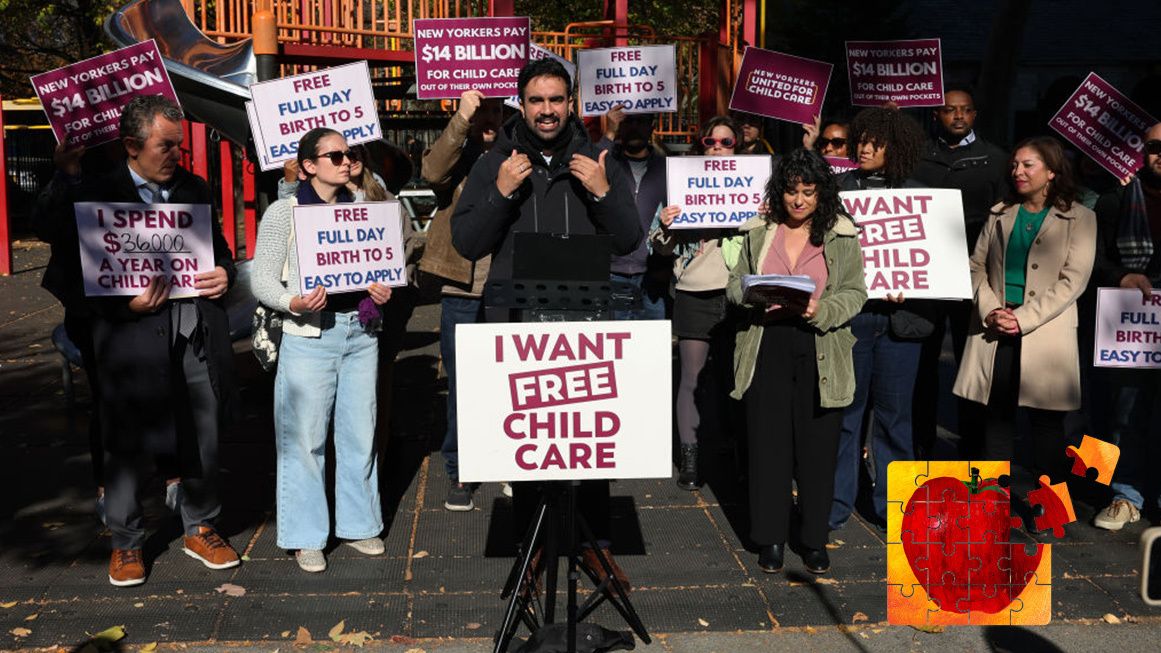
Mamdani ran on the most ambitious universal child care proposal in the country: free day care for all kids ages 6 weeks and above. Apparently, this pitch was compelling to the city's beleaguered parents: The self-styled socialist won by a hefty margin.
New York City already has universal child care guaranteed to 3- and 4-year-olds. When Bill de Blasio ran for mayor in 2013, he aimed to distinguish himself from then-Mayor Michael Bloomberg, who had created 4,000 new free pre-K seats but allocated them only to poor kids. De Blasio universalized the system in 2014.
Mamdani wants to expand to an even younger age group, which would cost an extra $6 billion a year. Those funds aren't available in city coffers, so Mamdani would need cooperation from the state government to raise the money, likely by taking another leaf from the de Blasio playbook and trying to hike taxes on the very rich.
Mamdani's political intuition is sound: The affordability issue is salient. The number of New York City families with three kids or more has dropped by nearly 17 percent over the last decade. Families with young children have been self-exiling in droves since the pandemic. The under-20 population has dropped by almost 200,000 over the last few years. The city's public school system has 915,000 students enrolled, down from 1.1 million a decade ago. New York's comptroller reports that the average cost of private child care for babies and toddlers now sits at $18,200 annually for family-based care and $26,000 annually for center-based care, shooting up in recent years. It's no wonder so many parents are clamoring to turn over their kids to the warm embrace of the state. They feel left out in the cold.
But universal 3-K (for 3-year-olds) hasn't served families as well as its supporters promised it would. It distorted the private market, driving day cares out of business. Rich families have used nifty hacks to get their kids into the best centers, while the poor are left with the rest. The universal nature of it might be politically valuable when you're currying favor with the tony Park Slope crowd, but it means that child care for rich people is subsidized by the slightly richer, and that day cares serving the poorest neighborhoods don't get what they need. Parents who choose to stay home with their kids or employ nannies get shafted, and costs for all forms of child care are driven up the more the government intervenes in the market. More government involvement won't make that better.
De Blasio's 'Tale of Two Cities'
How did we get here? Mostly by de Blasio's political aspirations colliding with cold, hard reality.
When he ran for mayor in 2013, de Blasio needed a big idea to sell. He bemoaned "the tale of two cities," the idea that New York is a place where extraordinary wealth is amassed and enjoyed but also a place where many hundreds of thousands barely scrape by. He sold himself as the messiah who could fix it all, and he proposed a way to level the playing field earlier in life: universal pre-K for the city's young, to help both the struggling and the flush. The high-earners—those making over $500,000 annually—could fund it. It was to be universal both because there's a specific flavor of Democrat who prefers large, across-the-board entitlement programs and because, as de Blasio later told The Atlantic, "anything that has a broad constituency will also have more sustainability."
De Blasio won. But then-Gov. Andrew Cuomo thought raising taxes on high-earners would be political suicide; he couldn't let de Blasio have his way. Instead, Cuomo grabbed $1.5 billion (spread out over the course of five years) from the state budget and sent it the city's way.
It turned out to be easier for de Blasio to run on those themes than to actually execute on them. Here's how the program worked in practice: Parents could rank order up to 12 day care programs based on proximity and reputation, but they were not automatically assigned to any specific one. If they had an existing relationship with any specific center, the city would give them priority when assigning them, so parents with strong preferences could use hacks to get into the highest-quality pre-K centers serving 4-year-olds (referred to as 4-K programs). For example, many of these centers also ran summer camps, and many of them had 3-K programs you could just pay for, thus marking your family as having an existing relationship with the high-quality day care provider.
For rich families, it was a great deal: Pay a relatively paltry sum for a summer camp, or a little extra for one year of day care for the 3-year-old, and get it totally funded by the state the next year. But it was a much worse deal for poor families. They couldn't afford the hacks, so the highest-quality centers stayed out of reach. Day care centers flourished in middle- and upper-middle-class neighborhoods, but were plagued by all sorts of issues in poor neighborhoods.
To be approved by the newly empowered Department of Education to participate in this program and receive funding from the state, "participating schools agree[d] to adhere to a 120-page book of guidelines, with city and state regulations on everything from the amount of juice (4 ounces) and sodium (1,700 milligrams) allowed per child per day to the number of minutes of daily free play (140) and screen time (no more than 15)," reported The Atlantic's Dana Goldstein. Sodium levels are very tightly controlled, but the quality of the caregivers has been only semimonitored.
At Bambi, a child care center in Crown Heights that participates in the universal pre-K program, a worker was caught abusing a toddler on camera. The Manhattan District Attorney's Office is investigating a Bright Horizons location that participates in universal pre-K following reports of children being hit with water bottles, strapped to chairs, and having their mouths taped shut. Those are outlier examples—the vast majority of day cares do not tolerate this sort of behavior and do a better job screening their employees—but these are the sorts of problems that city inspectors are supposed to catch.
Even setting such abuses aside, many parents seem frustrated by the choices presented to them and their lack of control over the process, given how high the stakes are.
"Got an offer from a day care center we've never heard of," wrote one parent on Reddit. "It does not meet our needs so we declined. Waitlisted #101 for our #1 choice."
"Live in midtown and got an offer in Bushwick," wrote another parent. (That would be an almost hourlong commute by subway.) "Waitlisted at #18 for our top choice."
Uptake is low in poor neighborhoods; demand (and uptake) are high in wealthy neighborhoods where the centers in question have better reputations. "Lower-income neighborhoods like Brownsville, Harlem, and the South Bronx still have the highest rates of seat vacancies," reports Manhattan Institute fellow John Ketcham in City Journal. But "families in wealthier neighborhoods in SoHo, the Upper East Side, northern Queens, and southern Brooklyn scramble to find open spots." Meanwhile, "the 3-K centers have been paid based on their maximum capacity, not their actual utilization, resulting in untold millions of taxpayer dollars wasted on empty seats." If New York's residents thought their tax dollars were going toward helping poor kids get competent child care, they thought wrong. The universal pre-K program functions more like a handout to the already-wealthy who could otherwise afford child care.
This is the program Mamdani wants to expand.
Mamdani's Magical Thinking
It's not yet clear if Mamdani's approach will be to extend the existing 3-K program to 2-year-olds (the way the 4-K program was expanded to the 3-year-olds) or if he hopes to open it to the youngest ages—6 weeks—in one fell swoop. It's also unclear if he will seek to use publicly run or fully publicly funded day care centers, or to simply build out the existing network of qualifying providers. The latter would be more practical, but we're talking about a man who thinks city-run grocery stores would be a good idea.
And since he's talking about expanding to a much younger age group, his team will have to figure out very carefully which criteria to prioritize when certifying centers. For example, what types of staff-to-infant ratios will be required? What about the many child care workers lobbying for their wages to be raised, who have fled from the industry in search of the higher wages granted by other forms of caretaking (like for the elderly)? Where will the new recruits come from to staff the centers? Are the training and degree requirements currently in place for child care workers necessary when they're taking care of preverbal infants?
Then there's the money. Mamdani's plan would cost $6 billion annually. This is both because expanding the number of seats is expensive and because Mamdani has pledged pay parity for child care workers and public school teachers (who are already notoriously well-paid in New York). He says all we need is a tax hike on millionaires and billionaires—something Gov. Kathy Hochul and the state Legislature actually control. (Hochul has already come out against this form of fundraising.) "The city actually doesn't have money in its budget to do everything for everyone," Andrew Rein, president of the Citizens Budget Commission, pointed out to The New York Times in August.
But forget about the budget for a second. Mamdani's plan should give parents pause on principle alone. We've already started down the path of letting the state decide which child care arrangements are preferable, worth subsidizing, and which aren't. Stay-at-home parents who opt out of universal child care (whose arrangements are subsidized by a working spouse) do not get to be beneficiaries of Mamdani's largesse but must still pay for it with higher taxes. Ditto for those who hire nannies.
The cost of private child care—both day cares and nannies—has continued to rise throughout the universal child care era. There's no way around the fact that it's just very expensive to care for young children, because people are expensive. "Child care is a prime example of the Baumol effect," writes economic policy analyst Jordan McGillis in The Washington Post, "in which prices for labor-intensive services rise even when worker productivity stays flat. What makes this possible is that wages in those sectors have to increase for employers (here, parents) to compete for workers who might otherwise be enticed to sectors further up the wage table." Worker pay alone tends to be about 60 percent to 80 percent of a standard day care's operating budget.
New York mandates caregiver-child ratios for day care centers. One adult is required for every four infants under 12 months, with a maximum of eight babies allowed per class; one adult is required for every five toddlers ages 12–24 months; one adult is required for every six toddlers ages 2 to 3 years old. But the best day cares that parents actually trust are not going to accept babies as young as 6 weeks with such ratios—you simply need more adults to help care for newborns.
In other words, Mamdani's magical thinking about who will pay can't fix the fact that this is a necessarily expensive proposition—and much more so than for the older age groups to which de Blasio expanded care, for whom 1–10 ratios are allowed.
With child care, as with all other things, "subsidies only change who pays—shifting the burden from families to taxpayers—not the underlying cost," writes McGillis. "Fundamentally lowering the cost of child care would require altering the supply-demand balance. In a sense, lower birth rates are doing that by reducing demand." The family exodus from New York is helping matters too, bleak though that may feel for those of us who remain. But we also must increase supply.
Let Markets Work
What would drive private child care prices down?
The lowest-hanging fruit would be to scrap the onerous requirements we place on day care workers. Group teachers in New York entrusted with the under-2 demographic are required to have associate's degrees (or high school diplomas with nine credits in an early childhood education study plan that will lead to an associate's degree). Bona fide preschool teachers (for 2-year-olds and above) must have a teaching certification or be enrolled in an approved study plan that leads to the teaching certificate. We could scrap these requirements, since they don't actually matter.
Expanding the number of J-1 au pair visas—instead of cracking down on them, as President Donald Trump's administration has aimed to do—and expanding the number of H-2B visas available to nannies (which McGillis suggests) would also help. Both ideas seem less politically likely these days.
Perhaps the best solution to this intractable-seeming problem is the most libertarian one. The rent is too damn high, and fixing that would actually allow more home-based day care centers (which tend to cater to the youngest demographic) to pop up and possibly charge less than they have been. Lowering rents lowers operating costs. And the way to lower rents is to scrap regulations that hinder building. Even more controversially: Scrapping the city's rent-stabilization regime would free up 28 percent of the total housing stock (and 44 percent of all rentals!), allowing market forces to work once again.
There is a fundamental tension at play in all efforts to make child care cheaper. It is profoundly labor-intensive, requiring great human resources to be expended. The most engaged, most highly qualified people won't be attracted to these jobs. You can sometimes get highly motivated, highly educated, super-qualified workers to perform the labor of child care—if it's for their own kids. That those families are penalized in today's New York, forced to fund the universal child care system with their tax dollars while not availing themselves of it, is wrong and unfair. It's made even more insulting by the fact that the universal pre-K system essentially functions as a giant network of handouts to the already-wealthy, with very little success in actually improving the offerings for poor kids.
Every family should be free to choose the child care arrangement that works for them, but no family should be required to pay for the child care choices of others.
This article originally appeared in print under the headline "Mamdani Can't Raise Your Kids."




