

Thanks to Antitrust Officials, iRobot Will Be Acquired by a Chinese Robotics Firm Instead of Amazon
The only thing the Federal Trade Commission and European Commission succeeded in doing was transferring ownership of iRobot from an American company to a Chinese one.
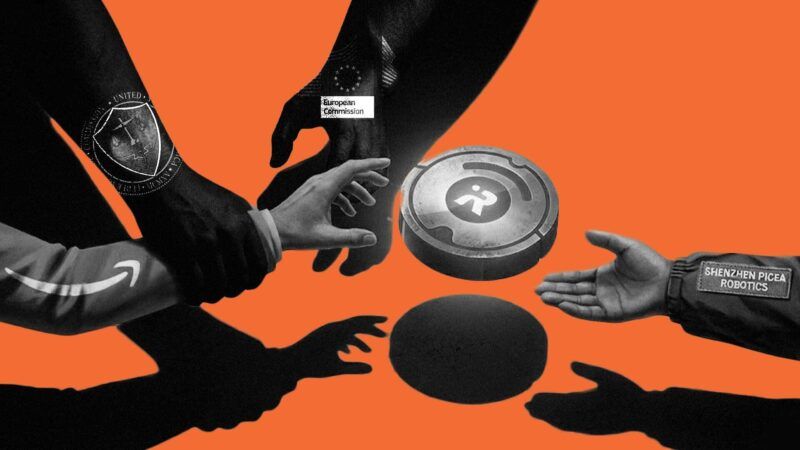
iRobot, the creator of Roomba, filed for bankruptcy on Sunday. If Amazon had been allowed to acquire the company in 2022, consumers likely would have enjoyed improved quality and lower prices. Now, thanks to antitrust regulators, iRobot will be acquired by a massive Chinese robot vacuum manufacturer, Shenzhen Picea Robotics, instead of American-owned Amazon.
iRobot was founded in 1990 by three roboticists from the Massachusetts Institute of Technology. After designing robots for space exploration and military use, the company released its first consumer product in 2002: the Roomba floor-vacuuming robot. By 2021, the year its stock value reached its maximum of over $133 per share, iRobot had sold over 40 million household robots. The company's value more than halved by the time Amazon offered to purchase it for $61 per share in August 2022.
This deal alarmed antitrust regulators in the United States and the European Union.
In September 2022, the Federal Trade Commission (FTC) "requested more information from both companies about the $1.7 billion deal…an indicator of deeper scrutiny by antitrust officials," CNN reported at the time. Likewise, the European Commission objected to the proposed acquisition in November 2023 on the grounds that it was likely to "restrict competition in the market for the manufacturing and supply of [robot vacuum cleaners]."
Not all antitrust regulators were opposed: The United Kingdom's Competition and Markets Authority "cleared the transaction, finding that it would not lead to competitive concerns in that market," noted Alden Abbott, former general counsel of the FTC.
But the British economy is only about one-tenth as large as the American economy, and about one-fifth that of the European Union. Accordingly, seeing "no path to regulatory approval in the European Union" and anticipating an imminent legal challenge from the FTC, Amazon withdrew its $1.4 billion bid to acquire the embattled robot company in January 2024, as Reuters reported.
When it did so, FTC Associate Director for Merger Analysis Nathan Soderstrom stated that the Commission was "pleased that Amazon and iRobot have abandoned their proposed transaction [because] the Commission's investigation revealed significant concerns about the transaction's potential competitive effects." Likewise, Margrethe Vestager, head of competition policy for the European Commission, said the merger would have "[led] to higher prices, lower quality, and less innovation for consumers."
Since then, iRobot's profit margin has been whittled away by intense price competition from foreign firms and double-digit tariffs on its imported Roomba products in the U.S., which cost the company $23 million. Giorgio Castiglia, economic policy analyst at the Information Technology and Innovation Foundation, says "iRobot struggled to compete against state-backed Chinese robotics rivals and laid off more than half of its workforce between late 2023 and March 2025." As of the first quarter of 2025, iRobot's share of the worldwide smart vacuum market was less than 10 percent, with Chinese companies Roborock, Ecovacs, Dreame, and Xiaomi making up more than half. Now that Picea Robotics has acquired iRobot in exchange for canceling over $260 million of its debt, Chinese firms make up more than 63 percent of the market.
Americans purchasing their robot vacuum cleaners from China is not a national security threat, nor does it mean that the market will be flooded with shoddy imports—Picea will compete with Roborock, Ecovacs, Dreame, Xiaomi, and other manufacturers to deliver increasingly inexpensive and high-quality products to consumers around the world, just as Amazon would have. However, thanks to the American government, a once American firm is now Chinese.




