
Trump Will Let Nvidia Sell Chips to China—but the Feds Will Get 25 Percent of the Profits
Why make the government a middleman in the chip war?
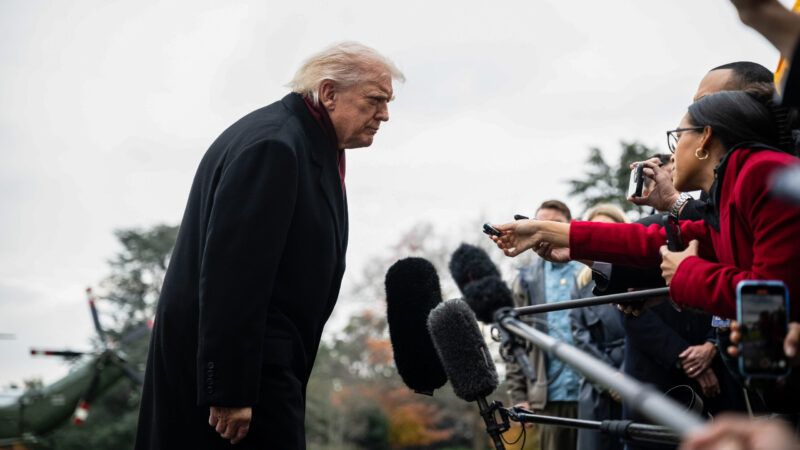
On Monday, President Donald Trump announced in a Truth Social post that he had "informed President Xi, of China, that the United States will allow NVIDIA to ship its H200 products to approved customers in China, and other Countries."
Under the terms of this deal, Nvidia will pay the U.S. government 25 percent of profits from the sale of H200 chips, and any potential customers will be "vetted by the Department of Commerce," according to CNBC. The president added that he'll apply the same approach to Advanced Micro Devices (AMD), Intel, and "other GREAT American Companies."
The announcement is a reversal of the Trump administration's previous stance on exporting chips to China, including a ban on the sale of Nvidia's A100, H100, and RTX 5090 graphics processing units (GPUs). The H200 is an upgraded version of Nvidia's H100 chip and is nearly six times more powerful than the older H20. The deal does not include Nvidia's next-generation Rubin superchip or its advanced Blackwell GPUs.
Despite being previous-generation products with less power than the Blackwell B30A and B300 chips, the H200 and H100 are still expected to be highly valuable for advanced computing and AI through 2026. Trump has repeatedly sought to use export controls to limit China's AI growth and spur American dominance in the sector.
In August, the Trump administration attempted a similar move, granting export licenses to Nvidia and AMD in exchange for 15 percent of the revenue generated by the sales. In response to those measures, the Chinese government "banned the country's biggest technology companies from buying Nvidia's artificial intelligence chips," per the Financial Times, choosing instead to strive for self-sufficiency.
While Trump has framed the deal as beneficial for both sides, a Tuesday Financial Times report casts doubt on his claim that "President Xi responded positively" to the announcement. According to the Financial Times, "Beijing"—already well-versed in navigating export controls—"is set to limit access to Nvidia's advanced H200 chips despite Donald Trump's decision to allow the export of the technology to China."
The tit-for-tat protectionist measures used by the U.S. and China fly in the face of economic reality. China has ramped up domestic production of advanced computing chips, with companies such as Huawei, Alibaba, and Baidu developing products to challenge Nvidia's market dominance.
However, an October study by the Institute for Progress, an innovation policy think tank, projects a "strong advantage" for the U.S. in semiconductor manufacturing through 2026 and 2027. With demand for advanced chips outpacing current supply, America's advantage lies in products like Nvidia's H200, Blackwell B300, and unreleased Rubin superchips, which have no substitute in the Chinese market.
Cutting China off from Nvidia's most advanced AI GPUs would incentivize production of domestic substitutes. Instead of Chinese firms spending their capital on products from Nvidia, AMD, or allied companies such as the Taiwan Semiconductor Manufacturing Company, they'd likely invest in China's chip manufacturers. As previously covered by Reason, export-driven growth has been a cornerstone of the U.S. semiconductor industry's success, even as American manufacturing capacity has fallen.
The federal government taking a 25 percent cut of Nvidia's sales reeks of crony capitalism and extends the use of failed tactics, like export controls, to promote sector growth. It could also be unconstitutional. Conditioning foreign sales of advanced chips on a 25 percent profit-sharing agreement would seem to contradict the Export Clause, which plainly states that "No Tax or Duty shall be laid on Articles exported from any State."
Unfortunately, the Trump administration has made a habit of determining when and with whom private firms can conduct business. While the president claims this policy will "support American Jobs, strengthen U.S. Manufacturing, and benefit American Taxpayers," it's more likely that this method of picking winners and losers will create a cascading effect of negative consequences beyond this administration.
