
Trump's $11 Billion Farm Bailout Is Further Proof That Tariffs Aren't Working
But don't expect the White House to think too hard about it.
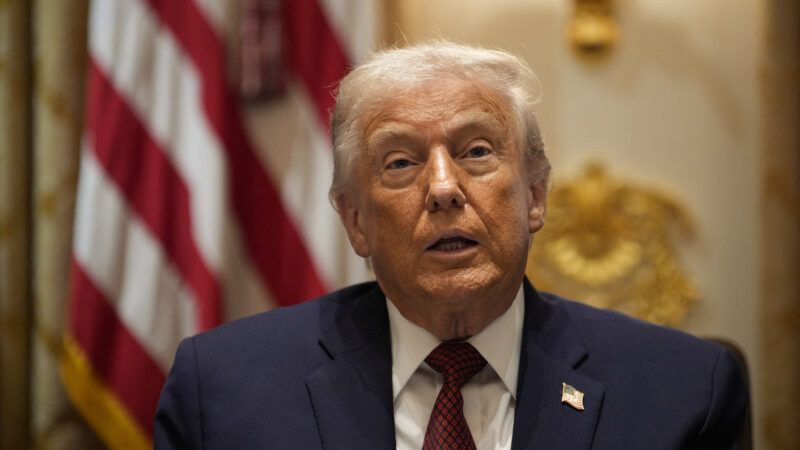
In a more serious presidential administration, the decision to spend $11 billion bailing out American farmers might inspire a moment of introspection.
Why is such a bailout necessary? It could be that President Donald Trump's tariffs are creating higher prices for farmers and making American agricultural products less competitive on the global market—as the Farm Bureau, an industry group, has been saying for months.
There was no such introspection on Monday afternoon, as Trump announced an $11 billion bailout—or a "bridge payment," as the White House termed it—for farmers facing economic hardship. Trump said he was "delighted" to spend what he called "a small portion" of the tax dollars collected via tariffs to fund the bailout.
"We're taking in so much money from the tariffs now," Trump said. "Without it, we wouldn't be able to help you."
Again, that ought to inspire some second-guessing. If the government wasn't "taking in" all that revenue from the pockets of American consumers—including farmers who have to buy equipment, fertilizer, and other things—maybe there would be no need for a bailout? Maybe the help wouldn't be needed if the harm weren't occurring in the first place.
Alas, the president and some of the administration's top officials took a very different approach to Monday's announcement. There was much blame heaped on the Biden administration for overseeing a surge in inflation, and much praise for Trump's ability to get inflation down to lower levels. But if inflation has been fixed (or has it?), then why the need for a bailout?
Such contradictions don't worry the Trump administration. Take Agriculture Secretary Brooke Rollins, for example. She spent months cheering for Trump's tariffs and reassuring farmers that the president's trade policies would be good for them. More recently, she's been the architect of the administration's bailout plan.
On Monday, she sat two chairs down from Trump and delivered the most spectacular assessment of the administration's plan.
"Instead of farming for government checks, they can farm to feed their family, sell their products, and pass it on to the next generation," Rollins said, at an event where the administration was literally announcing $11 billion in government checks for farmers.
But, of course, a more serious presidential administration would have learned this lesson already. When Trump hiked tariffs during his first term in office, much of the pain was felt by American farmers, who faced higher prices for equipment and fertilizer while also losing access to some key export markets. In response, the Trump administration spent $28 billion on a bailout that—like pretty much all bailouts—mostly helped the biggest and most politically connected farmers.
Yet here we are, several years later, and the same president has engaged in the same stupid trade policies with the same predictable results. Farmers are once again being hurt by higher costs and the loss of key export markets. In response, the Trump administration is once again throwing billions of taxpayer dollars at the problem and acting like that's a solution.
