
Donald Trump Says He'll 'Be Involved' in Choosing Who Gets To Merge With Warner Bros.
Paramount Skydance is banking on the Ellison family's relationship with Trump following Netflix outbidding the company to acquire Warner Bros.
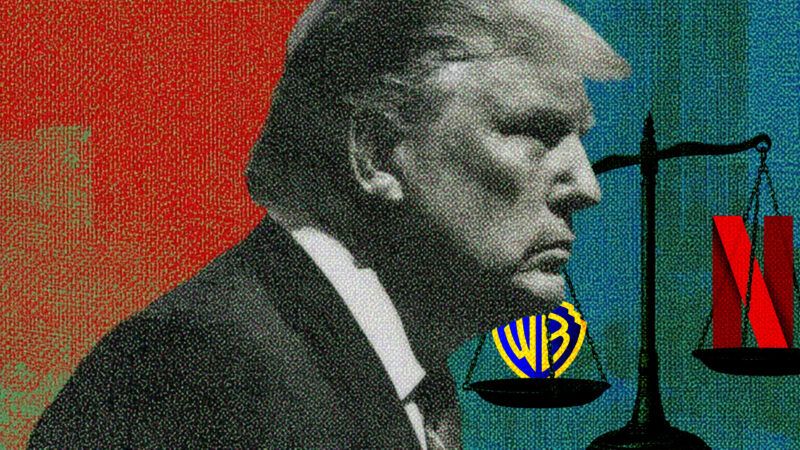
In the three days since Netflix announced its planned $83 billion acquisition of Warner Bros., neither the Federal Trade Commission (FTC) nor the Justice Department's antitrust division has released public statements about whether they will sue Netflix for anticompetitive conduct. But that doesn't mean the government won't impact the deal. On Sunday, President Donald Trump promised that he'll "be involved in that decision," in yet another instance of Republican central planning.
To be sure, there are legally sound reasons for the antitrust enforcers to bring action against Netflix's deal with Warner Bros. Section 7 of the Clayton Antitrust Act, traditionally enforced by the FTC, outlaws acquisitions "the effect of [which] may be substantially to lessen competition, or to tend to create a monopoly." Likewise, Section 2 of the Sherman Antitrust Act, typically invoked by the Justice Department, forbids attempts "to monopolize any part of the trade or commerce."
Neither the Clayton Act nor the Sherman Act specify a particular market share that a firm has to hit to be considered a monopoly. However, as Judge James Boasberg of the U.S. District Court for the District of Columbia noted in his recent decision in FTC v. Meta, the Supreme Court has never found a party with less than 75 percent market share to have monopoly power. If the deal goes through, Netflix's market share would fall well short of this threshold.
Eric Fruits, senior scholar at the International Center for Law and Economics, approximates that 18 percent of total streaming time is spent on Netflix, while 12 percent is spent on Warner Bros. (primarily through HBO Max). Even Paramount Skydance's lawyers estimated that Netflix and Warner Bros. "would have a 43% share among global [streaming video on demand] subscribers," in a letter sent to Warner Bros. on December 1 to dissuade the company from accepting Netflix's bid. While such a market share is unlikely to bring about a lawsuit under the Sherman Act, it is more than enough to justify a lawsuit under the Clayton Act.
And that's just what the FTC might do at Trump's behest. In March, Trump fired Democrat-appointed FTC commissioners Rebecca Slaughter and Alvaro Bedoya, and in November, moderate Republican Melissa Holyoak left to serve as interim U.S. attorney in Utah. That leaves only MAGA loyalists Mark Meador and Chairman Andrew Ferguson on the commission.
On Monday, Paramount Skydance, whose majority shareholders are Larry Ellison, an ardent Trump supporter, and his son, David Ellison, announced a hostile $100 billion bid. The $30 per share cash offer to purchase the entire company is financed, in part, by Affinity Partners, whose chief executive officer is Trump's son-in-law, Jared Kushner. The familial and financial ties, plus Trump saying that the deal "could be a problem," seem to indicate that the acquisition could soon be kaput.
But this is a notoriously mercurial president, and even Larry Ellison's close relationship with Trump may not be enough to inspire the president to direct the FTC to stop the Netflix–Warner Bros. merger.
In the weeks leading up to the acquisition announcement, Netflix co-CEO Ted Sarandos met with Trump to receive his approval for the Warner Bros. bid, according to The Hollywood Reporter. (Wooing the president has been a successful strategy for other Big Tech firms in the second Trump administration.) And on the same day that he warned about the impacts of a Netflix–Warner Bros. merger, Trump praised Sarandos for doing "an incredible job….a really legendary job" with Netflix. Trump's remarks about Paramount are less glowing. After 60 Minutes aired an interview with Trump's newest enemy, Rep. Marjorie Taylor Greene (R–Ga.), on Sunday, the president blamed Paramount, "the new ownership of 60 Minutes [for allowing] a show like this to air" and accused them of being "NO BETTER THAN THE OLD OWNERSHIP….Since they bought it, 60 Minutes has actually gotten WORSE!"
Considering Trump's acerbic remarks about 60 Minutes, the Ellison family may now be wishing that the president had less influence over supposedly independent agencies. Following Monday's oral argument in Trump v. Slaughter, the Supreme Court appears likely to overturn Humphrey's Executor, rendering the FTC even more subject to presidential caprice than it already is, and granting Trump even more control over the economy.
