

Donald Trump Says He'll 'Be Involved' in Choosing Who Gets To Merge With Warner Bros.
Paramount Skydance is banking on the Ellison family's relationship with Trump following Netflix outbidding the company to acquire Warner Bros.
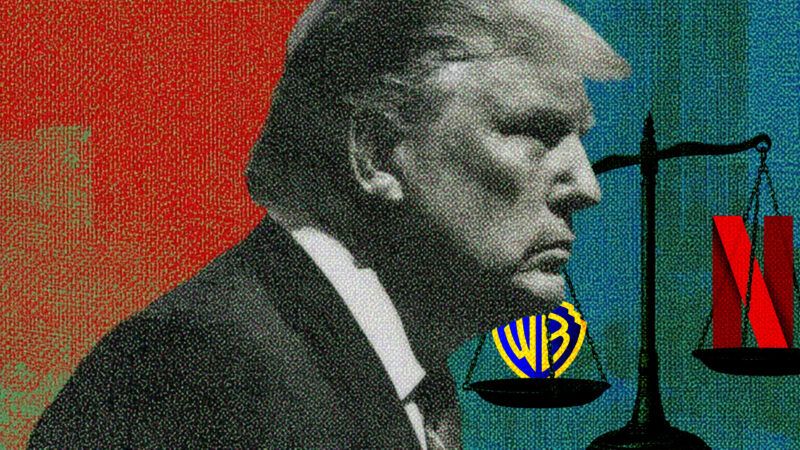
In the three days since Netflix announced its planned $83 billion acquisition of Warner Bros., neither the Federal Trade Commission (FTC) nor the Justice Department's antitrust division has released public statements about whether they will sue Netflix for anticompetitive conduct. But that doesn't mean the government won't impact the deal. On Sunday, President Donald Trump promised that he'll "be involved in that decision," in yet another instance of Republican central planning.
To be sure, there are legally sound reasons for the antitrust enforcers to bring action against Netflix's deal with Warner Bros. Section 7 of the Clayton Antitrust Act, traditionally enforced by the FTC, outlaws acquisitions "the effect of [which] may be substantially to lessen competition, or to tend to create a monopoly." Likewise, Section 2 of the Sherman Antitrust Act, typically invoked by the Justice Department, forbids attempts "to monopolize any part of the trade or commerce."
Neither the Clayton Act nor the Sherman Act specify a particular market share that a firm has to hit to be considered a monopoly. However, as Judge James Boasberg of the U.S. District Court for the District of Columbia noted in his recent decision in FTC v. Meta, the Supreme Court has never found a party with less than 75 percent market share to have monopoly power. If the deal goes through, Netflix's market share would fall well short of this threshold.
Eric Fruits, senior scholar at the International Center for Law and Economics, approximates that 18 percent of total streaming time is spent on Netflix, while 12 percent is spent on Warner Bros. (primarily through HBO Max). Even Paramount Skydance's lawyers estimated that Netflix and Warner Bros. "would have a 43% share among global [streaming video on demand] subscribers," in a letter sent to Warner Bros. on December 1 to dissuade the company from accepting Netflix's bid. While such a market share is unlikely to bring about a lawsuit under the Sherman Act, it is more than enough to justify a lawsuit under the Clayton Act.
And that's just what the FTC might do at Trump's behest. In March, Trump fired Democrat-appointed FTC commissioners Rebecca Slaughter and Alvaro Bedoya, and in November, moderate Republican Melissa Holyoak left to serve as interim U.S. attorney in Utah. That leaves only MAGA loyalists Mark Meador and Chairman Andrew Ferguson on the commission.
On Monday, Paramount Skydance, whose majority shareholders are Larry Ellison, an ardent Trump supporter, and his son, David Ellison, announced a hostile $100 billion bid. The $30 per share cash offer to purchase the entire company is financed, in part, by Affinity Partners, whose chief executive officer is Trump's son-in-law, Jared Kushner. The familial and financial ties, plus Trump saying that the deal "could be a problem," seem to indicate that the acquisition could soon be kaput.
But this is a notoriously mercurial president, and even Larry Ellison's close relationship with Trump may not be enough to inspire the president to direct the FTC to stop the Netflix–Warner Bros. merger.
In the weeks leading up to the acquisition announcement, Netflix co-CEO Ted Sarandos met with Trump to receive his approval for the Warner Bros. bid, according to The Hollywood Reporter. (Wooing the president has been a successful strategy for other Big Tech firms in the second Trump administration.) And on the same day that he warned about the impacts of a Netflix–Warner Bros. merger, Trump praised Sarandos for doing "an incredible job….a really legendary job" with Netflix. Trump's remarks about Paramount are less glowing. After 60 Minutes aired an interview with Trump's newest enemy, Rep. Marjorie Taylor Greene (R–Ga.), on Sunday, the president blamed Paramount, "the new ownership of 60 Minutes [for allowing] a show like this to air" and accused them of being "NO BETTER THAN THE OLD OWNERSHIP….Since they bought it, 60 Minutes has actually gotten WORSE!"
Considering Trump's acerbic remarks about 60 Minutes, the Ellison family may now be wishing that the president had less influence over supposedly independent agencies. Following Monday's oral argument in Trump v. Slaughter, the Supreme Court appears likely to overturn Humphrey's Executor, rendering the FTC even more subject to presidential caprice than it already is, and granting Trump even more control over the economy.

Editor's Note: As of February 29, 2024, commenting privileges on reason.com posts are limited to Reason Plus subscribers. Past commenters are grandfathered in for a temporary period. Subscribe here to preserve your ability to comment. Your Reason Plus subscription also gives you an ad-free version of reason.com, along with full access to the digital edition and archives of Reason magazine. We request that comments be civil and on-topic. We do not moderate or assume any responsibility for comments, which are owned by the readers who post them. Comments do not represent the views of reason.com or Reason Foundation. We reserve the right to delete any comment and ban commenters for any reason at any time. Comments may only be edited within 5 minutes of posting. Report abuses.
Please to post comments
Somebody tell the OrangeFather that his opinion isn't needed nor wanted.
Abolish the FTC. Repeal all anti-trust law.
If you were to look at the history of business monopolies, you would find that monopolies severely hurt consumers. Anti-trust laws are both important and need to be enforced more.
No, he would not, nor would any thinking person. You are the ignorant one, here as in almost every other instance of shooting off your mouth before thinking.
Top men.
If you were to look at the history of monopolies, you'd find that they tend to exist for one of three reasons. Most often monopolies exist because the government outlaws competition. Less often they exist because they're just really good at what they do which allows them to do what they do at a lower cost than competitors. Finally they exist because they have exclusive access to something, like a natural resource. The latter two come and go as market innovations give competitors an edge. The first one though, that is a problem created by government. And the solution is less government, not more.
They sometimes form due to aggressive business practices such as mergers and anti-competitive behavior. Every wonder why cable internet coverage maps common don't overlap?
Every wonder why cable internet coverage maps common don't overlap?
Generally that's because the delivery infrastructure that they built is expensive which makes them the third kind that I mentioned, and/or they're given regional monopolies by the government in the form of franchises.
A former coworker of mine didn't have cable or high speed internet because he lived off the beaten path. The cable company said they'd happily provide him with services if he ponied up the estimated fifteen thousand dollars it would cost the company to connect him to the nearest wires. Mergers and anti-competitive behavior had nothing to do with it.
Personally I have a choice between two companies.
Cable internet? Those city-granted monopolies? No, I KNOW why they don't overlap, and you would too if you'd been paying the slightest bit of attention to news over the past few decades.
If you don't support President Trump getting involved in business decisions then you're a leftist Marxist with TDS.
If the president was a Democrat then supporting them getting involved would make you a leftist Marxist with TDS.
Right and wrong are determined by political party, not what people actually do.
Ironically nobody has ever said this.
This is exactly you and anybody that hasn't muted you knows this.
Do you want to try a grammatically correct sentence?
Im sure you can help sarc out with a citation. Then again generally leftists choose to just push lies.
Should we bother calling this Crony Capitalism or just stick to Bribery.
Trump truly does want to bring back the "Great America" of the 1880s (the pre Garfield/Arthur era) and 1890s (McKinley)….tariffs and patronage. And what do they both have in common…vesting the determination of the success of businesses and individuals NOT in the meritocracy of individuals and businesses but in a king/party who decides who gets favor and who does not.
For any history “buff” watch the NFLX show “Death by Lightning” about James Garfield. Some interesting parallels to today….except then the desire was to destroy patronage in favor of a nonpartisan civil service structure vs prioritize patronage.
Tell us again how it is better when political factors and self-dealings are a better way to run the government than career experts.
How about neither? The market doesn't need "top men" in government, whether a politician or a bureaucrat, to make decisions like this.
Tell us again how vocal you were when Biden was the puppet-in-chief. Tell us again how vocal you have been against Pelosi and Bernie and Omar getting rich while in Congress.
Molly thinks the people you named ARE career experts.
"Tu quoque! Tu quoque!"
So if skydance buys them will future Warner movies only be 15 seconds long?
When I first saw TikTok my first thought was, "This is the platform where there the prophetic ow my balls will first find it's audience."
KNOCK IT OFF
Right here, in this very article, in the tail end if your begathon, you demonstrate every thing that is wrong with reason.com.
To be sure, there are legally sound reasons for the antitrust enforcers to bring action against Netflix's deal with Warner Bros. Section 7 of the Clayton Antitrust Act ...
What kind of libertarian pretends antitrust is a Constitutionally enumerated power of government?
What an unserious article, in an unserious magazine.
Saying that something is "legally sound" does not automatically imply that it is "a Constitutionally enumerated power of government".
Those are distinctly separate issues. If all articles about a law included a discussion about the constitutionality of the law, then the articles would quickly become tedious and boring. Like you.
The word youre too dumb to know is statutory.


