

Brazil's Democracy Is Not Safer After Bolsonaro's Conviction
The unprecedented conviction of the former president is reshaping Brazilian politics.
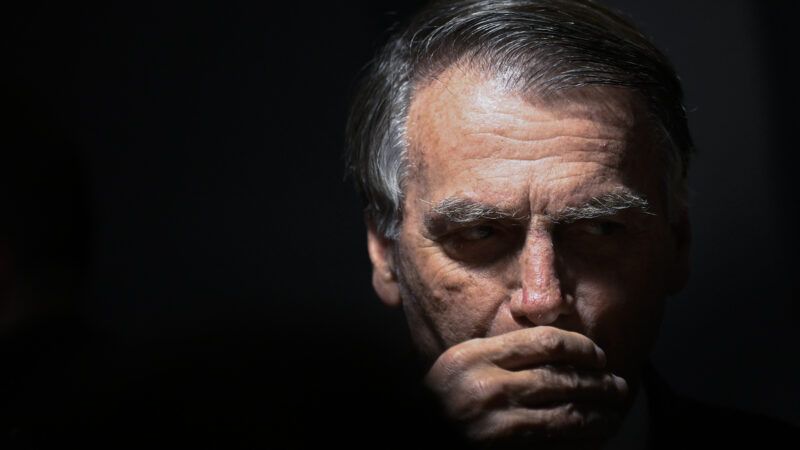
Brazil had its own January 6 in 2023, when hundreds of former President Jair Bolsonaro's supporters stormed Congress, the Supreme Court, and the presidential palace in Brasília. They were protesting Luiz Inácio Lula da Silva's presidential election victory. Nearly three years later, the Supreme Federal Court—the country's constitutional court—has sentenced Bolsonaro to 27 years in prison for allegedly plotting a coup.
The case began after police discovered a draft decree in the house of Bolsonaro's justice minister that would have annulled the 2022 election and placed Brazil's electoral authority under emergency rule. Testimony and phone records indicated that Bolsonaro reviewed the document and pressed military commanders to intervene.
Prosecutors accused Bolsonaro of leading a network that spread disinformation, courted the armed forces, financed protest camps, and tolerated plots of political violence.
Bolsonaro's trial has become a flashpoint, often compared to the January 6 riot in the U.S. Capitol, when a mob stormed the building as Congress certified Joe Biden's presidential election win. But Brazil's institutions don't map neatly onto America's. Unlike in the U.S., Brazil has a dedicated electoral court that regulates campaigns, while its Supreme Federal Court can both initiate investigations and judge the same defendants.
That concentration of investigative and adjudicative powers is different from the U.S. Supreme Court, says attorney Leonardo Corrêa, president of Lexum, an association of Brazilian legal scholars. In his view, President Donald Trump confronted "a system that resists personalism; Bolsonaro [was] judged by institutions that absorb and amplify it. The former struggles against the machine; the latter is prosecuted by a machine that has forgotten its limits."
Trump, who has cast Bolsonaro as a political ally, called the trial a "witch hunt." The White House responded with 50 percent tariffs on Brazilian imports and sanctions against Justice Alexandre de Moraes—a central figure in Bolsonaro's prosecution—under the Global Magnitsky Human Rights Accountability Act, freezing his assets and stripping his U.S. visa.
Bolsonaro denied leading a coup but, in June 2025 testimony, admitted to holding "conversations" with commanders and ministers about post-election "constitutional alternatives"—including extraordinary measures such as a state of siege, as reported by the Brazilian financial news website InfoMoney. On September 11, a five-member panel of Brazil's Supreme Federal Court convicted him on five counts, including "taking part in an armed criminal organization; attempting to violently abolish democracy; organizing a coup; and damaging government property and protected cultural assets," according to NBC News. Several allies received sentences of up to 26 years.
For some Brazilians, Bolsonaro's sentence stokes fears of creeping authoritarianism; for others, it confirms suspicions that the Supreme Federal Court is exceeding its constitutional limits. Brazilian lawyer João Ferreira tells Reason, "Unfortunately, we're witnessing a political, not a legal, trial. And with the U.S. attention on our situation, I fear next year's elections won't even be recognized. It would be a disaster for us."
A Genial/Quaest poll found Brazilians trust the Catholic church (73 percent) and the armed forces (70 percent) far more than they trust the Supreme Federal Court (50 percent), Congress (45 percent), or political parties (36 percent). The court's handling of the case "only accelerates the ongoing erosion of our democracy," says lawyer and political commentator Carol Sponza, pointing to "a Supreme Court justice sanctioned under the Magnitsky Act and a Senate that fails to perform its checks-and-balances role" as proof that "the institutions are not functioning properly."
Magno Karl, a political scientist and executive director of Livres, a Brazilian liberal political movement, says the country faces a paradox: "It strengthens democracy to prosecute people who conspire against it, but the extraordinary powers the Supreme Court claims to defend democracy have not always been used wisely…they have been used to silence critics."
For now, none of the sentences will be enforced. Brazil's appeals process allows challenges that could delay imprisonment for years, and Bolsonaro's lawyers plan to appeal both domestically and internationally.
Still, the conviction blocks Bolsonaro and his allies from holding public office ever again. That makes him both sidelined and politically useful. "Without the former president's blessing, no right-wing party will land a candidate for the Senate," says Sponza. Karl adds that Bolsonaro "will be seen by many as someone treated unfairly, someone who didn't deserve prison because he never actually overthrew the government—he didn't mobilize the army, there were no tanks in the street," despite the evidence presented against him.
"Even if he becomes a myth, people will move on. His legacy will remain, but more as a symbol than as a set of ideas," Karl adds. Bolsonaro "has four kids in politics, they will carry [his legacy] forward. Politics will move on. Life will continue. Next year there will be elections, and the Brazilian right will have a future beyond Bolsonaro."

Editor's Note: As of February 29, 2024, commenting privileges on reason.com posts are limited to Reason Plus subscribers. Past commenters are grandfathered in for a temporary period. Subscribe here to preserve your ability to comment. Your Reason Plus subscription also gives you an ad-free version of reason.com, along with full access to the digital edition and archives of Reason magazine. We request that comments be civil and on-topic. We do not moderate or assume any responsibility for comments, which are owned by the readers who post them. Comments do not represent the views of reason.com or Reason Foundation. We reserve the right to delete any comment and ban commenters for any reason at any time. Comments may only be edited within 5 minutes of posting. Report abuses.
Please to post comments
Sqrlsy prefers ass-to-mouth when he has a dirty bottom so he can receive an extra snack.
I'm sure our American politicians are taking notes. No doubt some see this as a shining example of justice.
Probably the same people who read Orwell's 1984 as a guidebook.
I keep telling leftists "1984" is not a guidebook for government, but they won't listen to me demonstrating once again you can lead a horse to water...
Not perfect justice, but better than everyone having to do with January 6th 2021 being pardoned and even put back into positions of power.
Like Pelosi?
Like Officer Byrd?
It almost happened here. All over the world, populist right (and here populist center) politicians who run afoul of the globohomo cartel are eliminated from the electoral process, if not outright jailed on flimsy pretext.
People who foment insurrections need to be removed from the electoral process. Long prison sentences are appropriate remedies.
So Clinesmirh, Biden, Comey, Clapper, Strzok, Page, Hillary, Vindman, Brennan, Blumenthal, and who else?
They may need to open up a new detention center
Add yourself as an overt sedition aider and abettor.
My impression of that self-important judge isn't improved by this. All he's done is create a living martyr. I have no doubt now that he thinks he's the most important person in the country, the only one who can prevent its slide into right-wing authoritarianism, which justifies his own left-wing authoritarianism. Thus it ever was with politics.
One of the greatest gifts a elected official can do for a country is to not become a dictator, to not run for endless terms, to not prosecute previous leaders.
Brazil is taking a dangerous turn towards a leftist dictatorship. Yes the corporate media always associates dictatorships with the right wing in large part because they are ignorant or lying about history. There is fair amount of abuse from both sides of the political perspective.
Brazil has an out of control supreme court official and a willing accomplice in the current president. The attempt is to create a permanent leftist state so they have continual power unchecked because they have criminalized any decent or ability to oppose their leftist rule.
The real danger is not the short term leftist overreach insanity regarding policy, but rather the criminalization of opposition. This destroys the natural ebbs and flows where parties overreach and the people are able to reign the government in are reset back to normalcy.
Societies move slower that leftists want and faster than traditionalists want. Not every hair-brained leftist idea is good or will ever be accepted by a society, but some are at least partially good. Typically these good ideas are somewhat twisted and need to be modified to be accepted by a society. Normally even the best leftist ideas contain twisted baggage that needs to be removed before they are viable.
Using force to change a society is only going to foment resistance and eventually karma will return and smack those using force back into place and perhaps beyond. The difficult thing is this works both ways.
Convicting Bolsonaros is a very bad look and very bad sign, not because I like or support Bolsonaros, but rather that it is counter productive and tends to lead to an oppressive government.
"Yes the corporate media always associates dictatorships with the right wing in large part because they are ignorant or lying about history."
Correction: modern corporate media fully supports left wing dictatorships, and, like with all their propaganda, uses "Right Wing!" as a slur.
"to not prosecute previous leaders"
One of the worst things a leader can do is to exempt crooked leaders from prosecution. It means that getting elected to high office is the best way to manage an organized criminal enterprise with no consequences. You are promoting kleptocracy.
I agree , but SCOTUS has given Obama immunity
"tends to lead to an oppressive government"
It was Bolonsaro who set out to stage a military coup. Brazil has had a lot of experience with such. Lula is no saint, but he is nothing compared to what the military dictatorships did.
The article mentioned this.
Prosecutors accused Bolsonaro of leading a network that spread disinformation, courted the armed forces, financed protest camps, and tolerated plots of political violence.
Is this an accurate depiction of what he was accused of?
>but some are at least partially good. Typically these good ideas are somewhat twisted and need to be modified to be accepted by a society.
Its worse than that and why Leftism is so horrible.
These (rare;) ideas *start out reasonable*. Its the Leftists themselves that twist them into horrific forms as they each try to outcompete each other in a purity spiral.
Take, for example, 'privilege'. In its original context its a useful tool for contextualizing the different ways people can experience a common society/culture.
Then it got turned into a reason to hate white people. Because, of course, we ALL have the same level of privilege Biden has enjoyed all his life . . .
Always remember the fundamental "ethic" of the left: their violence is speech, and any opposing speech is violence.
Prosecutors accused Bolsonaro of leading a network that spread disinformation, courted the armed forces, financed protest camps, and tolerated plots of political violence.
Is that an accurate description of what he was accused of?
"The unprecedented conviction of the former president is reshaping Brazilian politics."
TRANSLATION: Brazil is going back to the bad old days of being a banana republic with a authoritarian or totalitarian dictator as its sole form of government.
Worse - not *a* dictator but a whole bunch of them. Everyone of the seniormost judges are now a dictator.
Will be interesting to see how the internal civil wars within the judiciary for power develop.
>Brazil's Democracy Is Not Safer After Bolsonaro's Conviction
I am assured that the judiciary having total power of unreviewable judicial review, total power to override the rest of government, is absolutely necessary to preserve 'our precious democracy'.
Manufactured consent. Managed democracy.


