

The $1.9 Trillion American Recovery Act Could Have Huge Implications for State Tax Policies
Six different states are already suing over a broad prohibition on tax cuts that was slipped into March's $1.9 trillion COVID relief bill.
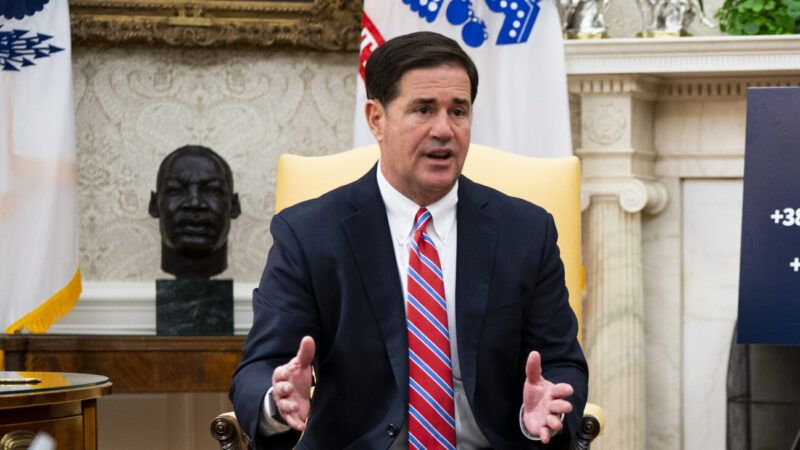
Like many states, Arizona has emerged from the COVID-19 pandemic unexpectedly flush with cash. Its budget surplus exceeds $1 billion.
But as fears of a pandemic-triggered recession have faded, federal policy has yet to catch up. Arizona got an extra $4 billion as part of an unnecessary federal bailout last month and is scheduled to receive another round of payments later this summer. With state coffers overflowing, Gov. Doug Ducey and state lawmakers are faced with an unexpected dilemma: find new ways to spend a one-time influx of revenue, or risk violating federal law by letting taxpayers keep some of their own money.
That last bit is what's at stake in a series of lawsuits launched by six states, including Arizona. The $350 billion state government bailout included in the American Rescue Plan, the $1.9 trillion emergency spending bill passed in March, included a provision expressly telling states that they "shall not use the funds provided…to either directly or indirectly offset a reduction in the net tax revenue," or do anything that "reduces any tax (by providing for a reduction in a rate, a rebate, a deduction, a credit, or otherwise) or delays the imposition of any tax or tax increase."
It's an unusual—and possibly even unconstitutional—rule, and it might trip up Ducey's plans for a sweeping overhaul of Arizona's income tax code. While Congress does have the power to limit how states can use federal funds, the broad nature of the provision in the American Rescue Plan may overstep the constitutional boundaries on congressional power in two key ways, according to Joe Bishop-Henchman, a vice president at the National Taxpayers Union Foundation (NTUF).
The first has to do with legal precedents regarding the conditions Congress can place on states that receive federal aid. Infamously, the Supreme Court in 1987 upheld a federal law that threatened to withhold some highway funds from states that refused to raise the legal drinking age to 21. More recently, however, the Supreme Court struck down a major component of the Affordable Care Act that threatened to withhold Medicaid funding from states that refused to expand Medicaid eligibility. Chief Justice John Roberts described that penalty, which could have cost some states as much as 10 percent of their overall revenue, as an "economic dragooning."
There is a wide grey area between the amount of money that was at stake in the drinking age mandate and the Obamacare Medicaid expansion mandate. But the more important aspect might be how tailored the mandate is.
"Congress can impose conditions on federal funds, but only if the condition is related to a federal interest in a national project or program, the condition is unambiguous, and the condition encourages rather than coerces states to act," Bishop-Henchman, who is also the national chairman of the Libertarian Party, writes. In amicus briefs filed by NTUF, the organization argues that the tax policy mandates imposed by the American Rescue Plan—specifically, the ban on "indirectly" using the bailout money to pay for tax cuts—are both too broad and too ambiguous to meet the standards established by courts.
The second issue is the Supreme Court's "anti-commandeering" doctrine, which prohibits the federal government from dictating policies to states whether money is involved or not. That was the reason why President Donald Trump couldn't order states to "reopen" after the early stages of the COVID-19 pandemic had passed, leaving him to rage on Twitter while governors mostly stayed in charge of state-level pandemic policies. It's also the reason why the Supreme Court recently struck down a 1992 law that effectively banned sports betting in most of the country.
So these lawsuits speak directly to how much control the federal government will be able to exert over state tax policies in the coming years. Under the terms of the American Rescue Plan, states would be barred from reducing taxes through 2024.
That has potentially momentous consequences for a state like Arizona, where the Republican governor is pushing for a total overhaul of the state's personal income tax code to create a flat tax of 2.5 percent. That would give a tax cut to all taxpayers in the state—the lowest of the state's four tax tiers currently is 2.59 percent, while the highest is 8 percent.
Set aside the debate over the merits of those particular tax rates—a debate that continues to rage in the state Capitol, where one vote could swing the bill's passage. Is this a decision that should be made in Phoenix or in Washington, D.C.? That's the question that will be in front of federal courts in the coming months.
"Federal lawmakers have put their state counterparts in an impossible spot, forced to budget under significant uncertainty surrounding an expansive claim of federal power," writes Jared Walczak, a vice president in charge of state projects for The Tax Foundation.
The Treasury Department issued some guidance last month that clarifies a bit of the state bailout provisions, but Walczak says it hardly goes far enough. And it isn't just major overhauls like the one proposed in Arizona that could be affected. Normal policymaking at the state level could be impacted too.
"Imagine if, for instance, a state reduces the size of its drug enforcement budget within law enforcement and corrections agencies following the legalization of marijuana," Walczak suggests. "At the same time, suppose that the Department of Corrections uses federal dollars to treat coronavirus cases in prisons, or the Department of State Police uses funding to offset salaries or provide supplemental pay for officers. In neither case would these federally financed expenditures in any way offset the savings from reduced drug enforcement, yet it appears that the federal government would prohibit using these savings to help finance a tax reduction, since they coexist in the same department or agency."
It's possible that the federal government will simply decline to go after states that break the rules created by the American Rescue Plans. And it's possible that courts will strike down this overly broad attempt at dictating state policy. But it's also possible that state governments will be hamstrung for the next several years by a bailout they didn't need in the first place.




