Michael C. Moynihan | October 1, 2007
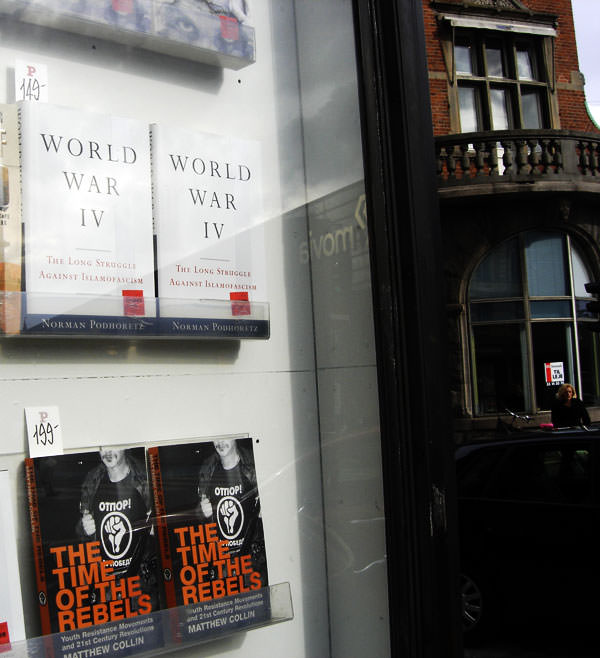
Over a year after the Danish newspaper Jyllands-Posten published those now-infamous cartoons of Mohammad—one of which portrayed the Muslim Prophet carrying a lit bomb in his turban—the country is still noticeably on edge. When I recently visited Copenhagen, a week after a pre-dawn raid netted a handful of suspected Islamic extremists, the twin issues of Islam and integration were difficult to avoid. On television, the news and chat shows were dominated by discussions of coexistence with the country's approximately 200,000 Muslims; newspapers were brimming with reader letters and editorials on Islamophobia, secularism and democracy; and a bookshop associated with the country's left-leaning daily Politiken prominently displayed Norman Podhoertz's latest book World War IV in the window, with a large stack on sale inside.
To get a sense of how this diminutive socialist country (previously famous for pork products, liberal views on pornography and Jante's Law) was tranformed into a main front in Europe's culture war, I sat down with the man responsible for printing the offending cartoons, Jyllands-Posten's culture and arts editor Flemming Rose. In a wide-ranging discussion, Rose expounded on his years in the Soviet Union, free speech versus "responsible speech" and his Muslim supporters.
I spoke with Rose in September at Jyllands-Posten's Copenhagen office.
reason: Did your time in Russia and as
Berlingske Tidende
correspondent in the Soviet Union inform your ideas of free speech
and political freedom?
Flemming Rose: Yes. I am going to write a book about the
cartoon crisis and I am going to compare the experience of the
dissidents in the Soviet Union to what has happened to people like
Ayaan Hirsi
Ali, Ibn
Warraq, Salman Rushdie and
Irshad
Manji... I am very much informed by my contact with [Soviet
dissidents] and I'm close to the Sakharov camp—people like Natan
Sharansky and
Sergei Kovalev... The dissidents were split between what I
would I would call the nationalist camp and the human rights
movement. And I would say that I identified more with the human
rights movement, although I am a big admirer of Solzhenitsyn, of
course, because of what he accomplished. But today he is, in fact,
supporting Putin and he believes that he's conducting a very wise
foreign policy program. I don't think Sakharov would have
subscribed to this view.
reason: Were you surprised by the reaction of those who
argued not for unfettered
free speech, but "responsible speech?"
Rose: Well, no. I think many people betrayed their own
ideals. The history of the left, for instance, is a history of
confronting authority—be it religious or political authority—and
always challenging religious symbols and figures. In this case,
they failed miserably. I think the left is in a deep crisis in
Europe because of their lack of willingness to confront the racist
ideology of Islamism. They somehow view the Koran as a new version
of Das Kapital and are willing to ignore everything else,
as long of they continue to see the Muslims of Europe as a new
proletariat.
Like during the Cold War, there is a willingness to establish a
false equivalence between democracy and oppression—between a
totalitarian ideology and a liberal ideology. When I look back at
my own behavior during the "cartoon crisis," it was very much
informed by my experience with Soviet Union because I saw the same
kind of behavior both inside the Soviet Union and those dealing
with the Soviet Union in the West.
reason: At the height of the "cartoon crisis," were you
surprised to turn the television on to images of people in Lahore
burning
Danish flags, mobs attacking Scandinavian
embassies? Did anyone at the paper anticipate such a
response?
Rose: Not at all. No one expected this kind of reaction.
Last year, I visited Bernard
Lewis at Princeton and he told me: "Your case in unique in a
historical sense. Never before in modern times, on such a scale,
have Muslims insisted upon applying Islamic law to what non-Muslims
are doing in non-Muslim country. It has never happened before. And
you can't really compare the Rushdie affair, because he was
perceived to be an apostate." And as he told me, there is a long
tradition of offending the Prophet in history. In the St. Petronio
church in Bologna there is, on the ceiling, a painting of Mohammad
in hell, based Dürer's paintings of Dante's Divine Comedy.
Those people who say, "you offended
one billion people," or "you offended a weak minority," they
lack the understanding of the raw power game that was at play here.
This had very little to do with insulting religious sensibilities,
though it was being used by influential groups and regimes in the
Middle East to stir up emotions. It was a very well planned and
executed operation. It was not spontaneous in any way.
Abu Laban, the Danish imam that promoted the cartoons in the
Arab world, was saying that we aren't allowed to build mosques in
Denmark, that the Koran is being censored, that we aren't allowed
to have our own cemeteries, that Muslims are almost on the verge of
being sent to concentration camps. But the fact is that Muslims in
Denmark enjoy more rights than they would in any Muslim country. In
fact, two weeks ago a delegation from the Egyptian parliament were
in Denmark and they were surprised when they spoke to Danish
Muslims who said "we enjoy living here."
Naser Khader, a Danish parliamentarian who
was very supportive of me and stood up in parliament and said "I am
very offended by those who insist on an apology to one billion
Muslims, because I am not offended by these cartoons." But, he
said, I am offended by being lumped into this grey mass of
"one billion Muslims."
reason: How do you rank the reactions of European
politicians?
Rose: I think it's a mixed bag. I think [European
Commission President]
Manuel Barraso, who has a background in an authoritarian
regime, understood the situation better than others, like, for
instance, Tony Blair and Jack Straw, who behaved disastrously.
Barraso came out very clear—a little late, maybe—but he said that
free speech is non-negotiable; it's the foundation of European
civilization. A lot of governments and opinion makers in Europe and
the West were driving this line that we have offended one billion
people and we should be ashamed of ourselves, free speech and but
responsible speech... all this crap.
But what really bothers me today—and this hasn't been reported very widely—is that right after the cartoon crisis, the Organization of the Islamic Conference at the United Nations sponsored a resolution condemning the "ridiculing of religion." It didn't pass, but in March of this year the United Nations Human Rights Consul, which is the highest international body in the world for the protection of human rights, passed a resolution condoning state punishment of people criticizing religion. I think this is a big scandal. This was a direct result of the "cartoon crisis." Fortunately the European Union voted against it. But countries like Russia, Mexico and China supported the resolution. And in this resolution, they call on governments to pass laws or write provisions into their constitutions forbidding criticism of religion. This would give a free hand to authoritarian regimes around the world to clamp down on dissidents.
One of the lessons I have drawn from this experience is that free speech is indivisible. I am in favor of removing all blasphemy laws and laws criminalizing Holocaust denial... I think that in a globalized world, the way forward is not raise barriers "protecting people," or calling for "responsible speech," but to do away with all kinds of limitations of speech.
Things have perhaps changing when they have their own cartoon
crises. I'm amazed that Swedish newspapers are republishing [artist
Lars Vilks cartoon of
Mohammad as a dog]-and not noticing the hypocrisy that they
didn't want to publish our cartoons. We published the Vilks
cartoon; almost all Danish newspapers did.
reason: Whose response disappointed you the most?
Rose: In Europe? Jacques Chirac, who lambasted
[Jyllands-Posten] and then flew to Saudi Arabia the next
week to sign a large weapons contract.
reason: How are the cartoonists doing?
Rose: They are OK: All back in Denmark. But they are still
under surveillance by the police.
reason: Are you under surveillance?
Rose: Every now and then. But we [at
Jyllands-Posten] don't feel in any immediate danger; we
aren't getting any information that we are being targeted. There is
an ongoing terror trial in
Odense, and according to the prosecutor, these young men
planned a terrorist attack against parliament and this
building.
I do receive some supportive emails from Muslims in Denmark, who
think that my struggle is their struggle. And I think this is very
important: Fundamentally, this is a struggle within the Muslim
community, and I think our duty is to send a very clear message
whose side we are on.
Michael Moynihan is an associate editor of
reason.

Help Reason celebrate its next 40 years. Donate Now!
Try Reason's award-winning print edition today! Your first issue is FREE if you are not completely satisfied.
Michael:
Why don't you take the time to interview Naser Khader, and/or other
leaders of Muslim groups who were taken-aback by both the cartoons
and the violent (and sad) reaction by some
Muslims? Someone other Hersi Ali would be great (and I can't wait
to read her article in the print version and prepare a response to
the "expert").
One of the lessons I have drawn from this experience is that
free speech is indivisible. I am in favor of removing all blasphemy
laws and laws criminalizing Holocaust denial... I think that in a
globalized world, the way forward is not raise barriers "protecting
people," or calling for "responsible speech," but to do away with
all kinds of limitations of speech.
What truly baffles me, is that some people educated in the west,
will argue with that.
One of the lessons I have drawn from this experience is that
free speech is indivisible. I am in favor of removing all blasphemy
laws and laws criminalizing Holocaust denial... I think that in a
globalized world, the way forward is not raise barriers "protecting
people," or calling for "responsible speech," but to do away with
all kinds of limitations of speech.
What truly baffles me, is that some people educated in the west,
will argue with that.
I for one won't. But don't expect to be quite about it in
both responding to those recklessly exercising their
freedom of speech, and to those Muslims who respond violently --
both I will speak out against.
You'll have to explain what "recklessly exercising their freedom of speech" means. As a listener, only reckless speech matters.
But don't expect to be quite about it in both responding to
those recklessly exercising their freedom of speech, and to those
Muslims who respond violently --
iih, no problems here. I think it's OK to call out rudeness.
You'll have to explain what "recklessly exercising their
freedom of speech" means. As a listener, only reckless speech
matters.
While freedom of speech is a right that can not and should not be
taken away, "responsible freedom of speech" is a choice that, if
made, results in all sides winning. Which would have gotten
farther, speech that is not entirely unaggressive and unprovocative
(sorry for the double negation)--enough so that it actually
attracts Muslims attention worldwide, but that is civil enough that
it does not incite the kind of silly and violent response by
some Muslims, or one that made the discussion trapped in
the "violence of the Muslims" on one side and "the hatred of the
West of Islam" on the other? The substance of discussion (Islam and
violence, Muhammed's character, etc) is now almost lost.
I think I have given my 2 cents... I have a deadline at 4, so
have to go finish my work, but will be back to join the discussion
later in the evening (just so that I am not accused of cut n'
runnin').
(Side note to J sub D: Good to know that you had a good night ;-)
)
speech that is not entirely unaggressive and unprovocative
(sorry for the double negation)
Hmm. Let's look up "provocative":
"tending or serving to provoke; inciting, stimulating, irritating,
or vexing...serving or tending to provoke, excite, or stimulate;
stimulating discussion or exciting controversy"
Seems there's lots of very different things one may "provoke" to be
called "provocative."
Anyway, so what. Speech is never above criticism, that
seems fairly self-evident. Critical reactions only become an issue
when those reactions employ violence, either of the mob or the
state.
"responsible freedom of speech" is a choice that, if made, results in all sides winning
The trouble is that there's not always an immediate consensus as to
what constitutes "winnning" - ie, benefiting. For example, an
outspoken atheist and an outspoken theist may each believe that
telling the other a painful truth, while offensive to the opponent,
expresses "tough love," and the jury may remain out for the
duration of the auditor's lifetime.
Case in point: The value of some of Jesus' provocative words are
still being debated.
iih -- While I will defend your right to call for others to
exercise "responsible" speech, I vehemently disagree with that
premise, since it is the basis behind censorship. Who is going to
define "reckless" or "irresponsible"? Mullahs? Religious fundies?
Socialist PC-mongers? People should be free to speak, and others
should be free to shun them for that speech, but using violence or
laws to shut down those who dissent from your viewpoint is
wrong.
I have offended many of the top-ranking politicians in my state, to
the point that one of them tried to get my oh-so-moderate and PC
boss to censor me. I had to threaten to quit my job, and truly mean
it, before I got my boss to back down on the calls to "voluntarily"
limit my attacks on the hypocrisy of the instigating
politician.
We lose freedom of speech, we lose liberty in its entirety.
We lose freedom of speech, we lose liberty in its
entirety.
OK -- five minute break -- I had to chime in on this.
I have never asked for restricting freedom of speech. I am just
aspiring, if you will, for a society (local and global)
where people debate civilly. It would be much smarter I think. Here
is an analogy: If you have a really very annoying neighbor, how far
do you expect to get with reaching any compromise: (a) aggressively
shouting out offensive words (exercising your right to do so), or
(b) expressing your concerns in a civil way? Given the current
state of affairs between East and West, I would choose (b). Also,
these kinds of cartoons are very reminiscent of orientalists'
"work" about Islam, its prophet, and Muslims. These kinds of
cartoons just strike a sensitive cord with many Muslims (who happen
to have very strong memories of the history with the Europeans). I
truly believe that these historical similarities are playing out at
a very deep but subconscious levels with Muslims.
I have never asked for restricting freedom of speech. I am
just aspiring, if you will, for a society (local and global) where
people debate civilly.
Sometimes, the very act of being uncivil is the message. Also, who
put you in charge of what is and isn't civil.
I agree with you often iih, but I think you're way off on this
one.
Why don't you take the time to interview Naser
Khader?
iih,
I would love to. Khader is a heroic figure in this whole cartoon
silliness. But alas, politicians are more difficult to pin down. (I
was only in Denmark for two days).
mm
Sometimes, the very act of being uncivil is the message.
Also, who put you in charge of what is and isn't civil.
Me! In a free society, each defines civility his/her own way and we
have a competition and see where we converge to. In the meantime, I
am sticking to my own definition of civility.
... and I should add that we may not converge to something with a consistent definition of civility, and, still in the meantime, I am sticking to my own definition of civility.
Actually Michael:
How about local Muslim organizations? It would be interesting to
hear what CAIR has to say. If you're in DC, I think they'd be happy
to speak to the media.
I've created a handful of satirical songs critical of religion. All but one deal with Christianity. I've never had a single complaint from a Christian. But when I published "The Mohammed Song" the jihadists came out of the woodwork, threatening to saw my head off and calling my mother comical names. They went berserk! How dare I make fun of Mohammed and Islam? That's the debate in a nutshell. Civilization vs. tribalism. Free speech and inquiry vs. violent censorship. Dark Ages vs. The Enlightenment.
I don't have the next print issue with me at work, but there's an interview of a female lapsed Muslim therein whose opinion would be interesting to get.
I don't know, if they were really about, and for, free speech,
then they would have made fun of the Last Supper or some other
Christian theme, just as The Folsom folks should only have been
allowed to make fun of Islam.
It's the only correct thinking as far as I can see.
I don't have the next print issue with me at work, but
there's an interview of a female lapsed Muslim therein whose
opinion would be interesting to get.
I am waiting for it too. Ayan Hirsi Ali, the author you are
referring to, is quite a controversy. My take on her is that (1)
she talks about Islam as if she is an expert on the subject (though
she is not a scholar on the subject), (2) most of her criticism is
anecdotal and tends to blow things way out of proportion, (3) very
closely associated with the right-wing politicians and
Islam-bashers (she is, by the way, at the American Enterprise
Institute), (4) lied on her application for Dutch citizenship, and
(5) was kicked out from the Netherlands after discovering her
application fraud. She does have a very sad story, but she is not
balanced at all in her writings on Islam.
Just listen to her on
Stephen Colbert and you'll find for yourself how deluded she is
(especially about Christianity -- though she is a self-proclaiming
atheist). I especially admired Colbert in this segment (he made
mild fun of her).
How dare I make fun of Mohammed and Islam?
You naughty infidel! (I saw it on youtube).
iih's definition of "civil" discourse seems to be discourse which
complies with the superstitious taboos of primitive societies.
I read Ali's interview the other day, and although she makes
many salient points about Islam, I was shocked at her strident call
for a clash of civilizations.
Her description of white European guilt and political correctness
is spot on - I saw it with my own eyes when I lived and travelled
there. I do think European countries should kick out and/or keep
out those immigrants who don't agree to live by the rules of civil
society or those who are tax eaters.
The problem is, most of those governments don't respect those rules
to begin with.
Monsieur Le Mur:
iih's definition of "civil" discourse seems to be discourse
which complies with the superstitious taboos of primitive
societies.
No where have I asked anyone to comply with anything specific.
Responsible speech is what I recommend -- and trust me this is a
choice (do you even know what a "choice" is?) that if you make,
you'd be a lot smarter. Say what you want to say but be
responsible. Here's a quote for Mr. F. "The Wall":
"Liberty means responsibility. That is why most men dread it."
George Bernard Shaw.
So, why do you dread it Mr. "The Wall"?
(Encoure une fois, est que vous êtes français? Vous ne m'avez pas
encore répondu a propos le dernier échange sur le weekend!)
I do think European countries should kick out and/or keep
out those immigrants who don't agree to live by the rules of civil
society or those who are tax eaters.
All the way agree! If they break the law they get penalized for it.
Some penalties may be worth kicking out of the country. But what
about either naturalized citizens and those born IN Europe? Do you
suggest kicking those out too?
I've never had a single complaint from a Christian.
That silence sounds consistent with Christianity.
Just sayin'.
iih, I'm sorry but I don't understand what you are saying. Speech isn't about "all sides winning" it is about ideas. Speech that is aggressive and provocative is the most important speech to protect. Otherwise, what is the point?
"Responsible speech" is as yet undefined, but in many
incarnations, it is intellectual suicide masquerading as
virtue.
If it means that some religious group's propensity to get riled up
has to be taken into account, then 'responsible speech' sounds sort
of like 'fettered speech' to me. I'd argue that a government taking
this stand has abdicated its role as the sole legitimate user of
force, and has ceded that power in part to an external religious
special interest. And that an individual who would take such a
position holds his own liberty in contempt.
When the threats of the aggrieved devout modulate our speech, and
evoke clucks of disapproval from our politicians and intellectuals
at the exercise of "irresponsible" speech- by this are zealots made
our rulers by acclamation.
When a riot here or there means that our government and
institutions will not vigorously protect the free speech rights of
our citizens, how can this be seen as anything but a capitulation
to an external force, driven, by our giving inordinate weight to
the sensibilities of one religious group because that group is
likely to go nuts if not appeased.
Saying it plainly: That some group riots over a cartoon is not a
valid reason to turn our backs on the cartoonist right to draw it,
no matter what he drew. No matter what he drew. If this
isn't clear, then perhaps our liberty is already lost.
No thank you.
On the other hand, responsible speech could mean that you are
prepared to meet civilized argument and disagreement to your
expression with the same, that you recognize in saying something
potentially offensive, you may be asked to explain, place into
context, or even apologize for what was said. In which case, I'm
all for it. But that isn't how it played out in this incident at
all.
Hey, Reason Magazine. Quit making sense! As God is my witness,
if you keep writing articles as well thought out as this one, so
help me I'll stop calling you 'just another outpouring of liberal
whine'.
I'm not kidding. I'll do it!
Simply put: Responsible speech is a matter of choice. I believe
that if one chooses it, that person in my eyes is smart. Otherwise,
s/he is not, but s/he has every right to his/her freedom of speech.
I am not asking for new laws -- I am just talking within the realm
of social norms of politeness (local and global).
So please don't make me sound like I am for changing any God-given
rights. Read my comments above again carefully. No where have I
implied that.
I am waiting for it too. Ayan Hirsi Ali, the author you are
referring to, is quite a controversy. My take on her is that (1)
she talks about Islam as if she is an expert on the subject (though
she is not a scholar on the subject)
So if someone writes a book called "Growing up Catholic" they
should master theology and church history as a precondition to
writing it?
(2) most of her criticism is anecdotal and tends to blow things
way out of proportion
Yeah, 'They killed my friend for making a movie about me'. What an
extremist! She didn't even try to understand the killers point of
view!
(3) very closely associated with the right-wing politicians and
Islam-bashers
Well, in a polarized environment, the enemy of your
enemy.....
I'd mention that she is also a friend of longtime left-winger
Christopher Hitchens, but I am sure that you don't regard his views
about Islam as being 'balanced' either.
So if someone writes a book called "Growing up Catholic" they
should master theology and church history as a precondition to
writing it?
No. But taking that book as an authority on Catholicism would be
silly.
Yeah, 'They killed my friend for making a movie about me'. What
an extremist! She didn't even try to understand the killers point
of view!
I was referring to her over-generalizations about FGM (as if it is
sanctioned by Islam), about terrorism (as if it is sanctioned by
Islam), etc.
I'd mention that she is also a friend of longtime left-winger
Christopher Hitchens, but I am sure that you don't regard his views
about Islam as being 'balanced' either.
But is he still a left-winger now? And, no, I do not think
that he is balanced or honest. I think that he is full of hate for
all religions. I have many atheist (including here on H&R), but
they are very decent and honest people when we have a discourse
about religion. I do not dislike Hitchens because of his atheism, I
dislike him because of his dishonesty. Same for Ali. I basically
think that she is disturbed, twisted (points number 4 and 5 above),
but her rhetoric is popular in many right-wing circles.
There are many authors and writers who criticize Islam, and other
religions, but who are sincere and objective in their criticism.
They do not make up things, or blow them out of proportion, to
serve a specific end they desire.
So if someone writes a book called "Growing up Catholic"
they should master theology and church history as a precondition to
writing it?
No. But taking that book as an authority on Catholicism would be
silly.
Let me add to this that such a book on Catholicism is in fact a
reflection on the state of affairs of Catholicism today, at the
place where that author had the experience with Catholicism, with a
certain types of Catholic parents. This experience, no matter what,
can not be taken to reflect the entire history, philosophy, belief
system, etc.
Same for Ali and Islam.
I don't know where you would send them - but there were a few
cases in Germany of kids who grew up there being deported. They
don't have birthright citizenship. No, I don't feel that's
just.
As for Europeans within Europe... there are few internal controls
on movement so it might be hard to kick someone out
permanently.
Pikeys the lot of 'em!
> But what about either naturalized citizens and those born IN
Europe? Do you suggest kicking those out too?
With free speech people don't understand that the best way to counter bad ideas is to give them press. Some redneck complaining to a few people how the balck man is keeping him down can find a sympathetic audience and win converts. The moment he is given a big stage the ridiculousness of his claims are exposed and he is quickly forgeotten.
John:
I just wonder, what is the claim behind drawing Mohammed as a dog,
other than an insult?
In any case, you make a very good point. I found the Iranian
government's fatwa against Rushdie dumb. Same for the Muslim riots
after the cartoons. If the Iranian government or the rioters were
any bit smart, they would just ignore these things and no one would
have been talking about it today. Better yet, why didn't they
respond in a civilized manner? They too were dumb. But, I think
that because the cartoons were not intended for anything except to
insult, the cartoonists were equally as dumb.
iih-
Does there need to be anything behind the cartoon, other than an
insult? Isn't that part of what cartoons are for?
Islam seems to have some very dangerous elements within it that
don't seem to tolerate dissent or criticism very well. Regardless
of the intent of criticism (whether honest dialogue or just plain
trouble-stirring), that's a BAD sign for these subgroups' ability
to get along in a pluralistic society.
An example might help here.
I've posted previously on H&R as "Lib Vegan", defending the
animal rights and environmental position re:eating meat. This is a
tough position to take because there are so many groups in the
animal rights community that are far too shrill and intolerant of
criticism that they overreact with emotional language and appeals
for freedom-squashing legislation in support of their goals. This
isn't an argument for me to say that people should have
"responsible speech" about my pet issue (I realize you're still
appealing to individual choice), but rather I ought to be
encouraging speech of the non-responsible type so that those
elements within my community learn to adapt a more useful stance
toward criticism.
I think you ought to consider that the lunatic fringe of Islam
(that some argue isn't a fringe) should be approached this way as
well - pointing out their inappropriate reactions may well be the
best way to engage them and address this inappropriate response to
criticism.
Just a thought.
Jason S.:
May be you are right. May be it takes an insult to start a
discourse. It may not be the smart way to do things (as in my
view), but it seems that this cycle of incitement (in the name of
free speech, which I am all for) and violent response by
irresponsible Muslims (and they are a fringe that the MSM keeps
replaying 24/7) will lead to widening the gap between the West and
Muslim nations. In light of terrorism concerns, fighting
fundamentalism and radicalism, again, I believe that an
insult-based approach to dialog could spiral down towards further
violence, hate, and conflict.
I rest my case.
Jason S:
Islam seems to have some very dangerous elements within it that
don't seem to tolerate dissent or criticism very well.
You noticed!
iih-
In light of terrorism concerns, fighting fundamentalism and
radicalism, again, I believe that an insult-based approach to
dialog could spiral down towards further violence, hate, and
conflict.
Well, if this did happen those publishing cartoons aren't
responsible for the "violence, hate, and conflict". Those rioting
and fatwa-ing are. Then it's very clear who's still stuck in the
7th century. People in the animal rights movement have learned to
tolerate a lot of pointed criticism by the MSM as well as others,
and I feel this is an important part of their learning to have a
constructive debate on the issues. So I guess I rest "my"
case.
Is "fatwa-ing" a word? It should be.
Jason S.:
Well, if this did happen those publishing cartoons aren't
responsible for the "violence, hate, and conflict".
Certainly, I agree and I have not made such a statement. But one's
legitimate (but silly) actions (as in the cartoons) may be cause
for others' violent (and illegitimate) reactions. I have never
defended the violent demonstrators, but I did criticize the
stupidity (but never the legitimacy) of the cartoons. Above all, I
am not for restricting freedoms of speech. I prefer someone give me
how they feel straight, especially if unfriendly.
I don't consider the cartoons a "cause" of anything. If you want
causes, we'll have to own up to cultural and religious situations
that make it alright for some large component of the muslim world
to riot over such a "legitimate (but silly) action".
I can appreciate your position and do also appreciate your
willingness to dialog on the issue.
Site comments/questions:
Media Inquiries and Reprint Permissions:
(310) 367-6109
Editorial & Production Offices:
3415 S. Sepulveda Blvd.
Suite 400
Los Angeles, CA 90034
(310) 391-2245