

The Volokh Conspiracy
Mostly law professors | Sometimes contrarian | Often libertarian | Always independent
Libel by Implication: When Is Half the Truth a Falsehood?
The Alexis Wilkins' (FBI Director's Girlfriend's) Libel by Implication Suit Can Go Forward post reminded me of one of my favorite cases, Memphis Pub. Co. v. Nichols (Tenn. 1978). The Memphis Press-Scimitar (what a great newspaper name) published the following article that mentioned Mrs. Ruth Ann Nichols:
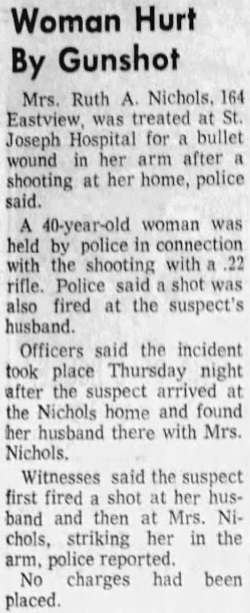
Please think briefly about the story, and then click on the MORE link below to learn what the court decided.
Did you read the story as suggesting that the shooter found her husband in a compromising position with Mrs. Nichols—perhaps having sex, or having had sex, or being just about to have sex? That's apparently how many readers read the story as well.
But it turns out that, though each statement in the story was literally true, Mrs. Nichols was at the Nichols home together with the shooter's husband, Mr. Nichols, and two neighbors. They were apparently all sitting in the living room, talking.
The court concluded that the story could be libelous—assuming negligence was shown on the newspaper's part—because, even though the statements were literally true, they carried a strong implication (that the husband and Mrs. Nichols were together by themselves in a compromising position) that was false:
In our opinion, the defendant's reliance on the truth of the facts stated in the article in question is misplaced. The proper question is whether the meaning reasonably conveyed by the published words is defamatory, "whether the libel as published would have a different effect on the mind of the reader from that which the pleaded truth would have produced."
The publication of the complete facts could not conceivably have led the reader to conclude that Mrs. Nichols and Mr. Newton had an adulterous relationship. The published statement, therefore, so distorted the truth as to make the entire article false and defamatory. It is no defense whatever that individual statements within the article were literally true. Truth is available as an absolute defense only when the defamatory meaning conveyed by the words is true.
Such "defamation by half-truth" decisions are rare. All statements, after all, omit something, and one can always argue that the full story would convey a somewhat different message from the partial story. Usually that's not enough to turn literal truth into libel. But in some situations, where the statement does carry a very strong implication that turns out to be false, a libel claim can indeed be brought even when the statement is literally true.
Another classic example—though just a hypothetical and not a real case—involves the first mate who, upset by his teetotaling captain, writes in the ship's log,
Captain sober today.
The statement may be literally accurate (the captain was sober today, as on all days) but it carries a very strong implication that turns out to be false (that today was unusual in this respect).
H.P. Grice's work on conversational implicatures, by the way, relates to this.




