

The Volokh Conspiracy
Mostly law professors | Sometimes contrarian | Often libertarian | Always independent
First Circuit Will Consider, En Banc, Important Questions About Government Employee Speech
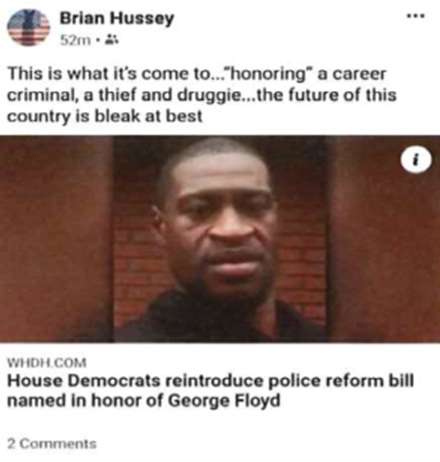
From today's order granting rehearing en banc in Hussey v. City of Cambridge:
The majority panel opinion relied on First Circuit precedent for the proposition that "speech commenting on public 'issues in a mocking, derogatory, and disparaging manner' is accorded less weight in the [Pickering] balancing test." Hussey v. City of Cambridge, No. 24-1279, Slip Op. (Aug. 15, 2025), at 16 (quoting MacRae v. Mattos, 106 F.4th 122, 137 (1st Cir. 2024), and also citing Curran v. Cousins, 509 F.3d 36, 49 (1st Cir. 2007) ("Speech done in a vulgar, insulting, and defiant manner is entitled to less weight in the Pickering balance.")).
- Is this precedent consistent with the Supreme Court's First Amendment jurisprudence, including but not limited to Rankin v. McPherson, 483 U.S. 378 (1987), and Connick v. [Myers], 461 U.S. 138 (1983)? Please address the propriety of giving less weight to "mocking, derogatory, and disparaging" speech on matters of public concern, and—in doing so—please discuss how the consideration of "manner, time, and place" in the Pickering balance bears on that question. Finally, please address whether the propriety of giving less weight to "mocking, derogatory, and disparaging" speech on matters of public concern depends on whether the speech occurred within the workplace or outside the workplace.
- Is there a more suitable approach, also consistent with First Amendment jurisprudence, for balancing the First Amendment right of a public employee to speak on a matter of public concern against the needs of the public employer?
- How would any proposed change in approach affect the analysis and outcome in this case? Please also discuss whether, and how, the Pickering balancing would differ under such an approach for speech by a public employee holding a different employment position or rank than appellant Hussey.
- If the proper Pickering inquiry considers whether the speech at issue disrupted the workplace without reducing the employee's interest in the speech, is it necessary to remand the case to the District Court? Or did the District Court already make a finding on that score?
Here's an excerpt from the panel majority, by Senior Judge Kermit Lipez, joined by Judge Gustavo Gelpí; the controversy was about police officer Hussey being disciplined for posting the Facebook post excerpted at the start of this post:
First, while Hussey's and the public's First Amendment interests in Hussey's speech are significant, the speech's value was modestly diminished due to its "mocking, derogatory, and disparaging" nature. Second, the Department's prediction that Hussey's post could undermine its relationship of trust with the community was reasonable. Third, there is no evidence suggesting that the Department's decision to discipline him was driven by anything other than that reasonable prediction. Given the importance of that trusting relationship to the Department's public service mission, we hold that the Department's interest outweighs Hussey's in the Pickering balancing test. Therefore, as explained above, our inquiry ends here.
And from the dissent by Senior Judge Jeffrey Howard:
There can be no disputing that a police department's management has a powerful interest in maintaining the public's confidence that the department serves without bias the entire community it is sworn to protect. But a government agency is not free to discipline an employee for simply expressing a viewpoint with which the employer disagrees to friends outside of work. Because Hussey's online comment merits no less than the maximum protection afforded by the First Amendment, and the record belies the reasonableness of his suspension, the Pickering balance tilts decidedly in his favor. I would accordingly reverse the district court's grant of summary judgment.
Finally, recall that, under Supreme Court precedents, the First Amendment protects a government employee's speech from being restricted by the employer if
- the speech is said by the employer as a private citizen, and not said as part of the employee's job duties, Garcetti v. Ceballos (2006), and
- the speech is on a matter of public concern, Connick v. Myers (1983), and
- the damage caused by the speech to the efficiency of the government agency's operation does not outweigh the value of the speech to the employee and the public, Pickering v. Bd. of Ed. (1968).

Editor's Note: We invite comments and request that they be civil and on-topic. We do not moderate or assume any responsibility for comments, which are owned by the readers who post them. Comments do not represent the views of Reason.com or Reason Foundation. We reserve the right to delete any comment for any reason at any time. Comments may only be edited within 5 minutes of posting. Report abuses.
Please to post comments
I would certainly think that "mocking, derogatory, and
disparaging" speech in the workplace (even on a matter of public concern) could be more disruptive to the employer's activities, and would therefore get less protection. Not saying that's necessarily the *right* result, but Pickering demands a somewhat employer-favorable analysis.
Now, if it were outside the workplace I would think it would have to be *incredibly* disruptive in order to interfere with the governmental employer's mission.
About the actual message:
On the one hand, if laws are named after anyone, they should be named after their sponsors. Like Magnuson and Moss, or Buckley, for instance.
Or the name could - hear me out here - briefly describe the provisions of the law.
Don't do silly stuff like naming it after (someone you believe to be) a sympathetic person, and don't arrange the letters in the title so it spells something clever.
So even if (especially if) you think George Floyd is a sympathetic person, don't name laws after him.
But the cop is not objecting to the *concept* of overly-clever names for laws, he's just obecting to a law being named after George Floyd in particular. Floyd could have been all kinds of bad person, but bear in mind that Floyd's killer was found guilty of various kinds of criminal homicide by a jury of his peers. I think that it is Floyd's status a *victim* which appeals to Democrats, since victims are cool, you know.
Likewise, the next time the Democrats introduce a gun-contol bill, they'll name it after a well-known victim of gun violence, like Charlie Kirk. /sarc
There's a general rule that "If a law is named after a person, it's probably bad." Oddly, I could not find a name for that principle but I have not yet found an exception to it. Legislation is named after a high-profile victim or given cutesy acronyms with the intent to trigger emotional responses. That undermines the deliberative process that we're suppose to hold our legislators to.
[comment omitted - not thought through enough even by Internet standards]
It appears the speech was not disruptive, but did generate one complaint.
I would answer the order's question b with a couple bright lines:
1. If the employee is purporting to speak on behalf of the employer, no free speech right to that speech.
2. If the employee is speaking using any employer resources (including time, computers, etc), no free speech rights to that speech.
3A. If the employee is speaking entirely using personal resources, is off-duty and (depending on their position in the company) includes a disclaimer that he/she is not speaking on behalf of the employer AND the employee is hired under a contract, contract terms apply.
3B. If the speech is fully-private and the employee is NOT hired under a contract, normal at-will employment rules apply, including any applicable whistleblower or other statutes.
This approach puts public employees on exactly the same footing as private employees. It does create the risk of loyalty tests which I will concede is a greater risk for public employers than private. (A private employer who artificially restricts their hiring of the most qualified candidate on non-job-related factors will lose money and suffer competitively - a factor sadly not applicable to public employers.) Adoption of this approach is significantly easier and less risky the fewer public employees/employers you have.
Alternatively, if you believe the loyalty-test risk outweighs the complexity and confusion of different standards, keep 1 and 2 above but change 3 to
3. If the employee is speaking entirely using personal resources, is off-duty and (depending on their position in the company) includes a disclaimer that he/she is not speaking on behalf of the employer, full free speech rights apply. No balancing tests and any adverse impact to the employer must be based on actual negative consequences. That is, no inferences, assumtions or guesses about possible future consequences. Mere disagreement by other employees is not an adverse consequence. If those other employees bring that disagreement into the workplace, that's their infraction, not the original speaker's.
This all would, however, replace the subjective Pickering balancing test and thus is not something a mere circuit court could simply adopt.
Alternatively, you could simply argue that "conduct unbecoming" (including speech unbecoming) is a viewpoint-neutral restriction and remand with instructions to determine whether the employee was on adequate notice about what "conduct unbecoming" entails.


