
The Volokh Conspiracy
Mostly law professors | Sometimes contrarian | Often libertarian | Always independent
Can The President Provide Notice on Truth Social?
Justice Jackson doubts whether Trump's social media post could have put Lisa Cook on notice that she would be removed.
During the first Trump Administration, the President's social media feed was a regular feature of federal court litigation. Courts cited Trump's tweet in cases concerning the travel ban, the cancellation of DACA, and more. Judges looked to these postings for insights into Trump's true intentions.
In Trump v. Cook, the President's social media has once again come to the fore. On August 20, 2025, Trump posted to Truth Social that Federal Reserve Governor Lisa "Cook must resign, now!!!" And, on August 25, Trump sent a letter to Cook purporting to fire her.
The traditional conception of due process requires notice and an opportunity to respond. The Solicitor General argued that the August 20 posting constituted notice. Then, over the ensuing five day period, Cook had an opportunity to respond. Thus, due process was complied with.
Justice Jackson was incredulous of this argument. In this exchange with Solicitor General John Sauer, Jackson doubts that Cook even was notified:
JUSTICE JACKSON: What is the removal order? The -Truth Social post?
GENERAL SAUER: It's the --no. It's the August 25th letter. I think it's Doc 1-4 in the district court. But the removal order addresses that. The evidence is you have mortgage applications within two weeks of each other that make clearly conflicting representations.
JUSTICE JACKSON: Was Ms. Cook given the opportunity in some sort of formal proceeding to contest that evidence or explain it?
GENERAL SAUER: Not a formal proceeding. She was given an opportunity in public because she was notified -
JUSTICE JACKSON: In the world?
GENERAL SAUER: Yes.
JUSTICE JACKSON: Like, she was supposed to post about it and that was the opportunity to be heard -
GENERAL SAUER: Yeah.
JUSTICE JACKSON: --that you're saying is --was afforded to her in this case?
GENERAL SAUER: Yes, and she's had plenty of opportunities in the ensuing months where we've had ongoing litigation where there's never been a personal statement addressing that or --or justifying it.
Sauer repeated this point later in the argument:
GENERAL SAUER: Our contention is that there already has been a process. There was a social media post that said, look, these two documents contradict each other. And the response was defiance. So there was a chance to tell --in the words of Loudermill, to tell her side of the story. It just wasn't --it wasn't adopted.
And Sauer clarified the timeline in an exchange with Justice Gorsuch.
JUSTICE GORSUCH: So just --just -just a meeting across a conference table finished with "you're fired"? I mean -
GENERAL SAUER: All Loudermill says is that you have to be told of what the basis is of the allegations against you and give a chance to tell your side -
JUSTICE GORSUCH: Okay.
GENERAL SAUER: --of the story. We believe that was provided in the five-day window -
JUSTICE GORSUCH: Yeah.
GENERAL SAUER: --between the Truth Social post and --and the removal letter.
I suppose Cook could have responded to Trump's posting, or shared her own content.
Justice Sotomayor was also skeptical:
JUSTICE SOTOMAYOR: As I understood it, Ms. Cook's letter, her attorney's letter, and, quite frankly, I've never understood that a letter from a lawyer wasn't a representation by a client. This is a new standard I've never heard of before in an informal proceeding. If the president can go by social media and one believes that that is adequate notice under law, I'm hard pressed to think a letter from a lawyer is not notice from the adversary. But we can move on from that. . . . This whole case is irregular, starting with the Truth Social notice or thinking of it as notice at all. It certainly didn't invite an opportunity to be heard. But that's where we are.
Paul Clement, counsel for Cook, did not dispute there was notice:
JUSTICE JACKSON: Final question. Do you I took you to be conceding that there was notice here. And I guess I'm a little concerned about that. I mean, do --are you conceding that a posting on social media is sufficient notice in a situation like this when the President is seeking to remove a governor for --for cause? I mean, I know it happened. She got notice. We live in a world that is connected, but I --I guess isn't notice a particular thing in the common law? Or in our law?
MR. CLEMENT: --I mean, me put it this way. Like I --I don't sort of resist the idea that the Truth Social post is notice because I think it's also fundamentally defective notice because it's also indisputable evidence that the President prejudged the matter.
Jackson asked why it was valid notice, and what would happen if Cook was not on Truth Social.
JUSTICE JACKSON: Why wouldn't he have to, like, send the letter to her? How --how is it that we can assume that she's on social media or has looked at the news or that that's sufficient notice even if she did turn on the news and he's saying that? I --I don't know why that would be enough. . . What if she doesn't have a Truth Social account, she doesn't show up, is that enough notice?
I think Clement recognizes that the President's social media posting, which was covered in global media, did the trick:
MR. CLEMENT: You know, I --I think under those circumstances, probably not, but I think as a practical matter in most circumstances, the President puts it on Truth Social, most people most of the time are going to consider that to be notice. Again, the --part of the reason I'm not resisting is --or I'm, you know, sort of moderating this is because, you know, this notice isn't the kind of notice the common law envisioned because the common law would envision notice that didn't prejudge the matter.
Under the circumstances, it seems very appropriate for the President to announce national policy through his typical means of announcing national policy. Clement wisely could not feign ignorance of the posting.
I am grateful that some Justices are now giving attention to how social media postings can affect legal obligations. In past years, we dealt with the scourge of subregulatory guidance. The executive branch would often "clarify" the law through blog posts, FAQs, and other documents, which were never published in the Federal Register. Many aspects of the Affordable Care Act were rewritten in this fashion. My 2016 article, Government by Blog Post, may be useful reading. In 2017, the first Trump Administration took bold steps to eliminate subregulatory guidance, but the Biden Administration rescinded this memo. In 2025, AG Bondi reissued that policy.
Update: President Trump sent an official communication to Canadian Prime Minister Carney over Truth Social:
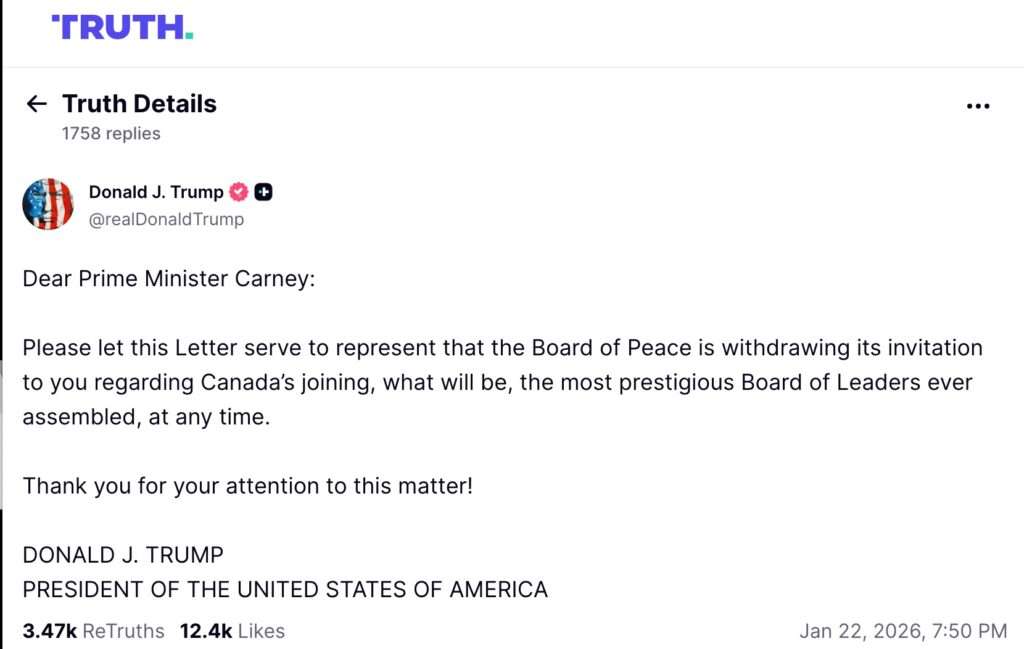
Dear Prime Minister Carney:
Please let this Letter serve to represent that the Board of Peace is withdrawing its invitation to you regarding Canada's joining, what will be, the most prestigious Board of Leaders ever assembled, at any time.
Thank you for your attention to this matter!
DONALD J. TRUMP
PRESIDENT OF THE UNITED STATES OF AMERICA
I think this posting reaffirms that social media is the President's preferred, and indeed official form of communication. I think this rule was established during Trump's first term when he blocked his critics on social media.
