

The Volokh Conspiracy
Mostly law professors | Sometimes contrarian | Often libertarian | Always independent
Chief Justice Roberts on the Declaration of Independence
Roberts' year-end report on the federal judiciary includes some notable statements about the Declaration and its relevance to constitutional interpretation and judicial review.
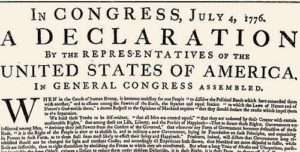
In his year-end report on the state of the federal judiciary, Chief Justice John Roberts makes some notable statements about the Declaration of Independence and its relevance to constitutional interpretation. The relevant section in Roberts' report is occasioned by upcoming 250th anniversary of the Declaration, and much of it reads like standard civics book material. But there are a few noteworthy passages.
First, Roberts notes that the Declaration "sets out a statement of political values
based on Enlightenment principles." This endorsement of the idea that the United States is a "creedal nation" based on universal liberal values may seem obvious. But it's at odds with the insistence of both far-leftists and right-wing ethno-nationalists that the Declaration and the Founding were meant to establish a nation promoting the interests of a specific racial or ethnic group (usually defined as Anglo-Saxon whites). I cannot know for sure. But I suspect that Roberts is aware of this dispute and included this language in the report for that reason.
Roberts rightly notes that the Declaration is "a statement of national aspirations, not a codification of enforceable legal obligations," and that its universalist aspirations were far from fully realized by the original 1787 Constitution. He particularly stresses the continued prevalence of racially based slavery, including its practice by many of the signers of the Declaration itself.
But Roberts also emphasizes that "throughout our history [the Declaration] has played a signal role in the development of the Nation's constitutional, statutory, and common law." He approvingly cites Supreme Court justices who relied on its principles as tools for constitutional interpretation. This is notable in light of the longstanding debate about whether the Declaration is relevant to constitutional interpretation. Roberts appears to agree that, at least in some situations, it is.
It's worth noting that this idea is perfectly consistent with originalism. If parts of the original Constitution and later amendments were intended to enforce the principles of the Declaration and were so understood at the time, this fact is relevant to any originalist interpretation of these provisions. I think it's particularly relevant to claims that the Constitution's structural constraints and protections for individual rights somehow do not apply to immigration restrictions, or apply with much lesser force. The principles of the Declaration of Independence strongly suggest otherwise. These natural rights principles are also relevant to interpretation of a range of other constitutional issues, such as property rights protected by the Takings Clause of the Fifth Amendment.
Finally, Roberts emphasizes that judicial independence was one of the objectives of the Declaration:
In the words of future Justice [James] Wilson during the ratification debates, the key passage of the Declaration's preamble…. "is the broad basis on which our independence was placed," and "on the same certain and solid foundation this system [the Constitution] is erected."
The connection between these two foundational documents could not be clearer when it comes to the judicial branch. The Declaration charged that George III "has made Judges dependent on his Will alone, for the tenure of their offices, and the amount and payment of their salaries." The Constitution corrected this flaw, granting life tenure and salary protection to safeguard the independence of federal judges and ensure their ability to serve as a counter-majoritarian check on the political branches. This arrangement, now in place for 236 years, has served the country well.
In normal times, this statement would be an obvious truism, hardly worthy of note. But it has special significance at a time when Trump and various administration officials have called for judges to be subservient to the executive, and give him sweeping deference on a vast range of important issues, ranging from tariffs to immigration to the domestic use of the military.
Whether Roberts' statements about the Declaration, its principles, and judicial independence portend anything about the Court's jurisprudence on key cases to be decided in the near future, remains to be seen. Roberts cannot control the votes of the other justices, and his own jurisprudence hasn't always lived up to these ideals.
My general take on Roberts is that he's good on some issues (e.g. - freedom of speech and constitutional property rights), but much less so on others (e.g. - some key issues related to immigration and executive power). But what he says in the report about the Declaration of Independence and its principles is both right and encouraging in its potential implications for the future.
Cornell law Prof. Michael Dorf has his own thoughts on the significance of these and other passages in Roberts' year-end report, including an interesting comparison between Roberts' take and Justice Thurgood Marshall's famous 1987 speech on the bicentennial of the Constitution. I agree with some of his points, but differ on others. In particular, I think the above points about the principles of the Declaration are more compatible with originalism than Dorf suggests. But I agree that reliance on those principles is in tension with much of the Court's recent reliance on later traditions. Those traditions often reflect failure to live up to the principles underlying the original meaning.

Editor's Note: We invite comments and request that they be civil and on-topic. We do not moderate or assume any responsibility for comments, which are owned by the readers who post them. Comments do not represent the views of Reason.com or Reason Foundation. We reserve the right to delete any comment for any reason at any time. Comments may only be edited within 5 minutes of posting. Report abuses.
Please to post comments
But it's at odds with the insistence of both far-leftists and right-wing ethno-nationalists that the Declaration and the Founding were meant to establish a nation promoting the interests of a specific racial or ethnic group
>>>>>>>>>>>>>>>>>>>
Pardon, but is 'ethnonationalism' a bad or good thing? In the media and in polite conversation it is almost always seen as a frightening label conjuring images of jackboots and swastikas. Yet many modern day mainstream accepted nations, perhaps the majority currently existing were clearly was founded and many continue to run on what seem like ethnonationalist principles. And nobody seems to care.
Like Israel for example. Secular zionists vehemently deny that Jew is a religious grouping so what else could it be?
Only the relatively more fringe anti establishment left seems to have any strong objections to the 'ethnonationalism' of Israel but most of their solutions seem to revolve around the establishment of a Palestinian ethnonationalist state either alongside or in the ruins of the Israeli one rather than ditching ethnonationalism altogether and living in mixed harmony.
Not that I have any particular beef with Israel or any of the many other 'ethnonationalist' countries or would object to a consistent anti ethnonationalist position or necessarily would like an ethnonationalist state. But isn't it a little odd the supposed universally terrifying concept of ethnonationalism is only a bad thing for and in Western countries?
It's not universally terrifying. As you correctly note, it's common across history and most of the world. It is, however, at odds with the US/American ideals and values of being a "melting pot". And despite a lot of bloviating to the contrary, the melting-pot ideal is still the majority's desire.
The term melting pot referred to mixing English, French, Dutch, Germans. That's all. It did not include Somali scammers.
It's a good thing that terminology is fixed and immutable, and doesn't shift its meaning over time. Otherwise your definition might look a little silly!
The Declaration also talks about "the merciless Indian Savages". Has that meaning changed?
Bitch slap to bloocow2!
Weird how Schlafly omits Jews, even though the term melting pot was actually coined specifically about them. And Russians.
Nope, the term "melting pot" is not and never was so limited.
Okay, understandable. But why do only white nations have to be melting pots and they all have to without a single exception? And that melting pot means as few whites as possible (where often even the stated goal of maintaining a ratio representative of the general population is sacrificed to the goal of driving down white representation even further) rather than a mix with whites? Why is it okay if everybody else is not a melting pot and ethnonationalist but if you set aside even one tiny piece of land for western whites to be as ethnonationalist thats unthinkably evil?
If you want the world or a big part of it to be a melting pot you do the things that will make it a melting pot. Deploying tactics that instead seemed geared more toward driving one particular group toward extinction or at least a greatly reduced presence seem counterproductive to the former goal.
...
I don't understand your use of "have to be" and "okay" in these questions. Where are these claims coming from?
It's not "only white nations", it's "only the US". We were the first (and largely still remain the only) nation to adopt that as a value.
It's also not "as few whites as possible". The 'melting pot' value means accepting anyone regardless of ethnicity who is willing to adopt our ideals of freedom and independence. The quota-goals you are describing are the beliefs of the "far-leftists and right-wing ethno-nationalists" who admittedly get a lot of airplay but are not representative of mainstream values.
I don't care about the whole world. I do want the US to maintain (or maybe return to) it's 'melting pot' values. And yes, I do what I can to oppose the policies that frustrate that goal. Unfortunately, our media makes a lot of money on conflict so getting voices of rationality to be heard is ... hard.
Roberts is giving a false history. The idea that a core USA value is to import non-whites has always be a minority view, and not one held by USA leaders for most of its history.
Roberts says: "the vast majority of the 56 signers of the Declaration (even Franklin) enslaved other humans". No, they did not enslave anyone. Some of the them owned slaves, but the slaves had previously been enslaved by others.
I didn’t traffic that girl, I just paid for her to be brought to and service me!
OK, that's pretty stupid. What about the slaves' children? Not "enslaved" because they were born already slaves?
Not only were they enslaving people, they knew they were, and that it was wrong. Thomas Jefferson:
"Indeed I tremble for my country when I reflect that God is just: that his justice cannot sleep forever: that considering numbers, nature and natural means only, a revolution of the wheel of fortune, an exchange of situation, is among possible events: that it may become probable by supernatural interference! The Almighty has no attribute which can take side with us in such a contest."
To some extent they thought themselves trapped, that they faced economic ruin if they stopped, but that was just rationalization, because some of them DID stop. Franklin, for instance, owned slaves, but became an abolitionist and freed them all. Likewise John Jay.
Maybe Jefferson thought that enslaving people was wrong, but owning slaves was not.
John Roberts will go down as one of the better Chief Justices, certainly within the top 5.
CJ Roberts achieves a unanimous result over 40% of the time; historically this is very high relative to his peers. He is an outstanding consensus builder, and promised as much during his confirmation hearing. I think it will be said of him by future historians: He was the right man at the right time for our country.
The chief justice only gets to assign the decision if he's part of the majority. So Roberts signs onto the majority so that he can assign or even write the decision, even if he disagrees with it.
This is why he ends up voting with the majority over 90% of the time: Not because he's winning people over, because he's tactically surrendering.
Chief Justice Roberts supposes that James Wilson intended Roberts to be a power unto himself, made permanently immune from majoritarian obligation. Roberts thinks Wilson wanted Roberts free to advance and protect without hindrance minoritarian rights in whatever ways Supreme Court Justices wanted them construed.
In short, Roberts remains clueless about Wilson, and Wilson's interpretation of American Constitutionalism. Wilson, unlike Roberts, distinguished the Constitution as separate and apart from sovereign power. In explicit utterance at nearly the exact time and place Roberts refers to, Wilson repudiated Robert's views as mistaken, and said those who held such views did so on the basis of misunderstanding. American sovereignty, wrote Wilson, was always embodied in the People themselves, not in their constitutions.
I am very disappointed in Professor Somin's take on John Roberts' latest exercise in hypocrisy, very similar to his 2024 report on the state of the judiciary. I believe that Roberts has already destroyed the U.S. Constitution, via his ghastly majority opinions in Trump v. Anderson, granting Trump a "pardon" for his seditious attempt to overthrow our constitutional system of government on Jan. 6, 2021 and then, in Trump v. United States, granting Trump a "super pardon" absolving him of all crimes he might commit in the future. The Constitution today simply says whatever John Roberts believes is most helpful for the cause of "higher conservatism". "Even" Andrew McCarthy, the constitution guy at the National Review, is willing to point out that Roberts is trying to position the Court to say that the president can fire any member of an "independent" federal agency except the Federal Reserve, because Roberts doesn't trust Trump to handle monetary policy, but does trust him to handle everything else.
I believe future historians will regard U.S. history from 1788 to 2016 as the "First American Repubic". We literally will need a new Constitution over the next 20 years. Professor Somin ought to be thinking about what that Constitution might say.
There is NO WAY 1788-2016 is uninterrupted by the ridiculous 16th Amendment, granting infinite fiscal power (and thus infinite power), and then the absolutely useless, totalitarian FDR, using it to begin the massive expansion of government.
1788-1913 - expansion and freedom
1913-2016 - collapse of freedom
2016-whatever - whatever BS you want to try to pin on Trump that was trivial compared with bombing Congress (pardoned by Clinton) or various more disruptive sit-ins.
Roberts is a POS RINO, supporting maximum government powers over individual rights. He is chicken to take on real issues. He SUCKS.
Gorsuch is the real deal. He is a real SCOTUS Justice, objective, setting his own views aside in deference to the law.
More Simon slop that is beneath the quality of Reason.
Trump is the only president asking for judicial deference? Lol. FDR literally corrupted the court. Liberal courts granted large deference to executive agencies. The expanded use of the commerce clause also comes from liberals.
Somin doesn't engage in rational debate he throws out ridiculous emotions (like immigration is a natural right!) unbefitting this great website.
Chief Justice Roberts is an utter lunatic to claim that the Declaration of Independence declared the United States a creedal nation that rejected religion as a unifying force.
The United States was a Protestant nation in every sense of the word from 1607 to 1960. The Anglican Protestants of Virginia attacked the Catholics in Maryland in the 1640's. Catholics were openly discriminated against for the next three centuries. American discrimination against Jews has never ended. Just ask Ilhan Omar how Islamophobic the United States is. Manifest Destiny that drove American settlement of the West was driven by a desire to free the area of governance by Catholic Mexico. During the era of Imperialism in the 19th and early 20th centuries, America strove to spread Protestant religion throughout Asia.
Maryland passed the Act of Toleration in 1649 to prevent Catholicism from being wiped out not to allow freedom of worship.
John Roberts spews utter nonsense.
How can you say Roberts is good or bad on anything when he votes with the majority 90% of the time?


