

The Volokh Conspiracy
Mostly law professors | Sometimes contrarian | Often libertarian | Always independent
N.Y. Synagogue Allowed to Fire Teacher for Anti-Zionist Blog Post
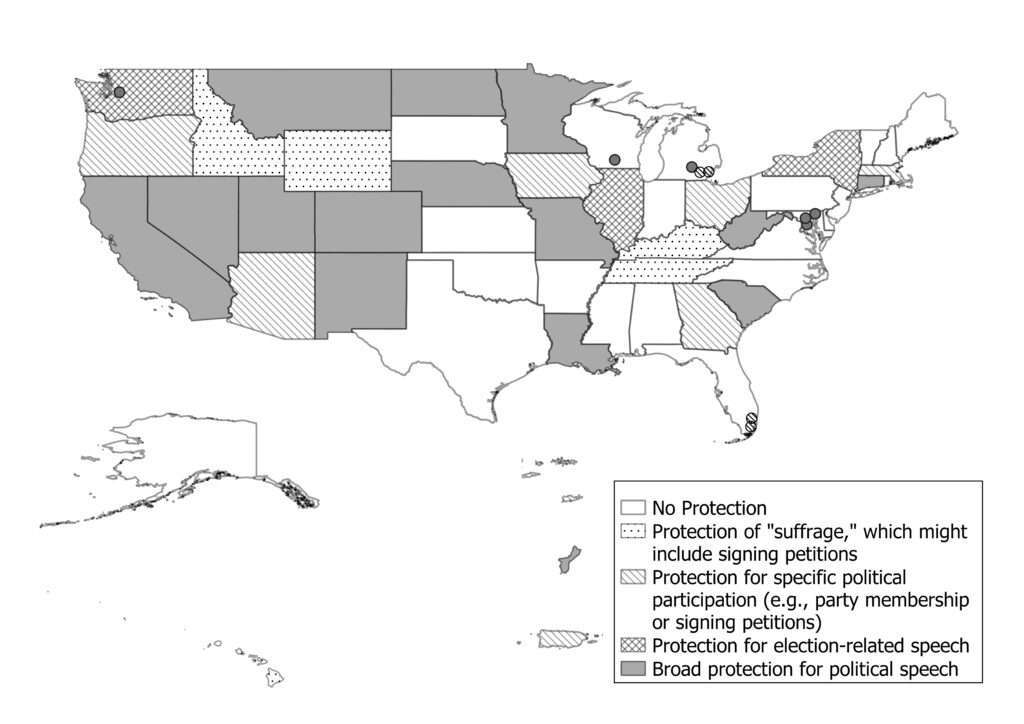
[1.] The First Amendment applies only to the government, and thus doesn't limit private employers from firing employees based on their speech. But many states have statutes that do impose such limitations, as the map above suggests. (For more on this, see my Private Employees' Speech and Political Activity: Statutory Protection Against Employer Retaliation and Should the Law Limit Private-Employer-Imposed Speech Restrictions? articles.)
Some of these statutes broadly protect a wide range of employee speech. Others protect particular forms of election-related activity: New York, for instance, bans employers from firing employees for campaigning for a candidate or raising funds for a candidate, party, or political advocacy group.
But New York also bans employers from firing employees for off-the-job "legal recreational activities," defined as
any lawful, leisure-time activity, for which the employee receives no compensation and which is generally engaged in for recreational purposes, including but not limited to sports, games, hobbies, exercise, reading and the viewing of television, movies and similar material.
There is also an exception for activity that "creates a material conflict of interest related to the employer's trade secrets, proprietary information or other proprietary or business interest."
Does blogging, Tweeting, etc. qualify as "recreational activities," much as "reading and the viewing of television, movies and similar material" qualifies? In yesterday's Sander v. Westchester Reform Temple, the N.Y. high court (in a majority opinion by Judge Caitlin Halligan for five of the seven judges) notes the issue but doesn't resolve it:
[The definition of recreational activities] sweeps broadly on its face …. The term "hobbies" has an expansive dictionary definition[, …] "a pursuit outside one's regular occupation engaged in especially for relaxation" …. Plaintiff argues that some hobbies surely have an expressive component and communicate content, and that reading or viewing media entails the selection of content as well. {We reserve this question of statutory interpretation for another day ….}
A solo concurrence by Judge Shirley Troutman, on the other hand, endorses the view of the intermediate appellate court in this case, which held that even if firing someone for blogging (or presumably for Tweeting or something similar) would be illegal firing for recreational activity, firing someone for the content of their blog post wasn't covered by the statute.
And a solo concurrence by Judge Jenny Rivera suggested a different approach:
Blogging—writing about one's observations, experiences, or areas of interest on an online platform—can be a recreational activity depending on the blogger's intended purpose…. [D]epending on the blog's content, uncompensated blogging may be a recreational activity, such as blogging about a recent vacation or the best local vegan eateries. These examples describe leisure-time musings—akin to "hobbies," a protected recreational activity under Labor Law § 201–d(1)(b). As the majority notes, "[t]he term 'hobbies' has an expansive dictionary definition." Further, plaintiff rightly argues that some hobbies surely have an expressive component and communicate content. Thus, there is support for interpreting blogging as a hobby or as a sufficiently similar activity to be of "like kind."
By contrast, other types of blog content may intend to provoke strong emotional responses in a manner disassociated from any leisurely endeavor of the writer. For example, blogging the writer's viewpoint to encourage others to take political action may not have a recreational purpose or be relaxing, fun, or entertaining; rather, it may be a convenient method for the writer to disseminate a message motivated by a sense of societal duty and responsibility.
Plaintiff's blogging is no doubt her physical act of posting her thoughts on a certain topic on her website. However, whether plaintiff's blogging can be characterized as a recreational activity based on its content is not as clear.
The law in New York about whether private employers may fire employees for the content of their blog posts, Tweets, and the like is thus unsettled. On the other hand, the lower court decision seemed to help settle the matter against substantial protection for off-the-job speech (outside the narrow protection clearly provided by the separate election-related political activity provision). By reversing the lower court decision, which read the recreational activity statute as essentially allowing such firing, the New York court has opened the door to at least some extent to lawyers' raising such claims.
[2.] This case, however, didn't involve just any private employer and private employee: It involved a synagogue (the Westchester Reform Temple) firing a teacher whose teaching included some religious subjects. The Supreme Court has held, in Our Lady of Guadalupe School v. Morrissey-Berru (2019) and Hosanna-Tabor Evangelical Lutheran Church & School v. EEOC (2012), that religious institutions have a First Amendment right to select such teachers—alongside clergy and other employees who had important religious duties—without regard to antidiscrimination laws. Under this so-called "ministerial exception," they could, for instance, discriminate based on race, sex, age, disability, and the like. And, unsurprisingly, the majority in this case concluded that they could also discriminate based on recreational activities (and presumably political activities):
Plaintiff's "core responsibilities as [a] teacher[ ] of religion" are similar to those in Hosanna–Tabor and Our Lady of Guadalupe. She was responsible for teaching religious texts through one-on-one study and weekly Torah portions, as well as planning and attending religious programming. Those duties leave little doubt that she was charged with "educating young people in their faith." ….
[3.] But the case didn't just involve a synagogue and a teacher; it also involved a teacher whose posts were anti-Zionist:
The blog post said, among other things, that the authors felt compelled to "speak out against israel's [sic] most recent attack on Gaza" and "reject[ed] the notion that Zionism is a value of Judaism." Plaintiff alleges that she and the Rabbi discussed the meaning of Zionism, and she assured him that she respected the Temple's position and would not share her views on the job. Plaintiff also alleges that the Rabbi subsequently expressed complete confidence in her teaching abilities. Nonetheless, Plaintiff was fired less than a week later….
And Judge Rivera's solo concurrence focused on that; she concluded that she needn't decide whether recreational activity generally covers political blogging, or whether the ministerial exception covered schoolteachers like plaintiff. Rather, she concluded that plaintiff's activity was excluded by the "material conflict of interest" exception in the statute—a conclusion that would apply far beyond just religious employers. She acknowledged that,
As a general matter, conflicts of interest in the employment setting confer some benefit on the employee or a competitor at the expense of the employer's business interests.
But she concluded, based on her reading of the statutory text, legislative history, and lower court caselaw that in this statute "conflict of interest" covered activity that affects "how the business is perceived within the relevant community and whether the employee's activity places the business and its mission in a negative light":
The statute … reflects the Legislature's intention to "strike the difficult balance between the right to privacy in relation to the non-working hours activities of individuals and the right of employers to regulate behavior which has an impact on the employee's performance or on the employer's business." … For example, in Thomas v. Smith (S.D.N.Y. 2008), the plaintiff—whose public employer provided services to both victims and perpetrators of sexual assault—alleged she was fired because she made comments at a community forum advocating the castration of sex offenders….The court found that the plaintiff's statements materially conflicted with the employer's business interests because her "public support of castration as a means for punishing sex offenders offended [the employer]'s methods and philosophy, and exposed [the employer] to unfavorable attention in the local press." …
Similarly, in Berg v. German Nat. Tourist Off. (N.Y. App. Div. 1998), the [New York intermediate appellate court] interpreted the "material conflict of interest" provision as allowing the German National Tourist Office to terminate an employee after learning that they were a translator of Holocaust revisionist articles. Although the court concluded without explanation that the exception applied, given the nature of the translated articles and the Holocaust's historical connection to Nazi Germany, it is evident that plaintiff's off-duty activity could invite a public backlash against the employer, thereby constituting "a material conflict of interest" between the employee and the German National Tourist Office's "business interest." …
Plaintiff espoused a viewpoint (i.e. anti-Zionism) at odds with her employer's "philosophy" (i.e. Zionism) and its mission. Thus, as the Temple asserts, plaintiff's publicly posted assertions and opinions directly undermine the Temple's business interest as a synagogue, as some congregants may view Zionism as a feature of their religious or ethnic identities as Jews.
Additionally, Sander's presence as a Jewish educator of children could invite a backlash among at least some of her students' parents due to her anti-Zionist views. If the Temple were to lose membership en masse, its proprietary or business interests—even as a nonprofit—would inevitably suffer….
So, under this view, blogging that is sufficiently unpopular, at least among the employer's clientele, is unprotected by the statute, even if blogging that is more popular or less controversial.
My general view is that the majority got it right on point 2: Religious institutions have a First Amendment right to choose their teachers of religion, including based on the teachers' off-duty speech (as well as their race, sex, etc.). As to points 1 and 3, I'm inclined to read recreational activity broadly enough to include public commentary (as on a blog or in tweets), and I'm inclined to read conflicts of interest more narrowly, to include just traditional conflicts such as working for a competitor. But these are difficult questions of how to interpret this state statute, and my views on that subject are quite tentative.




