
During a Week of Internet Problems, Congress Has Decided Roblox Is 1 of Them
Senators turned a Roblox hearing into a pitch for privacy-eroding online safety laws.
Quick game. Guess whether a Democrat or a Republican said this: "We cannot allow Big Tech to continue to put their profits ahead of people, ahead of precious children stealing innocence and in the most just, damning circumstances, stealing lives."
That was Sen. Katie Britt, a Republican from Alabama. But you would be forgiven if you thought the speaker was a Democrat, as keeping kids "safe" online has become a rallying cry for both parties.
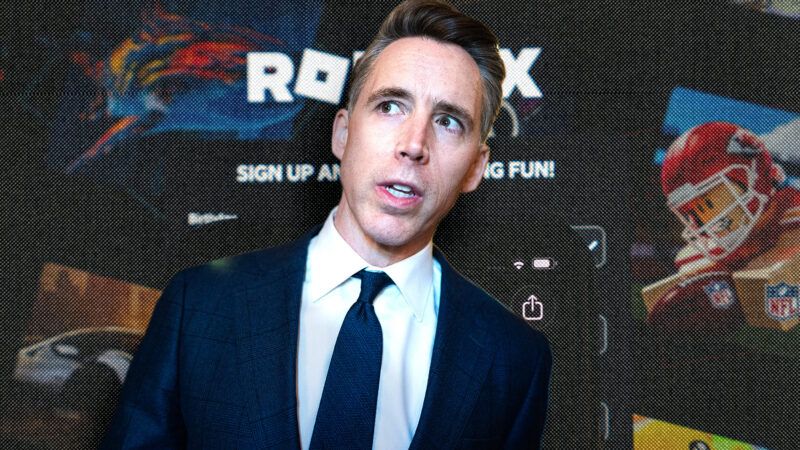
On Tuesday, Britt, along with a bipartisan group of lawmakers from the Senate Judiciary Subcommittee on Crime and Counterterrorism, including Josh Hawley (R–Mo.), Dick Durbin (D–Ill.), Marsha Blackburn (R–Tenn.), and Richard Blumenthal (D–Conn.), held a hearing entitled "Roblox and Online Gaming: Digital Playgrounds Endangering America's Children."
Roblox, the online platform that allows users to play community-made games, is no stranger to scrutiny. The California-based company currently faces more than 180 federal lawsuits from plaintiffs claiming the company has failed to protect children from online exploitation, according to The San Francisco Chronicle. Roblox has also been placed under the European Union's strictest platform rules. (Though what company hasn't been regulated by the E.U. at this point?)
The subcommittee held the Roblox hearing the day after Durbin and Hawley introduced the No Forced Arbitration for Child Sexual Exploitation and Cyber Injuries Act. This bill would allow families who say their children were exploited online to sue online platforms even if a child agreed to terms of service that would require private arbitration.
But the hearing was about far more than arbitration, as senators used their time to push for Congress to pass the Kids Online Safety Act (KOSA), which privacy and free speech advocates have long opposed. The bill "requires covered online platforms, including social media platforms, to implement tools and safeguards to protect users and visitors under the age of 17." The Senate version of the bill also includes a duty of care provision which would require online platforms to make design choices that mitigate harm. Free speech groups have warned that this duty of care provision could be broadly interpreted, leading to online censorship.
"If you go buy a car, there are safety standards. If you go buy a toaster oven, there are safety standards. But these social media platforms have zero," Blackburn, who was one of the original architects of KOSA, said before asking a witness to discuss the importance of online safety laws.
During the hearing, Blumenthal also raised the possibility of narrowing Section 230, a law which largely shields online platforms from being sued for what their users post.
"You are the reason we will pass the end of forced arbitration, kids' online safety, ending the immunity under Section 230 for Big Tech, [and] other kinds of reforms that are absolutely necessary," Blumenthal said to those who testified.
Eroding Section 230 has been a longtime goal for Blumenthal. In 2025, he co-sponsored legislation, along with the late Sen. Lindsey Graham (R–S.C.) to sunset Section 230. Chipping away at Section 230, however, would fundamentally change the online world. As the Electronic Frontier Foundation has noted, "without Section 230's protections, many online intermediaries would intensively filter and censor user speech, while others may simply not host user content at all."
The most cynical critics of online safety legislation may say that these lawmakers are pushing for a U.K.-style censorship regime to consolidate power. Perhaps this is true, but calling our lawmakers masterminds may be giving them too much credit. Often, our lawmakers are parents themselves (remember Britt's concerned mom State of the Union response?), and they know constituents are rightfully worried about deranged and potentially dangerous people contacting their children online. But it is misguided to think the state will best protect kids. According to a report from the U.K.'s online regulator, Ofcom, the country's online safety laws have not significantly changed the proportion of children encountering harmful content since they went into effect nine months ago.
There is no reason to think U.S. lawmakers will succeed where the U.K. has fallen short. Laws like KOSA may even push children to less regulated parts of the internet, exposing them to more inappropriate content. The best way to preserve online freedom and to truly protect children is to leave safety decisions in the hands of parents, not politicians like Blumenthal and Blackburn.