
Before the Falklands War, Islanders and Argentines Were Neighbors
A new history recovers the connections between the Falkland Islands and Argentina before their competing nationalisms took over.
Beyond the War: Argentines and Islanders in an Unknown Falklands, by Sebastián Carassai, Cambridge University Press, 372 pages, $50
Pamela McLeod and her husband, Reynaldo Reid, set off for Buenos Aires for a belated honeymoon in November 1970, likely hoping for a little privacy, relaxation, and time together. They got anything but.
Their marriage, it turned out, was politically irresistible. McLeod was a Falkland Islander, and Reid was Argentine. This was gold to an Argentine press eager to present the couple as evidence of the bonds between the British-held islands and Argentina. When the couple arrived in Buenos Aires, reporters and cameramen were waiting. The honeymoon became a 15-day publicity tour through television studios, ministries, and political offices.
The growth of Argentine nationalism, and Britain's increasing separation of the islands from the mainland, eventually allowed "the relationship between countries to displace the relationship between neighbors," writes Sebastián Carassai in Beyond the War. Carassai's book reminds us of the relationships between Argentines and Falklanders that existed beyond—and were eventually eclipsed by—their governments' competing nationalisms. (Those who side with Argentina would call the islands the Malvinas.)
Reid was emblematic of the region's blurred borders before the 1982 Falklands War. His father was Scottish and his mother English; he was born in Argentina, had Chilean sisters and an Argentine brother, and later spent much of his life with McLeod in the Falklands capital of Stanley.
The couple had seven daughters and two sons together, the youngest of whom was born in 1981. In Stanley, Reid became an informal Argentine delegate, and he co-ran what is now the third-oldest bar in the islands. After living in Stanley for more than a decade, he told the Argentine press that the island community had accepted him as just another member.
McLeod, who grew up in the Falklands' rural countryside, was an orphan brought up by families that took turns raising her. After living a "homeless life," as she described it to Carassai, she moved on to married life in Stanley. In April 1982, a few days after the Argentine invasion of the Falkland Islands, McLeod and seven of her children flew to Argentina to avoid the conflict.
Her eldest two children were already studying on the continent. The family intended to return to the islands once the crisis was over—the eldest daughter, who was studying to become a teacher in Buenos Aires, told a TV program that she planned to work at a school in Stanley. Yet the family ended up staying: "We went to spend a few days and stayed for thirty years," McLeod told Carassai.
After her husband's death, McLeod enjoyed the network of support she received from Jehovah's Witnesses while looking after her family of "refugees." Starting in the '90s, many of her children, now married to Argentines, began moving back to the Falklands. McLeod, with a new Argentine husband, also moved back to Stanley.
They weren't the only border-crossing individuals whose lives were disrupted by the clashing nationalisms. James Peck, an artist from the Falklands, was married to an Argentine woman and had two children, but he became estranged from his wife and kids in the late 2000s. Amid the family crisis, he was offered and accepted an Argentine identity card. The ceremony became an extraordinary political spectacle. It was chaired by then-president of Argentina, Cristina Fernández de Kirchner, and the official propaganda for the event described Peck as the first islander "to receive the Argentine DNI (Documento Nacional de Identidad) after the conflict." According to Carassai, the entire situation was "overwhelming" for Peck, who was considered a traitor by many Falkland Islanders. The Argentine government took advantage of a father in distress and used him to score political points.
"I feel like Argentina has cast a big shadow over my soul," Peck told The Guardian in 2016. "I had one thing on my mind: to fix my family and move on." After four years, Peck cut up the Argentine document, posted a photo of the pieces on Facebook, and returned to Stanley. "I realized, after, that real people did not seem to matter; it was all about making a statement, about the islands, and they had this prize," he told The Guardian.
Carassai spoke with islanders from across society (including politicians, business owners, and retirees), in addition to doing archival work. The interviews in his epilogue tell human stories too often lost in historical accounts of the Falklands, which tend to focus exclusively on the war; his conversations reveal a relationship far more complicated than the stories told by both the Argentine and the British governments.
Outside of the messy human accounts revealed through marriages, friendships, and migration, Beyond the War explores the economic ties that inevitably developed between the islands and the South American mainland. Falkland Islanders, who often referred to the nearby mainland simply as "the coast," were instrumental in establishing sheep farming, working on Patagonian estancias (ranches), and transferring agricultural expertise across the South Atlantic.
Indeed, the Falkland Islands and Patagonia were economically intertwined long before the sovereignty dispute came to dominate relations. In the late 19th century, Argentina actively recruited Falklanders to help with economic development in Patagonia. In 1886, the governor of Santa Cruz, Carlos María Moyano, married a Falkland Islander, Ethel Turner. With support from Buenos Aires, Moyano promised cheap leases for any farmer who would move to the scarcely populated Santa Cruz. Surnames familiar in the islands—Halliday, Rudd, Scott, Blake, Patterson, Hamilton, Waldron, Wood—also became common in Patagonia. Many of these migrants brought sheep-farming expertise to Argentina, helping to establish prosperous estancias. The largest ranch, Cóndor, covered 200,000 hectares and became the headquarters of the Patagonian Sheep Farming Company, which for many years was the most important livestock company in southern Argentina.
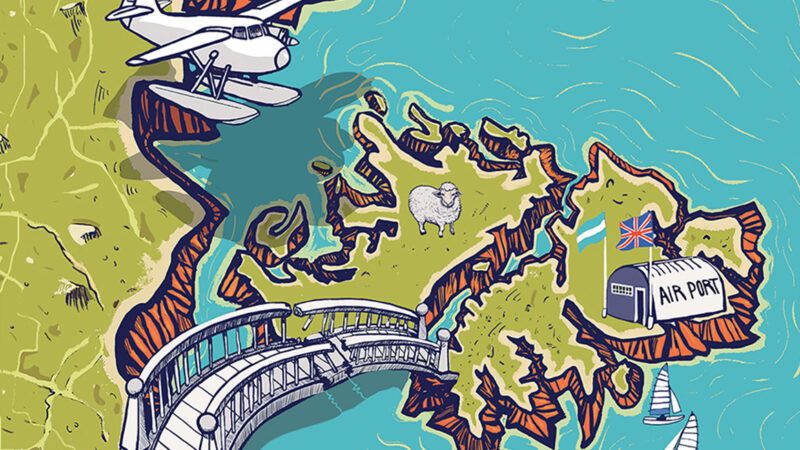
Trade between the communities went both ways. The Falkland Islands Gazette reported on the importation of animals (particularly horses) from "Patagonia," "Argentina," and "South America." By the 1970s, Argentina was supplying the islands with coal, oil, kerosene, and diesel for domestic use. Carassai describes the Argentine construction of an airstrip as "the most important work," which cost about 750,000 pounds (more than $12 million in today's money) and made regular air links with Argentina possible. In 1971, the British and Argentine governments signed the Communications Agreement, and regular flights became commonplace. Carassai argues that these projects were intended not only to improve life on the islands but also to signal to the islanders, Britain, and the United Nations that Argentina could be trusted "to look after the interests of the island population."
The introduction of regular flights had an enormous impact on the Falklanders. Children could go to Argentina for secondary school, patients traveled to Argentine hospitals, Argentine teachers worked in Stanley, and tourists began arriving from the mainland. Less than a year after regular flights began, The Falkland Islands Times cautioned readers about the pace of change.
"Although there were disadvantages of being so out off," Rev. Robin Forrester wrote of the era before the Communications Agreement, "there were also advantages, not the least of which was the fact that strangers couldn't creep in unawares. Nowadays, with a plane service each week, strangers abound and the pace of life is speeding up."
Beyond the War provides a rather different historical account of the Falkland Islands than is most commonly understood. Unfortunately, the islands are rarely thought of outside the 1982 war and are almost always discussed through the prism of the sovereignty dispute. Indeed, just this year President Javier Milei renewed Argentina's claim to the islands, pledging tougher sanctions on companies operating around the Falklands and more funding for a naval base in Tierra del Fuego. Prior to the war, the territory barely registered in the British public imagination at all; few Britons could have located it on a map, and some servicemen dispatched to the conflict initially assumed that the Falklands were somewhere off the coast of Scotland.
This book is valuable precisely because it recovers what the nationalistic framings obscure. Europeans established their first permanent settlement on the Falklands in 1764. There is a long, rich, and complicated history of migration, trade, tourism, and family ties across the region. Argentines lived in Stanley, Falkland Islanders worked in Patagonia, children crossed the sea for school, patients for medical treatment, and tourists for holidays. This history did not make the sovereignty dispute disappear. But neither did the sovereignty dispute make war itself inevitable.
Carassai's achievement is to recover a time when the British and Argentine governments may have had a disagreement about territory, but Falkland Islanders and Argentines could still be neighbors. Borders are drawn by governments, but life across them is rarely so neat.
This article originally appeared in print under the headline "What the Falklands War Made Us Forget."